Annual faunal survey begins in Munnar wildlife division
Source:The Hindu ↗
Why It Matters
Regular faunal surveys are critical tools for biodiversity conservation. They help track the health of ecosystems, monitor the population dynamics of indicator species like butterflies and odonates, and guide conservation strategies in biodiversity hotspots like the Western Ghats. Knowledge of protected areas and species monitoring is frequently tested in UPSC Prelims.
Summary
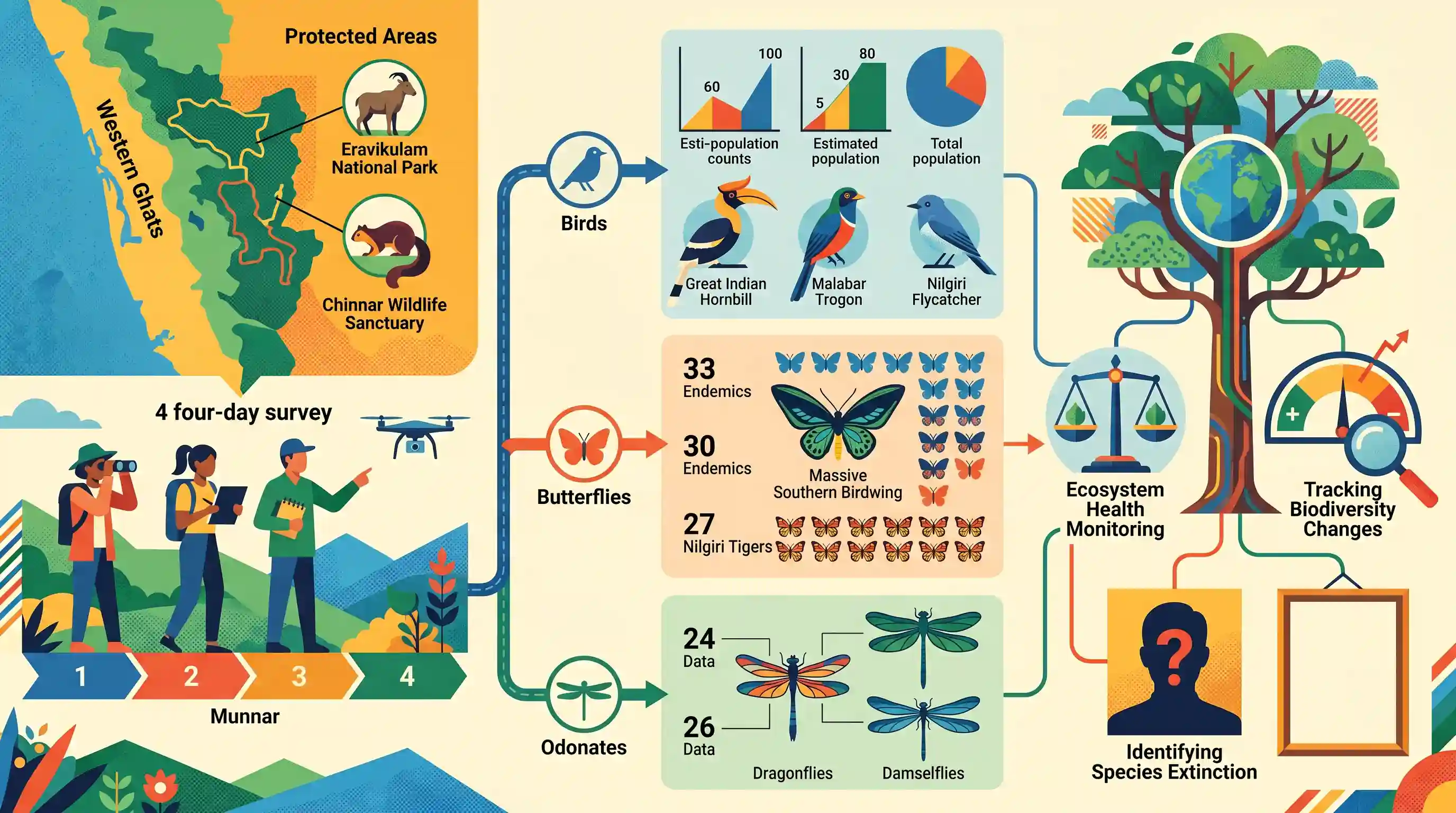
A four-day annual faunal survey has begun in the Munnar wildlife division in Kerala, conducted jointly with the Travancore Nature History Society. The survey covers several key protected areas, including Eravikulam National Park and Chinnar Wildlife Sanctuary, to estimate populations of birds, butterflies, and odonates. This monitoring effort is crucial for assessing ecosystem health, tracking biodiversity changes, and identifying any species extinction in the ecologically sensitive Western Ghats region.
Key Points
- A four-day annual faunal survey has commenced in the Munnar wildlife division in Idukki, Kerala.
- The survey is conducted jointly by the Munnar Wildlife Division and the Travancore Nature History Society (TNHS).
- It covers five protected areas: Eravikulam, Pampadum Shola, Anamudi Shola, Chinnar Wildlife Sanctuary, and Kurinjimala Sanctuary.
- The exercise aims to estimate the populations of birds, butterflies, and odonates (dragonflies and damselflies) to monitor ecosystem health and detect any signs of species extinction or population shifts compared to previous years.
Important Terms
Eravikulam National Park

Kerala's first national park, protecting the largest population of the endangered Nilgiri Tahr. It features high-altitude shola-grassland ecosystems and Anamudi, South India's highest peak.
UPSC context
GS III (Biodiversity). Tests knowledge of endemic species habitats, shola-grassland ecosystems, and protected area management.
Chinnar Wildlife Sanctuary
A protected area in Kerala's rain-shadow region, known for the endangered Grizzled Giant Squirrel and xerophytic scrub forests. It is a critical biodiversity hotspot in the Western Ghats.
UPSC context
GS III (Conservation). Relevant for understanding rain-shadow ecology and specific endangered species like the Grizzled Giant Squirrel.
Odonates
An insect order comprising dragonflies and damselflies, used as scientific bioindicators to assess the health of freshwater ecosystems and monitor biological water quality.
UPSC context
GS III (Environment). Frequent Prelims topic regarding bioindicators and their role in monitoring ecosystem degradation.
Nilgiri Tahr
An endangered mountain goat endemic to the southern Western Ghats. It is the state animal of Tamil Nadu and primarily inhabits montane grasslands and shola forests.
UPSC context
GS III (Species in News). Tests IUCN status, habitat requirements, and flagship conservation initiatives like Project Nilgiri Tahr.
Travancore Nature History Society (TNHS)
A Kerala-based NGO specializing in scientific faunal assessments and biodiversity documentation in the southern Western Ghats, collaborating with state departments for conservation research.
UPSC context
GS III (Environmental Governance). Illustrates the role of civil society and NGOs in scientific data collection and conservation efforts.
Munnar Wildlife Division
An administrative unit of the Kerala Forest Department managing a cluster of key protected areas, including Eravikulam, Chinnar, and several Shola national parks.
UPSC context
GS III (Conservation). Focuses on regional administrative frameworks for biodiversity management in the ecologically sensitive Western Ghats.
Prelims Trap
All Protected Areas in the Munnar wildlife division feature tropical wet evergreen and shola forests.
While Kerala is largely known for tropical wet forests, Chinnar Wildlife Sanctuary is uniquely situated in a rain-shadow region and features thorny scrub forests.
Static Concepts Connected
What are the unique ecological features of Shola forests?
- Altitude & Location: Found exclusively in the high-altitude valleys (generally >1500m) of the Southern Western Ghats, such as the Nilgiris, Anamalais, and Palani hills.
- Vegetation Mosaic: They consist of a unique, naturally occurring mosaic of stunted tropical montane evergreen forests interspersed with rolling grasslands.
- High Endemism: They host a high concentration of endemic and endangered species, notably the Nilgiri Tahr and the once-in-12-years blooming Neelakurinji.
Which major rivers of Kerala flow eastwards?
- The East-Flowing Trio: Out of Kerala's 44 rivers, only three flow eastwards: Kabini, Bhavani, and Pambar.
- Pambar River: It flows through the Chinnar Wildlife Sanctuary and eventually joins the Amaravathi River in Tamil Nadu, becoming part of the Cauvery basin.
- Ecological Significance: These rivers hydrate the rain-shadow regions of the Western Ghats (like Chinnar), supporting distinct dry flora and rare fauna like the Grizzled Giant Squirrel.
Cross-Topic Patterns
Shola ecosystems & Climate Vulnerability
High-altitude Shola-grassland mosaics are highly sensitive to warming. This forces lowland species higher, directly threatening cold-adapted endemic flora like Neelakurinji and fauna like the Nilgiri Tahr.
Odonates as ecological indicators
Tracking dragonflies and damselflies is crucial because their dual life-stages (aquatic nymphs, terrestrial adults) make them perfect barometers for freshwater ecosystem health and micro-climate shifts.

Expect a matching question in 2026 pairing Western Ghats PAs with specific features (e.g., Chinnar with rain-shadow/Pambar River).
Linked PYQs · 2
Linked PYQs · 2
- 2019PrelimsGS1
Which of the following are in Agasthyamala Biosphere Reserve?
- 2024PrelimsGS1
Consider the following : 1. Butterflies 2. Fish 3. Frogs How many of the above have poisonous species among them?
