Indian Origin NASA Astronaut Prepared for International Space Station
Source:Indian Express ↗
Why It Matters
This mission highlights the cutting-edge intersections of medicine, manufacturing, and international cooperation in space. It demonstrates how microgravity environments are being leveraged for advanced pharmaceutical and semiconductor manufacturing. For UPSC aspirants, the mission provides concrete, contemporary case studies of microgravity research (a topic recently featured in the 2025 Prelims) and the physiological/logistical challenges of human spaceflight (highly relevant to Mains GS3 and India's own upcoming Gaganyaan mission).
Summary
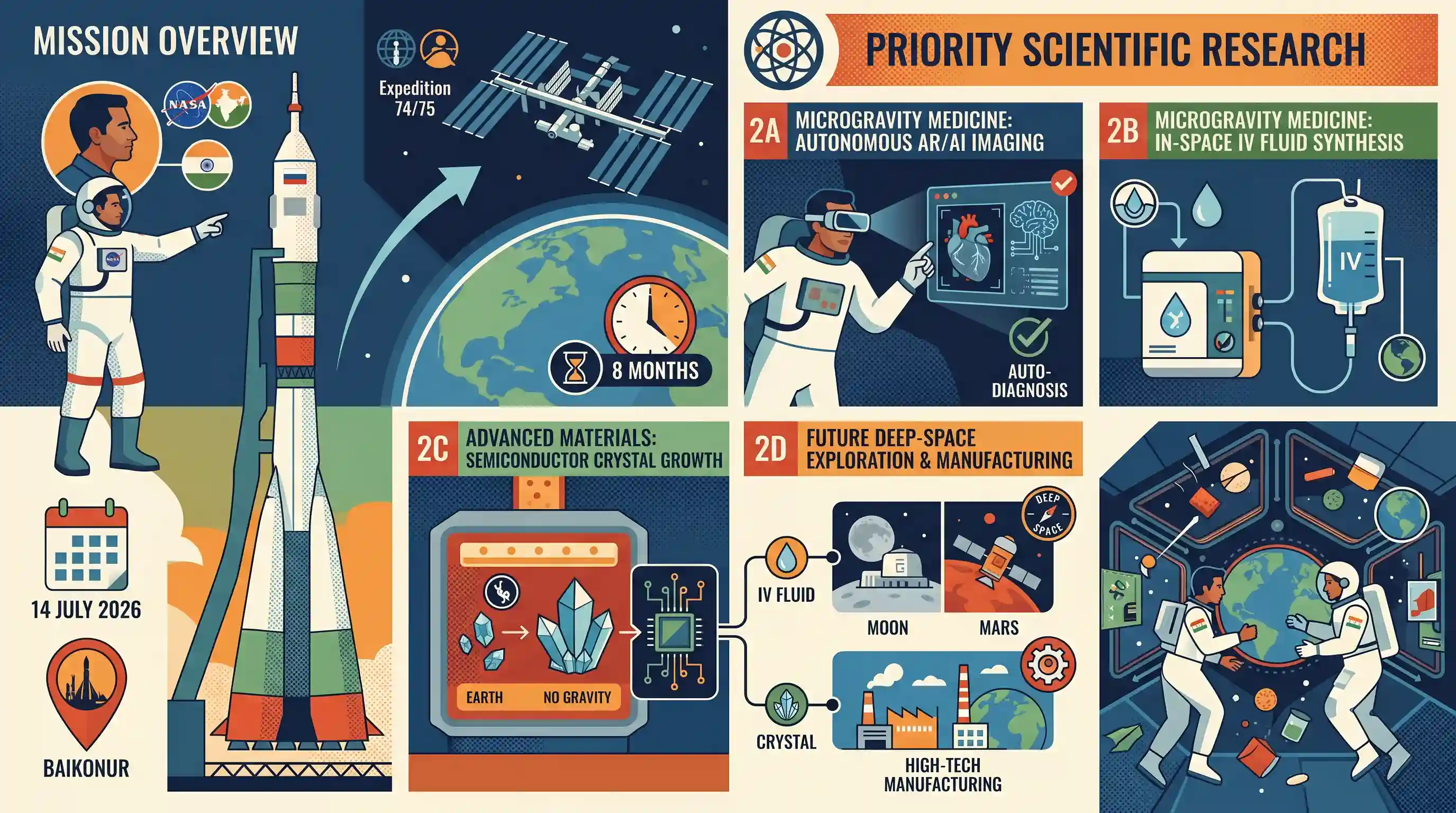
Indian-origin NASA astronaut and emergency medicine physician Anil Menon is set to embark on his maiden eight-month spaceflight to the International Space Station (ISS) on July 14, 2026. Launching via the Russian Soyuz MS-29 spacecraft from Baikonur Cosmodrome, Menon will conduct high-priority scientific research during Expedition 74/75. His mission will emphasize microgravity medicine—including autonomous AR/AI medical imaging and the in-space synthesis of intravenous (IV) fluids—as well as the experimental production of advanced semiconductor crystals, contributing crucial data for future deep-space exploration and high-tech manufacturing.
Key Points
- Indian-origin NASA astronaut Anil Menon is scheduled to launch on his first spaceflight mission to the International Space Station (ISS) on July 14, 2026.
- The 8-month mission (Expedition 74/75) will launch aboard the Roscosmos Soyuz MS-29 spacecraft from the Baikonur Cosmodrome in Kazakhstan, alongside Russian cosmonauts Pyotr Dubrov and Anna Kikina.
- Anil Menon is a 49-year-old emergency medicine physician and Colonel in the US Space Force, who has served as a NASA flight surgeon and SpaceX's first medical director, helping develop medical protocols for human spaceflights (such as Demo-2 and Starship) before being selected as an astronaut in 2021.
- A key research focus of the expedition is microgravity physiology, investigating changes in blood flow, vein structure, and blood composition to protect astronaut health during long-duration space travel.
- The mission will test critical deep-space medical technology, specifically an experimental system to manufacture intravenous (IV) fluids in space using the ISS's potable water purification system.
- Scientific experiments also include the in-space manufacturing of high-quality semiconductor crystals (which suffer fewer defects when grown in microgravity) to support advanced computing, AI, and medical devices.
- The crew will conduct medical investigations using Augmented Reality (AR) and Artificial Intelligence (AI) to perform ultrasound scans autonomously, reducing reliance on real-time Earth support during future interplanetary missions.
Important Terms
NASA

The independent federal agency of the United States government responsible for the civil space program, aeronautics, and aerospace research.
UPSC context
GS Paper 3 (Science & Tech); tests knowledge of global space agencies, bilateral missions (e.g., NISAR), and outer space exploration technologies.
Roscosmos
The state corporation responsible for space flights, cosmonautics programs, and aerospace research for the Russian Federation, succeeding the Soviet space program.
UPSC context
GS Paper 3 (Science & Tech); important for understanding global space partnerships, the Soyuz launch system, and international space station operations.
SpaceX
A private American aerospace manufacturer and space transportation company founded by Elon Musk, known for reusable rockets and commercial human spaceflight.
UPSC context
GS Paper 3 (Science & Tech); evaluates private sector participation in space, commercialization of spaceflight, and reusable launch vehicle technology.
US Space Force
The space warfare service branch of the US Armed Forces, responsible for organizing, training, and equipping forces to protect US space interests.
UPSC context
GS Paper 3 (Security/S&T); relates to the weaponization and militarization of space, space defense systems, and global geopolitical dynamics.
International Space Station
A multi-nation modular space station in Low Earth Orbit, serving as a collaborative microgravity and space environment research laboratory.
UPSC context
GS Paper 3 (Science & Tech); covers orbital laboratories, international space treaties, and India’s planned Bharatiya Antariksh Station.
Microgravity Research
Scientific experiments conducted in a state of apparent weightlessness (free-fall) to study physical, chemical, and biological phenomena without Earth's gravity.
UPSC context
GS Paper 3 (Science & Tech); highly relevant for space science, materials manufacturing, and Indian human spaceflight missions like Gaganyaan.
Space Medicine
A specialized field of medicine studying the physiological and psychological health challenges faced by humans during long-duration spaceflight.
UPSC context
GS Paper 3 (Science & Tech); tests understanding of space health hazards and recent ISRO-AIIMS collaborations for Gaganyaan.
Prelims Trap
Sir Chettur Sankaran Nair resigned from the Viceroy's Executive Council in protest against the passage of the Rowlatt Act.
He resigned specifically in protest of the Jallianwala Bagh massacre and martial law atrocities in Punjab, not the legislative passage of the Rowlatt Act itself.
Static Concepts Connected
Who was Sir Chettur Sankaran Nair and what was his historical significance?
- INC Presidency: Presided over the 1897 Amravati session of the Indian National Congress, advocating social reforms and political self-governance.
- Historic Resignation: Resigned from the Viceroy's Executive Council in 1919 in protest against the Jallianwala Bagh massacre.
- Judicial Career: Served as a Madras High Court judge and was known for his landmark legal decisions and critical stance on non-cooperation.
Why does microgravity improve semiconductor crystal growth compared to Earth?
- No Convection: Eliminates gravity-driven thermal convection, preventing structural defects and uneven distribution of impurities.
- No Sedimentation: Prevents heavier particles from settling, allowing perfectly uniform mixing of materials in suspension.
- Containerless Processing: Enables materials to solidify while levitating, avoiding contamination from contact with vessel walls.
Cross-Topic Patterns
Space medicine + Interplanetary logistics
Developing in-situ medical manufacturing like IV fluid synthesis is critical for bypassing Earth-bound supply chains during long-duration interplanetary missions to Mars and the Moon.
Diaspora + Modern scientific lineage
Modern diaspora milestones frequently intersect with colonial-era national history, offering examiners a dual-route to test both historical lineage and current scientific achievements.

UPSC could test Sir Sankaran Nair’s 1919 resignation as a history question, triggered by his descendant's 2026 ISS mission.
Linked PYQs · 2
Linked PYQs · 2
- 2025PrelimsGS1
Consider the following space missions : I. Axiom-4 II. SpaDeX III. Gaganyaan How many of the space missions given above encourage and support micro-gravity research?
- 2017MainsGS3
India has achieved remarkable successes in unmanned space missions including the Chandrayaan and Mars Orbitter Mission, but has not ventured into manned space missions. What are the main obstacles to launching a manned space mission, both in terms of technology and logistics? Examine critically.
