Judicial approach and substantive environmental jurisprudence
Source:Indian Express ↗
Why It Matters
The judiciary's approach to environmental disputes directly impacts the enforcement of conservation laws. Understanding the critique of 'procedure over substance' is crucial for analyzing the effectiveness of India's environmental governance and evaluating topics spanning judicial activism (GS2) and ecological conservation/EIA (GS3).
Summary
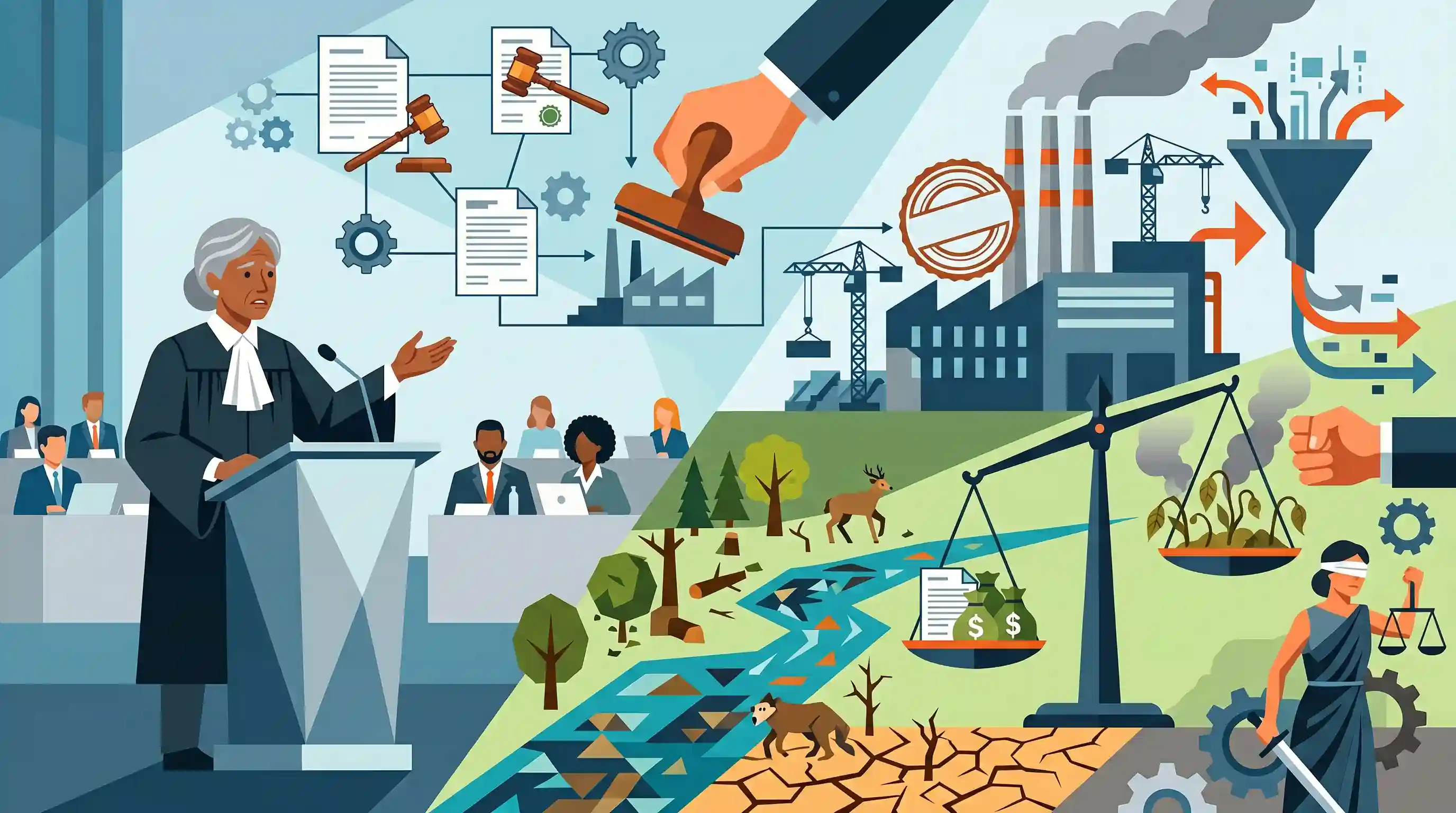
At the Anil Agarwal Dialogue 2026, former Supreme Court Judge Deepak Gupta criticized the Indian judiciary for increasingly prioritizing procedural technicalities over substantive environmental damage in ecological disputes. He specifically highlighted concerns regarding the growing acceptance of post-facto environmental clearances, warning that such practices dilute the Environmental Impact Assessment (EIA) framework and undermine the constitutionalization of environmental justice. The critique points to a shifting dynamic where developmental projects may exploit procedural loopholes to the detriment of environmental protection.
Key Points
- Former Supreme Court Judge Deepak Gupta criticized the Indian judiciary for increasingly focusing on procedural compliance rather than actual ecological damage in environmental cases.
- Speaking at the Anil Agarwal Dialogue 2026, he highlighted concerns over the practice of granting 'post-facto' environmental clearances, which undermines the core purpose of Environmental Impact Assessments (EIA).
- This shift in judicial approach raises questions regarding the effectiveness of environmental jurisprudence and the mandate of bodies like the National Green Tribunal (NGT) in delivering substantive environmental justice.
- The remarks underscore the ongoing tension between developmental imperatives and strict enforcement of environmental conservation laws in India.
Important Terms
Environmental Impact Assessment (EIA)

A regulatory process that evaluates the potential environmental, social, and economic consequences of a proposed project before it is granted approval, ensuring sustainable resource use.
UPSC context
GS Paper 3: Environment & Ecology; vital for understanding the balance between developmental projects and ecological conservation.
National Green Tribunal (NGT)
A specialized statutory body established in 2010 for the expeditious disposal of cases related to environmental protection, forest conservation, and the enforcement of environmental legal rights.
UPSC context
GS Paper 2 & 3: Statutory Bodies and Environmental Governance; tests knowledge of judicial mechanisms for environmental justice.
Post-facto Environmental Clearance
A controversial mechanism allowing projects to obtain environmental approval after construction or operations have already commenced, effectively regularizing prior illegalities through penalties.
UPSC context
GS Paper 3: Environment; highlights the conflict between the 'Precautionary Principle' and industrial development in current jurisprudence.
Environment (Protection) Act, 1986
An umbrella legislation enacted in 1986 that provides a framework for the coordination of central and state authorities' activities for environmental protection and improvement.
UPSC context
GS Paper 3: Environmental Laws; the foundational statute for major notifications like EIA and Coastal Regulation Zones.
Centre for Science and Environment (CSE)
A New Delhi-based public interest research and advocacy organization that publishes the 'State of India’s Environment' report and 'Down To Earth' magazine.
UPSC context
GS Paper 3: Environment; influential in policy advocacy, environmental education, and civil society's role in governance.
Precautionary Principle
A core tenet of environmental law requiring that if an action poses a risk of serious harm, lack of full scientific certainty shall not justify postponing prevention.
UPSC context
GS Paper 3: Environmental Jurisprudence; frequently cited by the Supreme Court to prioritize ecology over unverified industrial claims.
Prelims Trap
"The Supreme Court has placed a complete, absolute ban on granting ex-post facto environmental clearances."
UPSC often uses extreme words like 'complete'. While historically criticized, the Supreme Court has permitted post-facto clearances in exceptional circumstances (e.g., Pahwa Plastics case).
Static Concepts Connected
What is the statutory framework of the Environmental Impact Assessment (EIA) in India?
- Statutory Backing: Derived entirely from the Environment (Protection) Act, 1986. India does not have a separate statutory "EIA Act."
- Prior Clearance: Legally mandates environmental clearance before project commencement for scheduled activities, aiming to prevent harm proactively.
- Core Stages: Typically involves screening, scoping, public consultation, and final appraisal by expert committees before granting or rejecting clearance.
What are the foundational doctrines of Indian Environmental Jurisprudence?
- Precautionary Principle: Environmental degradation must be anticipated and prevented; lack of scientific certainty cannot justify delayed action (Vellore Citizens case).
- Polluter Pays: The polluting enterprise is absolutely liable to compensate victims and bear the costs of restoring environmental degradation.
- Public Trust Doctrine: The State holds natural resources like rivers, forests, and air as a trustee for the general public, not as absolute owner.
Cross-Topic Patterns
Judicial Restraint vs. Article 21
The transition from 1990s judicial activism in environmental PILs (like the MC Mehta cases) to current judicial deference towards executive developmental projects marks a major shift in constitutional jurisprudence.
Ease of Doing Business vs. Precautionary Principle
Government initiatives prioritizing "Ease of Doing Business" often manifest as relaxed EIA norms and post-facto clearances, directly clashing with the Precautionary Principle.

Post-facto clearances and the Precautionary Principle are highly likely to appear as a combined multi-statement Prelims question.
Linked PYQs · 4
Linked PYQs · 4
- 2022MainsGS2
“The most significant achievement of modern law in India is the constitutionalization of environmental problems by the Supreme Court.” Discuss this statement with the help of relevant case laws.
- 2024MainsGS3
What role do environmental NGOs and activists play in influencing Environmental Impact Assessment (EIA) outcomes for major projects in India? Cite four examples with all important details.
- 2018PrelimsGS1
How is the National Green Tribunal (NGT) different from the Central Pollution Control Board (CPCB)? 1. The NGT has been established by an Act whereas the CPCB has been created by an executive order of the Government. 2. The NGT provides environmental justice and helps reduce the burden of litigation in the higher courts whereas the CPCB promotes cleanliness of streams and wells, and aims to improve the quality of air in the country. Which of the statements given above is/are correct?
- 2014MainsGS3
Environmental Impact Assessment studies are increasingly undertaken before a project is cleared by the Government. Discuss the environmental impacts of coal-fired thermal plants located at coal pitheads.
