Anganwadi Workers in Jaipur Launch Indefinite Strike
Source:times-of-india ↗
Why It Matters
Anganwadi workers and Saathins form the backbone of grassroots nutrition, maternal-child care, and women empowerment schemes (like ICDS and PMMVY) in Rajasthan. This strike highlights key issues in public administration: the tension between e-governance targets (such as Poshan Tracker data entry) and actual digital literacy, the debate surrounding the care economy, and the demand for social security for honorary state workers.
Summary
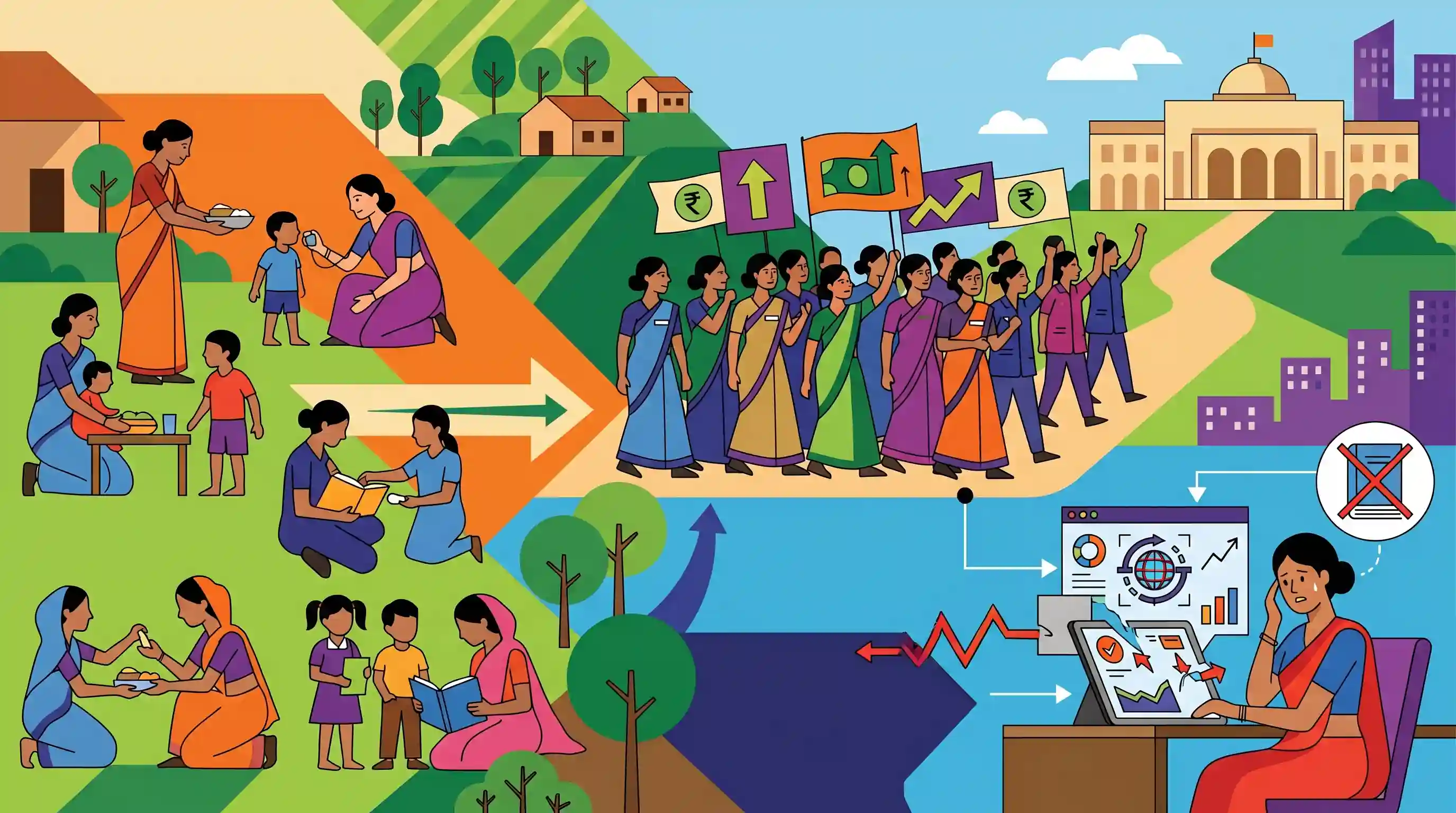
Anganwadi workers in Jaipur launched an indefinite strike demanding regularization, a hike in their monthly honorarium from Rs 6,000–9,000 to Rs 13,000, and addressing digital work challenges. The workers and 'saathins' argued that while they carry out crucial grassroots duties for the government, they lack job security, and mandatory tracking on digital portals has been enforced without formal training. Led by union leaders, they have threatened to gherao the Rajasthan Vidhan Sabha during the budget session if their demands remain unaddressed.
Key Points
- Anganwadi workers in Jaipur, Rajasthan initiated an indefinite strike in January 2025 to press for better pay and regularization of services.
- Key demands include converting temporary/honorary positions into permanent government jobs and raising the monthly honorarium from Rs 6,000–9,000 to a minimum of Rs 13,000.
- Protesters highlighted operational challenges caused by mandatory real-time digital reporting on official portals (like the Poshan Tracker) due to a lack of formal training and varying digital literacy levels among workers.
- Issues facing 'Saathins' (grassroots women mobilizers under the state's Women's Development Programme) were also raised, noting their heavy workload without equivalent social security or permanent status.
- The All Rajasthan Women and Child Development Employees Union, led by President Laxmi Yadav, threatened a massive rally on January 21, 2025, and a demonstration (gherao) outside the Rajasthan Vidhan Sabha during the budget session if demands are unmet.
Important Terms
Integrated Child Development Services (ICDS)

A centrally sponsored scheme providing supplementary nutrition, preschool non-formal education, primary healthcare, immunization, health check-ups, and referral services to children under 6 and mothers.
UPSC context
GS Paper II: Social Sector and Welfare Schemes; tests grassroots delivery and challenges of addressing malnutrition in rural areas.
Sathin Scheme (Women Development Programme)
A grassroots women empowerment initiative in Rajasthan employing local female workers ("Sathins") at Gram Panchayat levels to advocate for women's rights and prevent domestic violence.
UPSC context
GS Paper II: Grassroots administration and Women Empowerment; tests community-level mobilizers and challenges of honorary labor models.
Poshan Tracker (Poshan Abhiyaan)
An ICT-based mobile application launched by the Ministry of Women and Child Development to track Anganwadi activities, digitize registers, and dynamic-track child malnutrition.
UPSC context
GS Paper II: e-Governance and Digital Divide; tests ICT integration in welfare schemes and tech challenges faced by frontline workers.
Department of Women and Child Development, Government of Rajasthan
The state government department in Rajasthan responsible for implementing developmental programs, coordinating ICDS, and managing Anganwadi networks for child nutrition and women's welfare.
UPSC context
GS Paper II: Social Sector management; tests state-level administrative convergence and execution of central and state welfare programs.
Prelims Trap
Anganwadi workers are regular civil servants and are legally entitled to minimum wages under the Minimum Wages Act, 1948.
They are classified as honorary/voluntary workers, which excludes them from regular civil service pay scales and the Minimum Wages Act, though they are eligible for gratuity.
Static Concepts Connected
What is the legal status and gratuity rights of Anganwadi Workers?
- Honorary Classification: They are legally deemed "honorary/voluntary workers" under ICDS, denying them regular government employee status and standard civil service rules.
- Gratuity Landmark Ruling: The Supreme Court (Maniben Maganbhai Bhariya, 2022) ruled they perform statutory duties and are eligible for gratuity under the 1972 Act.
- Minimum Wage Exclusion: Being voluntary staff, they are excluded from the protection of the Minimum Wages Act, 1948, receiving monthly honorariums instead.
How does the National Food Security Act, 2013 leverage Anganwadi Centres?
- Nutritional Support: Mandates free daily age-appropriate meals to children (6 months to 6 years) and pregnant/lactating mothers through Anganwadi centres.
- Maternity Cash Benefit: Guarantees a minimum of ₹6,000 cash transfer to pregnant women and lactating mothers, partially disbursed via Anganwadi networks.
- Operational Oversight: Positions Anganwadis as the primary institutional vehicle to implement and monitor nutritional standards at the village level.
Cross-Topic Patterns
Care Economy & Feminized Labor
Connects GS1 societal gender roles with GS3 labor economics, showing how classifying vital frontline welfare work as "voluntary" or "honorary" structurally undervalues female care labor.
Technology vs. Grassroots Capacity
Links GS2 e-governance (Poshan Tracker) to rural development. Mandatory real-time digital logging without systematic training exposes structural digital divide limits in welfare delivery.

Mains 2026 may analyze how the 'honorary' status of frontline workers acts as a structural bottleneck in achieving NFSA nutrition targets.
Linked PYQs · 2
Linked PYQs · 2
- 2023RPSC_PRELIMSGS1
Which scheme aims to improve the health and nutritional status of pregnant women and lactating mothers and their infants (0 to 6 months) by promoting the use of appropriate practices, care, and services during pregnancy, safe delivery, and breastfeeding?
- 2025RPSC_PRELIMSGS1
Kwashiorkor, which is a type of malnutrition, results from the deficiency of which of the following?
