Sociological Contributions of Andre Beteille on Caste and Class
Source:Indian Express ↗
Why It Matters
André Béteille's sociological theories are directly relevant to the UPSC Mains GS1 syllabus on Indian Society. His insights provide aspirants with the analytical vocabulary needed to answer questions about the shifting nature of the caste system, the rise of the middle class, and the intersection of social mobility, class, and political power in modern India.
Summary
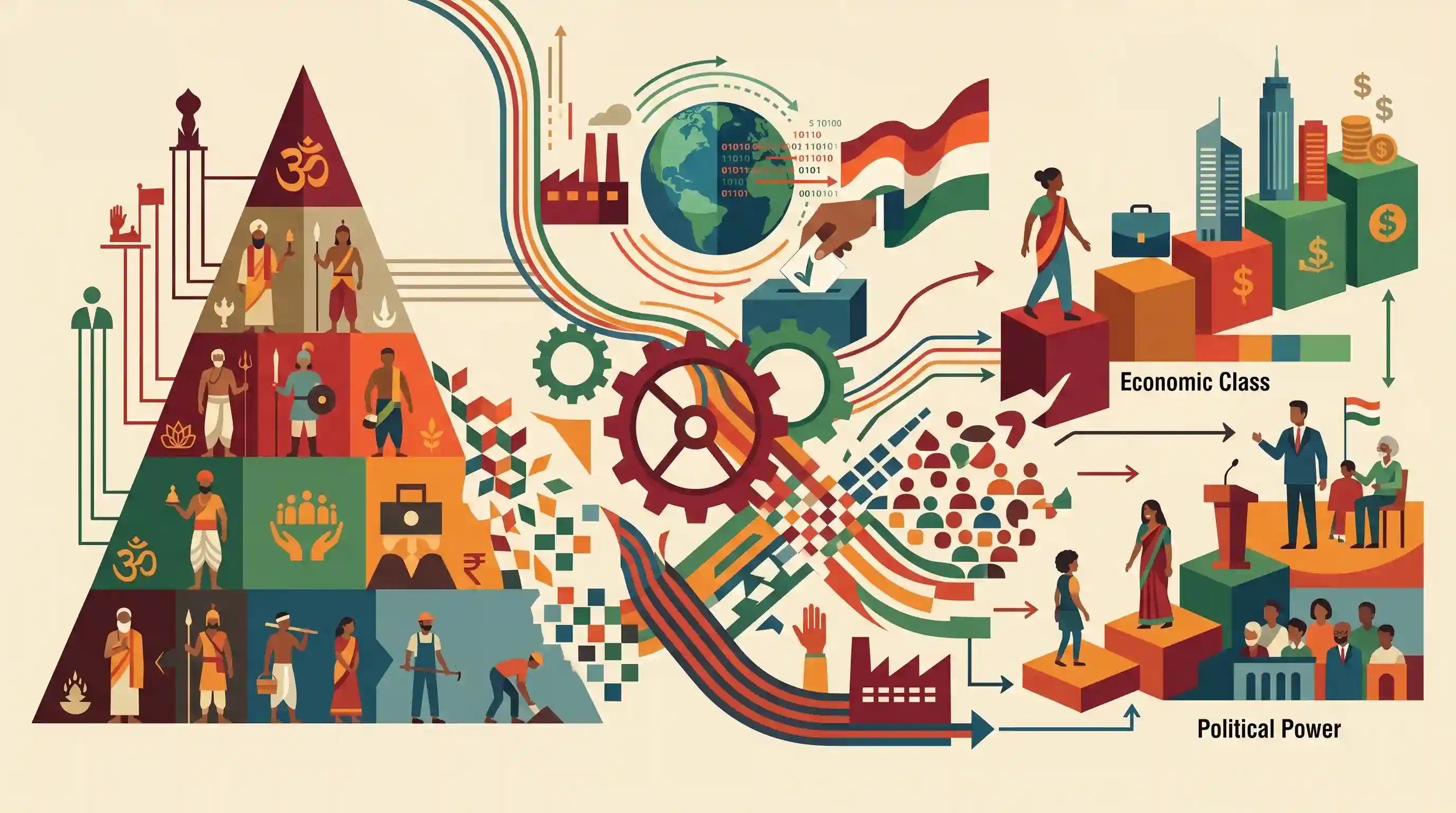
The article highlights the contributions of the eminent Indian sociologist André Béteille by recommending five of his foundational books on caste, class, and social inequality. Béteille’s most famous ethnographic work, *Caste, Class, and Power*, analyzed how modern democratic and economic forces in a Tanjore village decoupled political power and economic class from the traditional caste hierarchy. His extensive scholarship tracks the evolution of Indian society, shedding light on how traditional social stratification adapts to modernization, market economies, and new institutional frameworks. His work remains highly relevant for understanding the structural realities and changing relevance of caste in contemporary India.
Key Points
- André Béteille is a pioneering Indian sociologist renowned for his empirical and theoretical studies on social stratification, institutions, and inequality in India.
- His seminal 1965 book, *Caste, Class, and Power*, based on fieldwork in the Tanjore village of Sripuram, mapped the transition from a traditional caste-bound society to a more complex social structure.
- Béteille observed that while caste, class, and power were historically fused (with upper castes holding economic and political power), modernization caused these axes of stratification to become uncoupled.
- His broader bibliography explores the tension between constitutional ideals of equality and the persistent realities of social inequality, emphasizing the role of modern institutions in shaping a new middle class.
- Béteille's frameworks are foundational for sociological and GS1 studies of how the caste system assumes new associational forms and identities in contemporary, democratic India.
Important Terms
Delhi School of Economics (DSE)

A premier Indian institution where André Béteille and M.N. Srinivas established a rigorous tradition of empirical sociology and ethnographic fieldwork, moving beyond textual studies.
UPSC context
Relevant for Sociology Optional (Paper II); signifies the institutional shift toward field-based research in Indian sociology.
André Béteille
An eminent Indian sociologist (1934–2024) renowned for his comparative study of social stratification, particularly the evolving relationship between caste, class, and political power.
UPSC context
GS Paper I (Indian Society) and Sociology Optional; crucial for understanding modern transformations of the caste system.
Caste, Class, and Power
The 1965 seminal work by André Béteille that applied Max Weber's tripartite model of stratification to analyze a South Indian village's social hierarchy.
UPSC context
Sociology Optional (Paper II: Systems of Stratification); tests the ability to analyze multi-dimensional inequality in rural India.
Sripuram Study
The ethnographic site (a village in Tanjore, Tamil Nadu) where Béteille observed that political power and economic class were decoupling from traditional ritual caste status.
UPSC context
GS Paper I (Caste System) and Sociology Optional; used as a classic field study example of social change.
Social Stratification
The hierarchical arrangement of individuals into social groups (strata) based on factors like wealth, prestige, and power, often intersecting in the Indian context.
UPSC context
GS Paper I (Salient features of Indian Society) and Sociology Optional (Paper I: Stratification and Mobility).
Harmonic and Disharmonic Systems
Béteille's conceptual framework distinguishing between traditional societies where inequality is normatively accepted (harmonic) and modern democracies where egalitarian ideals clash with persistent inequalities (disharmonic).
UPSC context
Sociology Optional (Paper I & II); critical for discussing the tensions between constitutional equality and social reality.
Prelims Trap
"Modernization and democracy have eradicated the caste system, replacing it entirely with an economic class-based hierarchy."
Béteille argued that caste, class, and power decoupled (disharmonic structure), not that caste vanished. Caste adapted into new political and associational forms rather than being replaced.
Static Concepts Connected
What is the "decoupling" of caste, class, and power in Indian society?
- Harmonic system: Historically, ritual status, land wealth, and political power were concentrated in the exact same upper castes, creating overlapping stratification.
- Disharmonic system: Democracy and market forces separated these axes. A person's economic or political power in modern India no longer strictly depends on their ritual caste purity.
How does Louis Dumont's view of caste differ from André Béteille's?
- Dumont (Ideological): Viewed caste as a rigid, pan-Indian closed system based primarily on the overarching ideology of ritual purity and pollution.
- Béteille (Empirical): Studied caste empirically, viewing it as a dynamic, competitive hierarchy that adapts to modernization by shifting from ritual to secular and political forms.
Cross-Topic Patterns
Caste census and associational forms
Béteille’s observation of castes acting as political interest groups provides the foundational sociological framework for understanding modern GS2 issues like demands for a nationwide caste census and expanded reservations.
Agrarian transition and Dominant Castes
The rural transition mapped by Béteille mirrors the broader pan-India agrarian shift where the Green Revolution empowered middle-peasant castes, breaking traditional upper-caste political dominance.

Expect a GS1 Mains question analyzing whether modern democratic institutions have successfully 'decoupled' caste from economic class.
Linked PYQs · 3
Linked PYQs · 3
- 2018MainsGS1
Caste system is assuming new identities and associational forms. Hence, caste system cannot be eradicated in India." Comment.
- 2020MainsGS1
Has caste lost its relevance in understanding the multi-cultural Indian Society? Elaborate your answer with illustrations.
- 2024MainsGS1
Intercaste marriages between castes which have socio-economic parity have increased, to some extent, but this is less true of interreligious marriages. Discuss.
