Andhra University Plans Centres of Excellence in Emerging Tech
Source:communicationstoday ↗
Why It Matters
Reflects state-level higher education institutions aligning with national technology missions (like the National Quantum Mission and Semiconductor Mission) to foster deep-tech research and skill development.
Summary
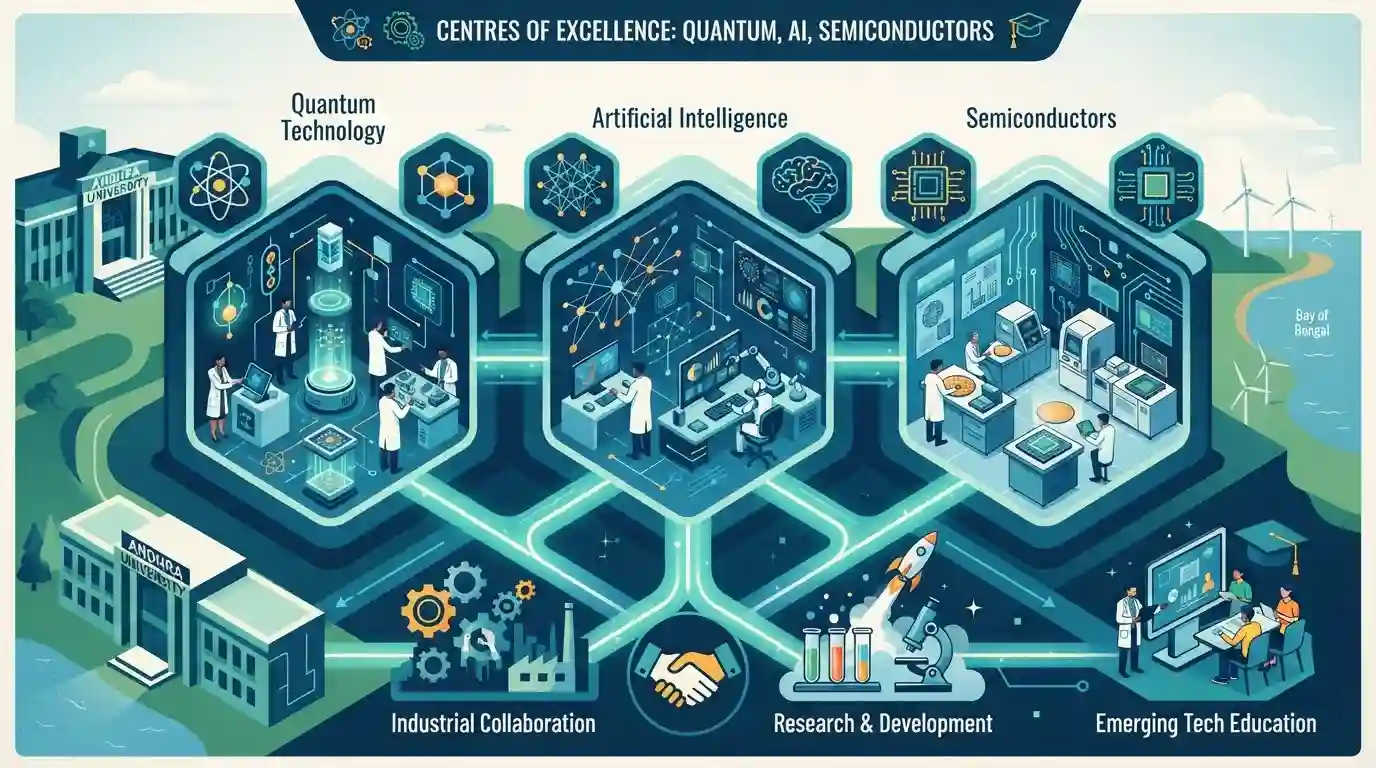
Andhra University has announced plans to set up Centres of Excellence (CoEs) dedicated to Quantum Technology, Artificial Intelligence (AI), and Semiconductors, aiming to drive high-end research, emerging tech education, and industrial collaboration in Andhra Pradesh.
Key Points
- Andhra University is planning to establish Centres of Excellence (CoEs) focused on Quantum Technology, Artificial Intelligence (AI), and Semiconductors.
- The initiative aims to boost advanced research, innovation, and skill development in emerging deep-tech domains within Andhra Pradesh.
- Aligns with national strategic goals like the National Quantum Mission and India Semiconductor Mission to build indigenous capability and industry-academia collaboration.
Important Terms
National Quantum Mission

A flagship central initiative by the Department of Science and Technology to build indigenous capabilities, research frameworks, and four thematic hubs in quantum computing, communication, and materials.
UPSC context
Relevant for UPSC/APPSC Science & Technology (Emerging Technologies); tests understanding of national missions promoting deep-tech research and digital sovereignty.
India Semiconductor Mission
A specialized business division under Digital India Corporation (MeitY) aimed at building a vibrant domestic semiconductor and display manufacturing ecosystem.
UPSC context
Important for APPSC/UPSC General Studies Paper III (Industrial Policy and High-Tech Manufacturing); tests policy measures for electronic self-reliance.
Andhra University
A prominent state university in Andhra Pradesh that announced plans to establish Centres of Excellence in Quantum Technology, AI, and Semiconductors.
UPSC context
Core for APPSC Regional Current Affairs and Higher Education developments; tests awareness of state-level academic contributions to emerging technologies.
Static Concepts Connected
What are the core thematic pillars and financial outlay of the National Quantum Mission (NQM)?
- Outlay & Duration: Approved with an outlay of ₹6,000 crore for 2023-2031 to seed, nurture, and scale scientific and industrial R&D in quantum tech.
- Thematic Pillars: Focuses on four thematic hubs (T-Hubs) in Quantum Computing, Quantum Communication, Quantum Sensing & Metrology, and Quantum Materials & Devices.
- Nodal Ministry: Implemented by the Department of Science and Technology (DST) under the Union Ministry of Science and Technology.
Cross-Topic Patterns
Emerging Tech Hubs + Centre-State Funding Synergy
State-level deep tech infrastructure like Amaravati Quantum Valley pairs with central missions (NQM, ISM) to test federal-fiscal cooperation in emerging tech funding.

NQM outlay (₹6,000 cr) and AP quantum initiatives are prime targets for APPSC Group-1 matching or statement-based tech questions.
Linked PYQs · 2
Linked PYQs · 2
- 2024APPSC_PRELIMSGS1
Which of the following statement/statements is/are valid regarding the socio-economic status of Andhra Pradesh ? I. Andhra Pradesh won the Best State Award of ICAR - National Research Center for Banana (NRCB) for export promotion. II. Andhra Pradesh GSDP growth rate has been registering a decline in recent times owing to repeated lower returns in certain sub-sectors of the Service Sector. III. For the FY 2024 - 25, the Revenue Deficit is budgeted higher than the Fiscal Deficit in terms of percentage of Andhra Pradesh GSDP. IV. The technology used by the Government of Andhra Pradesh while conducting resurvey of landholdings is referred to as 'Continuously Operating Reference Stations (CORS)' technology. Select the correct answer using the codes given below :
- 2023APPSC_PRELIMSGS1
Which of the following entries of the Indian Constitution deals with the institutions for scientific or technical education financed by the Government of India, wholly or in part, and declared by Parliament, by law to be institutions of national importance ?
