Andhra Pradesh Urban Local Body Elections Halted by SEC
Source:newindianexpress ↗
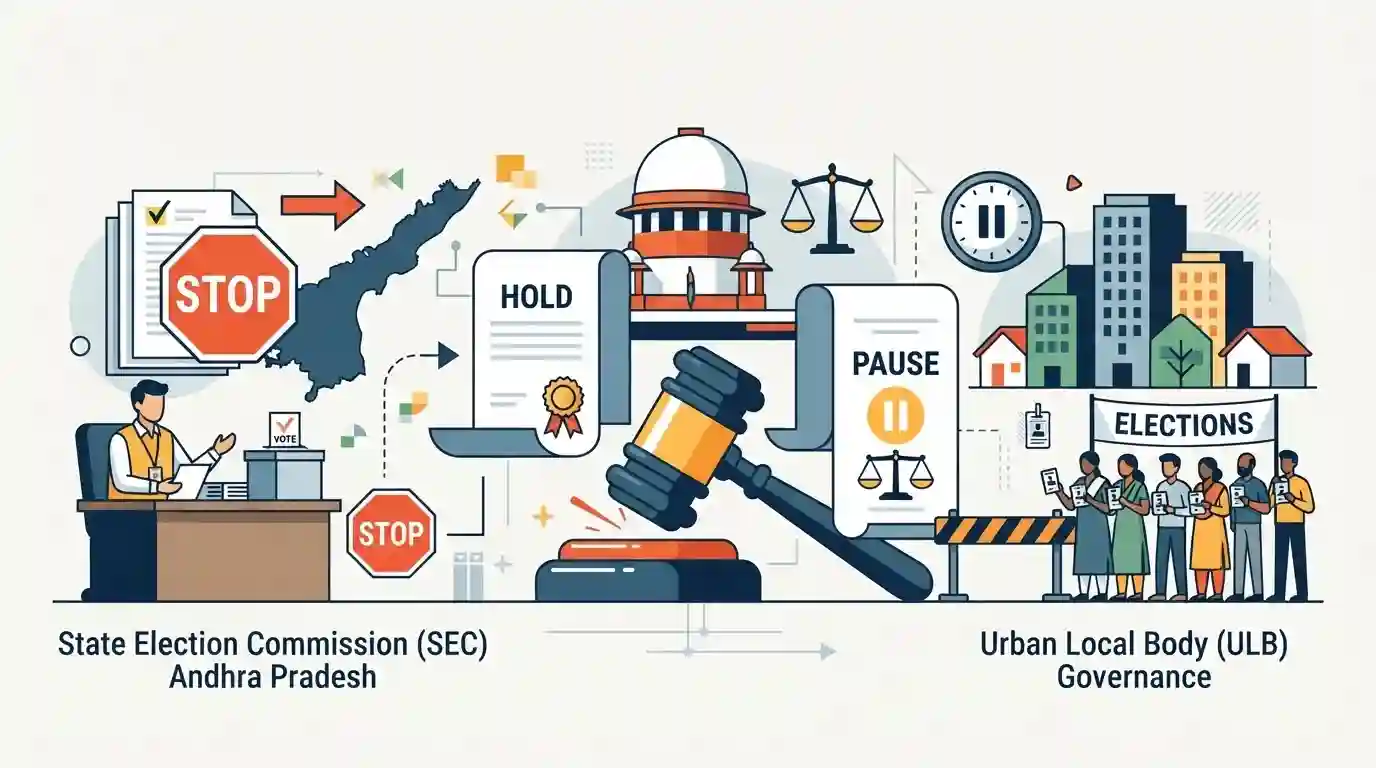
Why It Matters
Understanding the constitutional powers of State Election Commissions (SEC), the impact of judicial interventions by the Supreme Court on local body polls, and the framework of urban local governance under the 74th Constitutional Amendment Act is crucial for APPSC Group 1 aspirants.
Summary
The State Election Commission (SEC) of Andhra Pradesh has officially halted the process for urban local body (ULB) elections following an intervening order from the Supreme Court of India. This brings to focus the legal intricacies surrounding local body governance, judicial oversight, and the functional jurisdiction of State Election Commissions in India.
Key Points
- The Andhra Pradesh State Election Commission halted the election process for urban local bodies (ULBs) in compliance with a directive/order from the Supreme Court.
- The development highlights the role and authority of apex judicial bodies in overseeing or pausing electoral processes conducted by state election authorities when legal or constitutional questions arise.
- Urban local body elections in India derive their mandate from Part IXA of the Constitution (74th Amendment Act), with supervision vested in respective State Election Commissions under Article 243K.
Important Terms
State Election Commission (SEC) Andhra Pradesh

A constitutional body established under Article 243K responsible for superintendence, direction, and control of the preparation of electoral rolls and the conduct of panchayat and municipal elections in the state.
UPSC context
Important for APPSC Group 1/2 Polity and Governance, focusing on constitutional bodies, devolution of powers, and the autonomy of local governance in Andhra Pradesh.
74th Constitutional Amendment Act
Landmark legislation enacted in 1992 that constitutionalized urban local government, adding Part IX-A to the Constitution and providing statutory status to municipalities and municipal corporations.
UPSC context
Crucial for APPSC Polity syllabus under Local Government, examining decentralization, urban governance structures, and the functional domain of urban bodies.
Supreme Court of India
The apex judicial body in India that acts as the guardian of the Constitution, exercising appellate and writ jurisdiction over matters involving constitutional authorities and fundamental rights.
UPSC context
Relevant for APPSC Polity and Governance regarding judicial review, judicial oversight of constitutional bodies, and centre-state or institutional disputes.
Static Concepts Connected
What are the constitutional provisions governing State Election Commissions under Part IX and IXA?
- Constitutional Mandate: Article 243K vests the superintendence, direction, and control of panchayat and municipality elections in a State Election Commissioner.
- Tenure & Removal: The State Election Commissioner is appointed by the Governor and enjoys security of tenure similar to a judge of a High Court.
Cross-Topic Patterns
State Election Commission vs Article 324 Powers
Article 243K guarantees independent State Election Commissions, analogous to the Election Commission of India under Article 324, yet state-level judicial interventions highlight unique federal tension points.

Expect a conceptual question on the removal procedure of State Election Commissioners and their constitutional independence under Article 243K.
Linked PYQs · 3
Linked PYQs · 3
- 2023APPSC_PRELIMSGS1
The powers of the Election Commission include which of the following? I. The Election Commission takes decisions on every aspect of conduct and control of elections from the announcement of elections to the declaration of results. II. During the election period, the Election Commission can order the Government to dismiss some government officials. III. When on election duty, Government officers work under the control of the Election Commission. Choose the correct answer using the codes given below:
- 2024APPSC_PRELIMSGS1
Consider the following statements with reference to the Election Commission of India : I. The Constitution of India has debarred the retiring Election Commissioners from any further appointment by the government. II. In 'Anoop Baranwal Case' (2023), the Supreme Court has directed the Government to treat the Regional Commissioners on par with the Election Commissioners (other than the Chief Election Commissioner), as far as removal from office is concerned. III. Since its inception, the Election Commission had functioned as a multi-member body. IV. The power of superintendence, direction and control of elections to the office of Vice-President of India is vested in the Election Commission. Which of the above statement/statements is/are valid ?
- 2019APPSC_PRELIMSGS1
What is the name of the project launched with the objective of computerization of Urban, Local bodies ?
