Andhra Pradesh Records High GSDP Growth Rate and Capital Outlay
Source:The Hindu ↗
Why It Matters
The fiscal health, growth rates, and capital projects of Andhra Pradesh form the bedrock of the state-specific economy questions in the APPSC Group 1 Prelims. Understanding the dynamics of the state's debt-to-GSDP ratio and the funding for national projects like Polavaram is critical for aspirants.
Summary
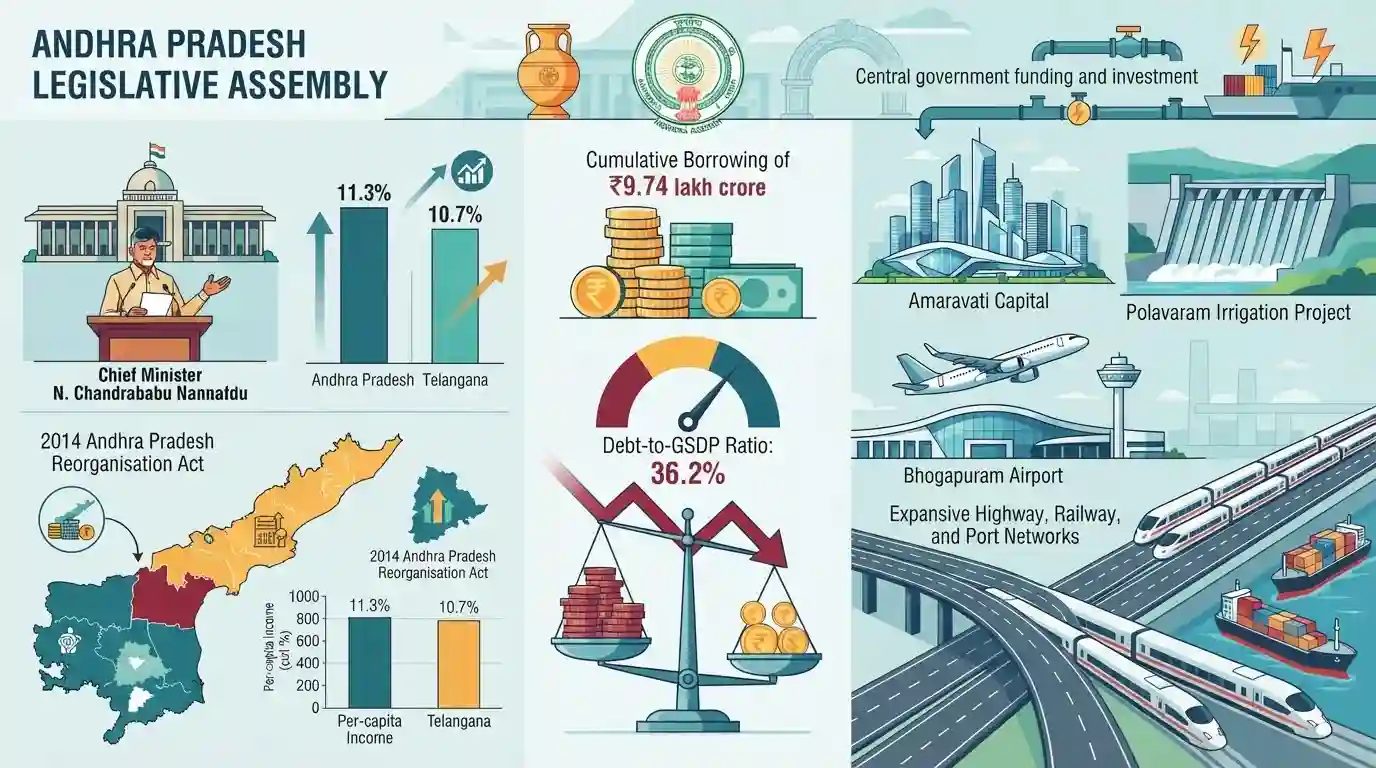
Andhra Pradesh Chief Minister N. Chandrababu Naidu presented the state's economic performance in the Assembly, noting an 11.3% growth rate that currently outpaces neighboring Telangana's 10.7%. While celebrating the growth, he highlighted concerning fiscal indicators, particularly the state's debt-to-GSDP ratio, which surged to 36.2% due to cumulative borrowing of ₹9.74 lakh crore, alongside a widening per-capita income gap with Telangana. To drive future economic resilience, the administration is focusing on mega capital expenditure and infrastructure development, bolstered by Central government funding for projects like Amaravati, the Polavaram irrigation project, the Bhogapuram airport, and expansive highway and railway networks.
Key Points
- Andhra Pradesh recorded a Gross State Domestic Product (GSDP) growth rate of 11.3%, marginally ahead of Telangana's 10.7%, according to recent RBI and GoI data highlighted by the Chief Minister.
- The state's debt-to-GSDP ratio has climbed to an alarming 36.2% (totaling loans of ₹9.74 lakh crore), significantly higher than the national average of 24.3%.
- Despite the overall GSDP growth, the per-capita income gap between Andhra Pradesh and Telangana has widened considerably over the past five years.
- The state is pursuing heavy capital expenditure on marquee infrastructure projects, securing significant central allocations including ₹10,000 crore for the Amaravati capital and ₹8,300 crore for the Polavaram project.
Important Terms
Polavaram Irrigation Project

A major multi-purpose national irrigation project under construction on the Godavari River in Andhra Pradesh, designed for irrigation, power generation, and inter-basin water transfer to the Krishna River.
UPSC context
GS Paper I & III: Geography (water resources) and economic development; tests river-linking concepts and inter-state water disputes.
Pattiseema lift irrigation scheme
India's first operational river-linking scheme that lifts surplus water from the Godavari River and transfers it to the Krishna River via the Polavaram Right Canal, relieving drought in the Krishna delta.
UPSC context
GS Paper I & III: Geography (river interlinking) and economy (infrastructure); tests knowledge of water conservation and engineering solutions.
Jalayagnam
A mega water management and irrigation infrastructure program launched by Andhra Pradesh in 2004 to construct reservoirs and lift systems to bring water to drought-prone, backward regions.
UPSC context
GS Paper III: Agriculture and state finances; tests mega infrastructure planning, irrigation policy, and public expenditure management.
Self Help Groups (SHGs)
Small, voluntary, community-based groups of people (predominantly rural women) who pool savings to access micro-loans, fostering grassroots financial inclusion, economic self-reliance, and empowerment.
UPSC context
GS Paper II & III: Social justice, governance, and rural development; tests women's empowerment, micro-finance, and poverty alleviation models.
Reserve Bank of India (RBI)
India's central bank and monetary authority, which acts as the banker and debt manager to central and state governments, monitoring subnational fiscal deficits and borrowing ceilings.
UPSC context
GS Paper III: Public finance and fiscal federalism; tests state-level debt sustainability and central banking oversight of fiscal deficits.
Prelims Trap
The Constitution of India explicitly limits a state's debt-to-GSDP ratio to 20% to ensure macroeconomic stability.
The 20% debt-to-GSDP limit for states is a statutory recommendation by the N.K. Singh FRBM Review Committee, not a constitutional mandate under Article 293.
Static Concepts Connected
What are the constitutional constraints and FRBM targets for State borrowing?
- Article 293 constraint: States cannot borrow internationally. Under Article 293, they require the Centre's consent to raise domestic loans if any previous Central government loan remains outstanding.
- FRBM targets: The N.K. Singh FRBM Review Committee recommended a 20% debt-to-GDP ceiling for states, a target severely breached by states like AP operating at 36.2%.
What is the geographical and statutory significance of the Polavaram Project?
- Inter-basin transfer: It serves as a vital inter-basin link, diverting up to 80 TMC of surplus Godavari river water to the historically deficit Krishna river basin.
- National Project status: The AP Reorganisation Act 2014 declared it a National Project, shifting its execution and irrigation funding responsibilities from the state to the Union Government.
Cross-Topic Patterns
GSDP Growth vs Per-Capita Reality
AP outpaces Telangana in GSDP growth (11.3% vs 10.7%), yet the per-capita income gap is widening. This perfectly illustrates how population bases and historical capital concentration distort absolute growth metrics in regional development.
River linking and Tribunal Awards
Diverting Godavari water via Polavaram triggers compensatory water-sharing entitlements for Maharashtra, Karnataka, and Telangana under the 1980 GWDT Award, linking mega-infrastructure projects directly to interstate river disputes.

Expect a multi-statement Prelims question mixing Article 293 (state borrowing limits), FRBM state targets, and inter-basin water transfers.
Linked PYQs · 4
Linked PYQs · 4
- 2024APPSC_PRELIMSGS1
Which of the following statement/statements is/are valid regarding the socio-economic status of Andhra Pradesh ? I. Andhra Pradesh won the Best State Award of ICAR - National Research Center for Banana (NRCB) for export promotion. II. Andhra Pradesh GSDP growth rate has been registering a decline in recent times owing to repeated lower returns in certain sub-sectors of the Service Sector. III. For the FY 2024 - 25, the Revenue Deficit is budgeted higher than the Fiscal Deficit in terms of percentage of Andhra Pradesh GSDP. IV. The technology used by the Government of Andhra Pradesh while conducting resurvey of landholdings is referred to as 'Continuously Operating Reference Stations (CORS)' technology. Select the correct answer using the codes given below :
- 2023APPSC_PRELIMSGS1
Part V of the Andhra Pradesh Reorganisation Act deals with
- 2024APPSC_PRELIMSGS1
Which of the following statement/statements is/are incorrect regarding the Andhra Pradesh Industrial Policy 2023 - 27? I. To achieve a minimum contribution of 25% by industry in the State GDP II. To provide end-to-end facilitation in 2 weeks III. To envisage ten (10) priorities of accomplishment IV. To focus on becoming a 'Plug and Play State' for investments V. Ensuring land allotment by APIIC within a period of 2 weeks upon receipt of application Select the answer using the codes given below :
- 2023APPSC_PRELIMSGS1
Polavaram Project is a
