TTD Varuna Yagam Vedic Rituals for Timely Rains in Andhra Pradesh
Source:deccanchronicle ↗
Why It Matters
Understanding ancient Vedic traditions, Shrauta and Smartha rituals, and key deities (like Varuna and Parjanya) is crucial for APPSC Group 1 Art & Culture and History syllabus, which regularly quizzes students on Vedic society and religious developments.
Summary
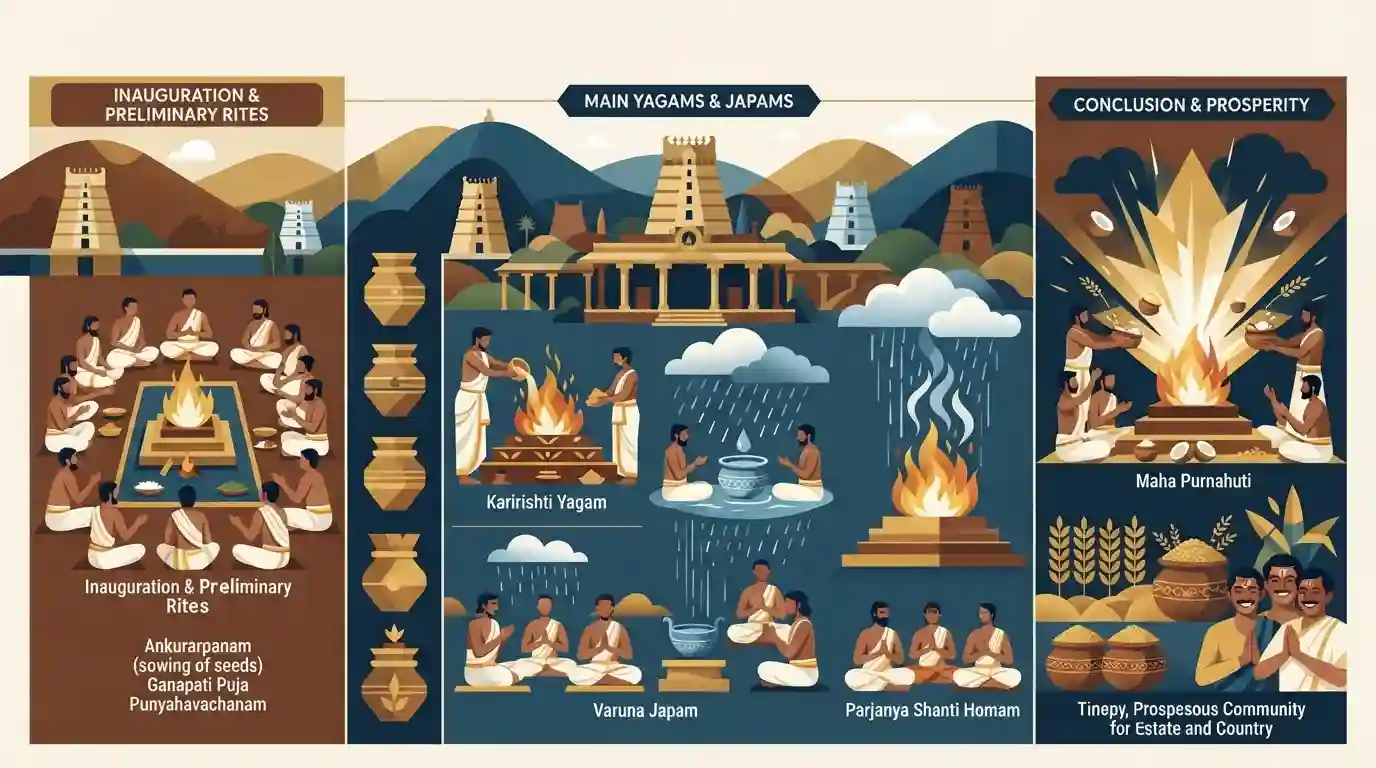
Tirumala Tirupati Devasthanams (TTD) initiated a five-day Vedic ritual sequence, including Karirishti Yagam, Varuna Japam, and Parjanya Shanti Homam, at Dharma Giri Veda Vijnana Peetham in Tirumala, Andhra Pradesh. Performed by 32 scholars from the Shrauta and Smartha traditions, the rituals are meant to seek timely rainfall and prosperity for the state and country. Key ceremonies include Ankurarpanam, Ganapati Puja, Punyahavachanam, and Prayaschitta Homam, concluding with Maha Purnahuti.
Key Points
- Tirumala Tirupati Devasthanams (TTD) commenced a five-day Varuna Yagam at Dharma Giri Veda Vijnana Peetham in Tirumala, Andhra Pradesh, to invoke rain and seek national prosperity.
- The performance includes specialized Vedic ceremonies such as Karirishti Yagam, Varuna Japam, and Parjanya Shanti Homam, aiming to appease Varuna (god of waters) and Parjanya (god of rain-clouds).
- A panel of 32 scholars well-versed in Vedic, Shrauta, and Smartha traditions are performing the rituals.
- Key ritualistic components conducted include Ankurarpanam (seed-sowing), Ganapati Puja, Punyahavachanam (purification), Prayaschitta Homam (penance), and the final Maha Purnahuti.
- This event highlights the preservation of ancient Vedic practices, Shrauta (solemn Vedic sacrifices), and Smartha (traditional domestic worship) streams of Hinduism in Andhra Pradesh.
Important Terms
Tirumala Tirupati Devasthanams

An independent administrative trust established by the Andhra Pradesh government that manages the operations, finances, and institutions of the Venkateswara Temple in Tirumala, the world's richest Hindu shrine.
UPSC context
APPSC Group I/II General Studies; tests governance of public religious trusts, state temple administration, and regional heritage management.
Dharma Giri Veda Vijnana Peetham
A premier residential Vedic educational institution run by TTD in Tirumala, established in 1884 to preserve and propagate Vedas, Agamas, and Smartha traditions via the traditional Gurukula system.
UPSC context
APPSC Art & Culture; tests the history of traditional educational institutions, Vedic preservation initiatives, and state-backed cultural legacy.
Kareerishti Yagam
An ancient, highly specialized Vedic fire sacrifice performed to propitiate Varuna, the rain deity, seeking timely, plentiful rainfall, agricultural prosperity, and the alleviation of drought.
UPSC context
APPSC History and Culture; tests Vedic sacrifices, the contemporary survival of ritualistic traditions, and socio-religious practices in Andhra Pradesh.
Smarta Tradition
A major synthesis-oriented Hindu movement developed in the classical period, notable for the domestic worship of five equal deities (Panchayatana) and aligned with Advaita Vedanta philosophy.
UPSC context
APPSC History & Culture; tests ancient religious synthesis, evolution of sectarian worship, and key philosophical developments in Hinduism.
Shrauta Tradition
A conservative, ritual-centric lineage of Vedic Hinduism strictly based on Sruti scriptures, focusing heavily on executing complex public fire sacrifices (Yajnas) like Agnihotra and Soma.
UPSC context
APPSC History & Culture; tests early Vedic liturgy, the distinction between Sruti and Smriti texts, and traditional priestly duties.
Prelims Trap
Varuna was initially conceptualized in the early Rigveda as a deity exclusively presiding over rain, water, and oceans.
In early Rigvedic theology, Varuna was primarily a celestial (Dyusthaniya) deity guarding cosmic and moral order (Rita). His exclusive association with water/oceans crystallized in later texts.
Static Concepts Connected
What is the distinction between Shrauta and Smartha traditions in Hindu ritualistic orthodoxy?
- Shrauta basis: Derived directly from Shruti (Vedas), involving solemn, public, large-scale fire sacrifices (Yagnas) requiring multiple specialized priests.
- Smartha basis: Based on Smriti (remembered texts, Grihya Sutras), focusing on domestic, household rituals (Sodasa Samskaras) and personal multi-deity worship.
- Textual source: Shrauta rites rely strictly on Shrautasutras; Smartha rites rely on Grihyasutras and Dharmasutras.
How does Vedic theology distinguish between Nitya and Kamya rituals?
- Nitya Karma: Obligatory daily rituals (like Sandhyavandanam) performed without any specific desire for worldly fruits, aimed at maintaining spiritual order.
- Kamya Karma: Desire-driven, occasional rituals (like Karirishti Yagam) performed specifically to attain worldly benefits, such as rain or wealth.
Cross-Topic Patterns
Ritualistic vs Scientific Drought Mitigation
Links Vedic rain rituals (Karirishti) to modern AP state disaster management practices, contrasting faith-based atmospheric appeals with scientific cloud-seeding technologies.
State Patronage & Intangible Heritage
Connects Temple Administration (TTD Act) with Article 29/30 rights, exploring how state-endowed boards legally fund and preserve ancient Vedic oral traditions.

APPSC may test Vedic ritual classifications (Shrauta vs Smartha) or Rigvedic deity domains (Rita/Varuna) via TTD's active revival events.
Linked PYQs · 2
Linked PYQs · 2
- 2023APPSC_PRELIMSGS1
Select the correct statements about religious beliefs of the Rig Vedic Period: I. Dyus was a celestial God of the Rig Vedic Aryans similar to Jupiter of the Greeks. II. Prithvi was considered as the mother of all Gods. III. Agni was worshipped as the intermediary of taking the offerings to the deities. IV. Cow sacrifice was also the part of worship.
- 2019APPSC_PRELIMSGS1
Which of the following pairs of temples and places is not correctly matched? (Temple) (Place)
