Andhra Pradesh Performance on Twenty Point Programme Targets
Source:business-standard ↗
Why It Matters
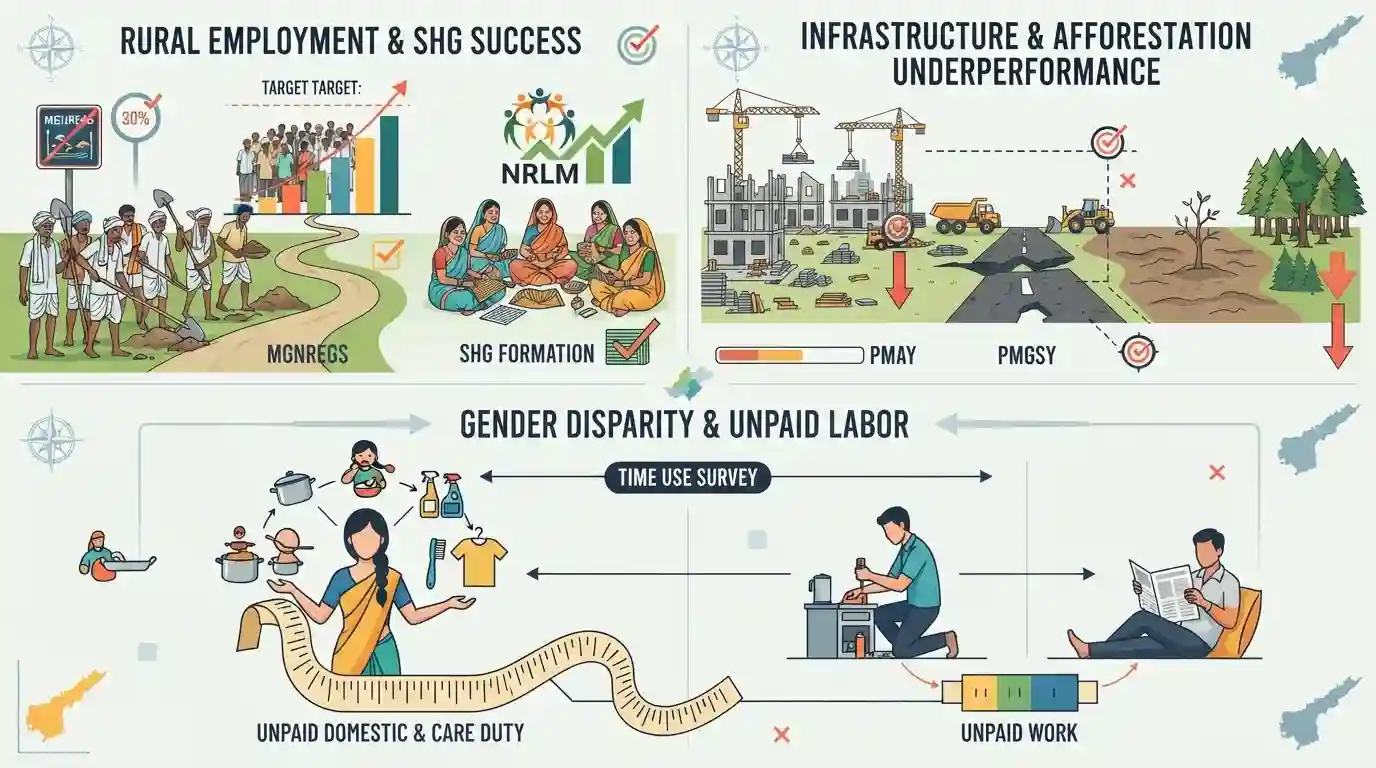
Assessing state-level execution of Centrally Sponsored Schemes is vital for understanding governance effectiveness and socio-economic progress. The article contrasts successful human-capital interventions (employment and SHGs) with alarming deficits in physical infrastructure (housing and roads), alongside highlighting persistent gender inequality in labor distribution.
Summary
According to the Twenty Point Programme (TPP) progress report for April-December 2023, Andhra Pradesh exceeded targets in providing rural employment under MGNREGS and forming Self-Help Groups (SHGs) under the National Rural Livelihood Mission. However, the state drastically underperformed in rural and urban housing (PMAY), road construction (PMGSY), and afforestation. Concurrently, a Time Use Survey (TUS) highlighted stark gender disparities, indicating that females spend considerably more time daily on unpaid domestic and caregiving duties compared to males.
Key Points
- Andhra Pradesh overachieved its April-December 2023 targets under the Twenty Point Programme for creating rural employment via MGNREGS and mobilizing women into SHGs under NRLM.
- The state heavily underperformed in physical infrastructure, realizing only 1% of its rural housing target (PMAY-G) and completely missing its road construction (PMGSY) targets.
- Significant shortfalls were also recorded in urban housing allocations under PMAY(U) and in afforestation/tree plantation drives.
- A Time Use Survey (TUS) released alongside highlighted deep gender disparities, revealing that women spend approximately 3.5 to 5 hours more daily on unpaid domestic and caregiving work than men.
Important Terms
Twenty Point Programme (TPP)

Launched in 1975 and restructured in 2006, the TPP is a package of poverty alleviation, employment, and rural development schemes monitored by the Ministry of Statistics and Programme Implementation.
UPSC context
Essential for GS Paper 2 (Governance/Poverty) and GS Paper 3 (Economic Development). Evaluates the execution of major welfare policies.
Mahatma Gandhi National Rural Employment Guarantee Scheme (MGNREGS)
A statutory rural development initiative that guarantees at least 100 days of wage employment per financial year to rural households whose adult members volunteer for unskilled manual work.
UPSC context
Core to GS Paper 2 (Welfare Schemes) and GS Paper 3 (Inclusive Growth), testing poverty alleviation and rural labor dynamics.
National Rural Livelihood Mission (NRLM)
A poverty alleviation project by the Ministry of Rural Development promoting self-employment by organizing the rural poor, particularly women, into financially supported Self-Help Groups (SHGs).
UPSC context
Crucial for GS Paper 2 (Role of SHGs) linking women's empowerment to financial inclusion and poverty eradication.
Pradhan Mantri Awaas Yojana (PMAY)
A flagship infrastructure scheme aiming to provide affordable 'Housing for All,' divided into rural and urban segments, providing financial assistance for constructing permanent homes.
UPSC context
Key for GS Paper 2 (Welfare Schemes) and GS Paper 3 (Infrastructure), assessing living standard improvements.
Pradhan Mantri Gram Sadak Yojana (PMGSY)
A centrally sponsored scheme designed to construct all-weather road connectivity to unconnected rural habitations, fundamentally boosting agricultural access and broader socio-economic development.
UPSC context
Important for GS Paper 3 (Infrastructure) and GS Paper 2, illustrating physical infrastructure gaps in rural administration.
Time Use Survey (TUS)
A periodic survey conducted by the National Statistical Office measuring how individuals allocate time between paid employment and unpaid domestic or caregiving activities, exposing societal gender disparities.
UPSC context
Vital for GS Paper 1 (Society/Women's Issues) and GS Paper 3 (Economy), spotlighting the unremunerated economic contributions of women.
Prelims Trap
"The Time Use Survey (TUS) is published by the Ministry of Women and Child Development."
Aspirants assume gender/care data is published by MWCD or NITI Aayog. The TUS is actually conducted by the National Statistical Office (NSO) under MoSPI.
Static Concepts Connected
What is the Twenty Point Programme (TPP) and who monitors it?
- Origin: Originally launched in 1975 and restructured multiple times (latest TPP-2006) to eradicate poverty and improve life quality.
- Nodal monitor: The Ministry of Statistics and Programme Implementation (MoSPI) tracks the performance of states/UTs on these poverty alleviation targets.
- Scope: It aggregates targets from various ministries, covering MGNREGS, PMAY, rural roads, and afforestation under a single monitoring umbrella.
How does the Time Use Survey (TUS) measure the 'Care Economy'?
- Nodal agency: Conducted by the NSO to measure the participation and time spent by individuals in paid and unpaid activities.
- SNA vs Non-SNA: It classifies activities into System of National Accounts (SNA) (productive/paid) and non-SNA (unpaid domestic/caregiving) tasks.
- GDP exclusion: Unpaid domestic work remains excluded from standard GDP calculations, structurally underestimating female economic contributions.
Cross-Topic Patterns
Employment schemes vs. durable asset creation
High MGNREGS job creation alongside lagging PMAY/PMGSY targets suggests a reliance on distress rural employment without successfully translating state funds into durable, long-term physical infrastructure.
SHG mobilization vs. the Care Economy
While states easily meet NRLM targets for women's SHGs, the TUS highlights a "double burden," where women balance new micro-enterprise roles with heavily skewed unpaid caregiving work.

Expect a 2026 Prelims multi-statement question pairing Time Use Survey findings with NSO's System of National Accounts (SNA) definitions.
Linked PYQs · 5
Linked PYQs · 5
- 2023APPSC_PRELIMSGS1
Which of the following is not a feature of MGNREGS? I. Guaranteed minimum wage employment II. Rights-based employment scheme III. Generation of wage employment in rural areas IV. Provision of nutritious food Choose the correct answer using the codes given below:
- 2019APPSC_PRELIMSGS1
At present with which name is Swarnajayanti Gram Swarozgar Yojana (1999) implemented ?
- 2004APPSC_PRELIMSGS1
The National Rural Employment Programme and the Rural Landless Employment Guarantee Programme were launched during the
- 2019APPSC_PRELIMSGS1
Which of the following in general is eligible as a borrower under National Rural Livelihood Mission (NRLM) ?
- 2024APPSC_PRELIMSGS1
In the context of Central Government programmes, which one of following statement/statements is/are incorrect ? I. The objective of Pradhan Mantri Anusuchit Jaati Abhyuday Yojana (PM-AJAY) is aimed at reducing poverty of the ST communities by generating additional employment opportunities. II. Under the Pradhan Mantri Shram Yogi Maan-dhan Yojana (PM-SYM), monthly contribution is payable by the beneficiary, the State Government and the Central Government. III. Under the 'FutureSkills Prime' Programme, Centre for Development of Advanced Computing (C-DAC) is the key implementing agency. IV. Mission Karmayogi comprises of eight key pillars that are intended to create functional and behavioural competencies among the civil servants. Select the answer using the codes given below :
