Andhra Pradesh Thermal Power Procurement and DBFOO Model
Source:gktoday ↗
ఇది ఎందుకు ముఖ్యం
Demonstrates a state-level regulatory approach to managing energy security and grid stability by integrating dispatchable thermal power through competitive DBFOO bidding. It provides key insights into the operationalization of the Electricity Act, 2003, and the Central Electricity Authority's resource planning, critical for APPSC and UPSC GS3 Energy segments.
సారాంశం
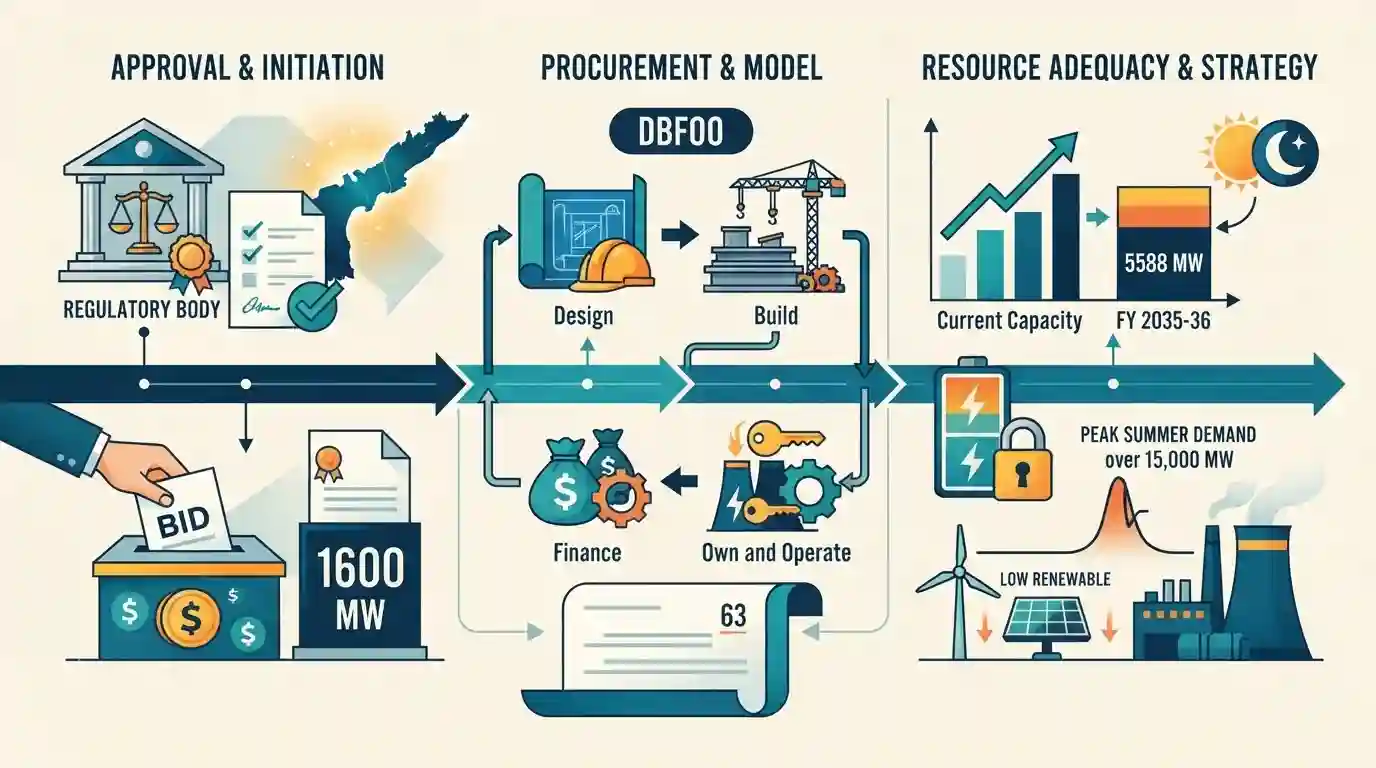
The Andhra Pradesh Electricity Regulatory Commission (APERC) has granted in-principle approval for state distribution companies to initiate competitive bidding for 1,600 MW of coal-based thermal power. The process will utilize the tariff-based Design, Build, Finance, Own and Operate (DBFOO) model as outlined in Section 63 of the Electricity Act, 2003. This procurement forms the first phase of a broader strategy tied to the Central Electricity Authority's Resource Adequacy Plan, which suggests adding 5,588 MW of thermal capacity by FY 2035-36. The move is strategically designed to ensure energy security and manage peak summer demands exceeding 15,000 MW, particularly when renewable energy generation is low.
ముఖ్య అంశాలు
- The Andhra Pradesh Electricity Regulatory Commission (APERC) approved competitive bidding for procuring 1,600 MW of coal-based thermal power.
- Procurement will be conducted using the tariff-based Design, Build, Finance, Own and Operate (DBFOO) model under Section 63 of the Electricity Act, 2003.
- The initiative aligns with the Central Electricity Authority's Resource Adequacy Plan, which recommends adding 5,588 MW of thermal power in AP by FY 2035-36.
- The added capacity is aimed at meeting the state's peak summer demand of over 15,000 MW and providing a reliable dispatchable source during periods of low renewable energy generation.
ముఖ్యమైన పదాలు
Electricity Act, 2003

The primary legislation governing India's power sector, overseeing generation, transmission, distribution, and trading. It aims to introduce competition, protect consumer interests, and establish statutory bodies like the CEA and Regulatory Commissions.
UPSC context
GS Papers 2 & 3 (Policies & Infrastructure). Tests knowledge of power sector reforms, regulations, and statutory frameworks.
Resource Adequacy Plan
A capacity planning framework mandated by the Central Electricity Authority to ensure sufficient generation resources, including renewable energy and storage, are available round-the-clock to reliably meet projected long-term electricity demand.
UPSC context
GS Paper 3 (Energy Infrastructure). Tests understanding of grid stability, energy security, and transition to renewable energy.
Central Electricity Authority (CEA)
A statutory organization under the Electricity Act, 2003. It advises the central government on the National Electricity Policy, specifies technical and safety standards, and formulates long-term power system development plans.
UPSC context
GS Paper 2 (Statutory Bodies). Tests awareness of institutional mechanisms for national power planning and grid standardization.
DBFOO Model
Design, Build, Finance, Own and Operate (DBFOO) is a Public-Private Partnership model where a private entity takes full responsibility for designing, funding, building, owning, and running an infrastructure facility.
UPSC context
GS Paper 3 (Investment Models). Tests understanding of PPP frameworks, infrastructure financing, and private sector participation.
Andhra Pradesh Electricity Regulatory Commission (APERC)
A state-level statutory regulatory body established under the Electricity Act, 2003, responsible for determining electricity tariffs, regulating power purchases, and facilitating state power sector efficiency.
UPSC context
GS Paper 2 (Statutory Bodies). Tests knowledge of decentralized regulatory authorities and state-level power sector management.
ప్రిలిమ్స్ ఉచ్చు
"In the DBFOO model, ownership of the power plant is transferred to the government after the concession period ends."
Under the DBFOO model, the private entity retains permanent ownership of the asset. It does not transfer back to the government, unlike DBFOT or BOT models.
అనుసంధానమైన స్థిర భావనలు
How does the DBFOO model differ from traditional BOT in infrastructure?
- Permanent Ownership: Under DBFOO (Design, Build, Finance, Own, Operate), the private developer retains permanent ownership of the project asset.
- Concession Expiry: Under BOT (Build, Operate, Transfer) or DBFOT, ownership strictly reverts to the government authority after the concession period expires.
- Revenue Mechanism: In DBFOO power projects, long-term revenue visibility is usually secured via Power Purchase Agreements (PPAs) based on competitive bidding rather than toll collection.
What is the statutory mandate of the Central Electricity Authority (CEA)?
- Statutory Origin: Constituted originally under the Electricity (Supply) Act, 1948, it is now governed by the Electricity Act, 2003.
- Core Functions: It formulates the National Electricity Plan, ensuring optimal utilization of resources, and specifies technical standards for electrical plants and grids.
- Advisory Role: It advises the Union Government on matters relating to the national electricity policy, safety regulations, and cross-border power trade.
అంతర-అంశ నమూనాలు
Thermal Base Load & RE Intermittency
Despite massive renewable energy pushes, states are forced to procure coal thermal power to manage grid stability and peak summer demand when renewable generation drops (Resource Adequacy framework).
Tariff Determination: Cost-Plus vs Bidding
The shift from Section 62 'cost-plus' tariffs to Section 63 'competitive bidding' reflects broader power sector reforms aimed at minimizing regulatory delays and ensuring market-determined pricing.

Expect a 2026 question linking CEA's Resource Adequacy Planning with grid stability constraints and infrastructure PPP models like DBFOO.
అనుసంధాన PYQలు · 3
అనుసంధాన PYQలు · 3
- 2023APPSC_PRELIMSGS1
Match the following Coal-based Thermal Power Stations and their States: | List I (Thermal Power Station) | List II (State) | |---|---| | a. Kudgi | I. Chhattisgarh | | b. Kahalgaon | II. Karnataka | | c. Sipat | III. U.P. | | d. Dadri | IV. Bihar | Choose the correct answer using the codes given below: Code: a b c d
- 2024APPSC_PRELIMSGS1
The Interim Union Budget (FY25) has proposed initiatives to boost India's Green Energy Sector. Which of the following proposals are connected with developing India's Green Energy ? I. Viability Gap Funding (VGF) for utilizing solar energy projects II. To set up coal gasification and liquefaction capacity of 100MT by 2030 III. Optional blending of Compressed Bio Gas (CBG) in Compressed Natural Gas (CNG) for transport and Piped Natural Gas (PNG) for domestic purposes IV. Provision of financial assistance for procurement of biomass aggregation machinery V. Setting up of a payment security system for expanding the bio-manufacturing system in the country Select the correct answer using the codes given below :
- 2023APPSC_PRELIMSGS1
Part V of the Andhra Pradesh Reorganisation Act deals with
