Andhra Pradesh crop loan disbursement ranking and SLBC targets
Source:deccan-chronicle ↗
Why It Matters
APPSC consistently tests candidates on state-specific welfare schemes, direct benefit transfers (DBTs) like the Annadata Sukhibhava Scheme (the successor to Rythu Bharosa), and mechanisms of agricultural finance such as interest subvention and crop loans.
Summary
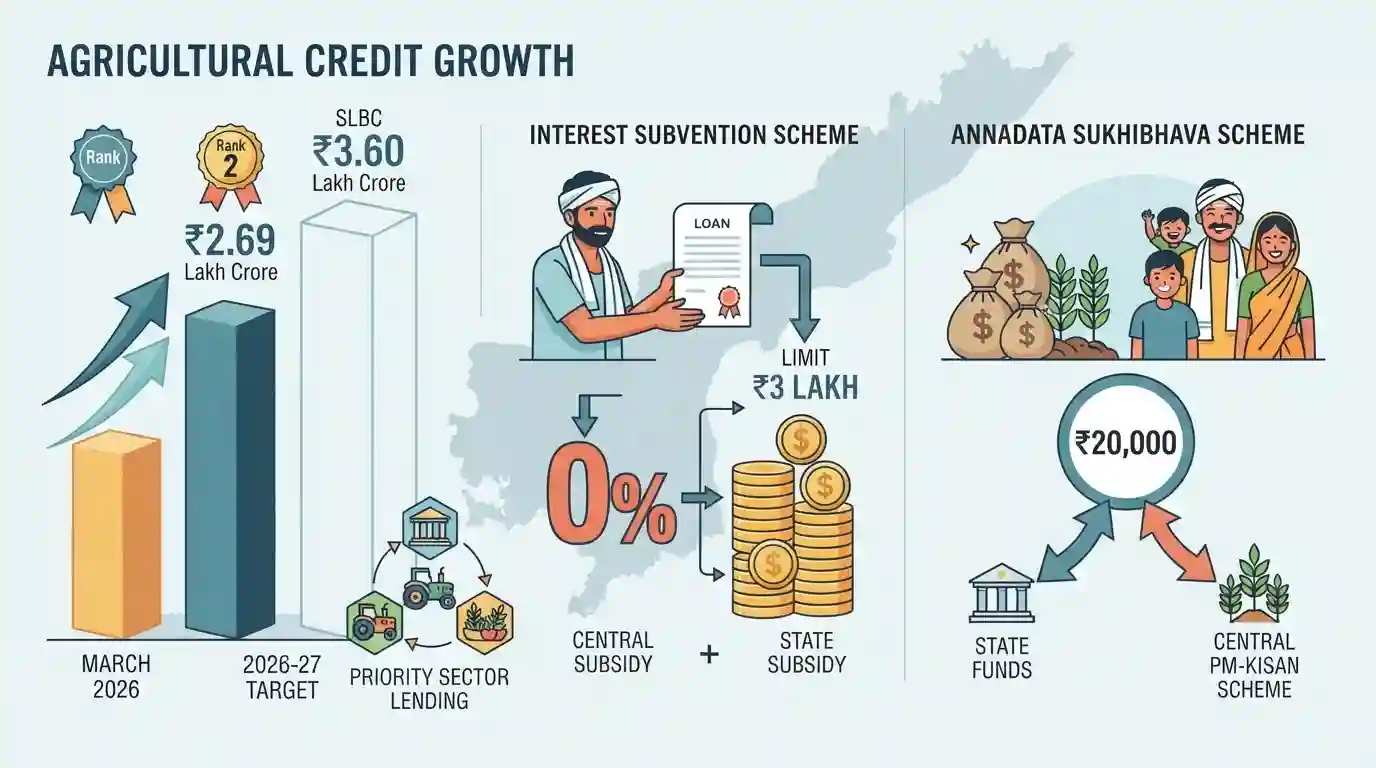
Andhra Pradesh has secured the second position nationwide by releasing Rs 2.69 lakh crore in crop loans by the end of March 2026, with the SLBC setting a future target of Rs 3.60 lakh crore for 2026-27. The state extensively supports its agriculture sector through the Interest Subvention Scheme, providing zero-interest crop loans up to Rs 3 lakh by combining central and state subsidies. Additionally, farmers are highly supported by the Annadata Sukhibhava Scheme, which provides Rs 20,000 in annual direct financial assistance through a combination of state funds and the central PM-KISAN scheme.
Key Points
- Andhra Pradesh ranks second among 35 states and union territories in India for the release of crop loans, disbursing Rs 2.69 lakh crore by March 31, 2026.
- The State-Level Bankers Committee (SLBC) has set an ambitious crop loan target of Rs 3.60 lakh crore for the state in the 2026-27 financial year.
- Farmers receive crop loans up to Rs 3 lakh at an effective zero percent interest rate, supported by a 3% interest subvention from the Central Government and a 4% subvention from the State Government.
- Under the Annadata Sukhibhava Scheme, farmers receive a total annual financial support of Rs 20,000, combining Rs 6,000 from the Centre (PM-KISAN) and Rs 14,000 from the AP State Government.
- The scale of finance for loans is systematically determined by bankers in coordination with agricultural officials based on factors like landholding size, crop type, and crop duration.
Important Terms
Annadata Sukhibhava Scheme

Andhra Pradesh's flagship farmer income support scheme. It provides eligible agricultural households ₹20,000 annually: ₹14,000 from state funds combined with ₹6,000 from the central PM-KISAN scheme.
UPSC context
Tests GS2 (Welfare Schemes) and GS3 (Agriculture). Highlights state-central synergy in Direct Benefit Transfers and supplementary farm-income support.
Pradhan Mantri Kisan Samman Nidhi (PM-KISAN)
A Central Sector Scheme offering ₹6,000 annually (in three equal installments) to eligible landholding farmer families via Direct Benefit Transfer, aiming to supplement farm input and domestic needs.
UPSC context
Crucial for GS2 and GS3 (Agriculture, Direct Benefit Transfers, Financial Inclusion), demonstrating structural shifts from price support to income support.
Modified Interest Subvention Scheme (MISS)
A Central Sector Scheme providing short-term crop loans up to ₹3 lakh at a concessional 7% interest rate. Timely repayment earns an extra 3% subvention, reducing the effective rate to 4%.
UPSC context
Vital for GS3 (Agricultural Credit). Tests knowledge of rural banking, Kisan Credit Cards, and government interventions combating rural indebtedness.
State-Level Bankers' Committee (SLBC)
An apex state-level institutional forum under RBI's Lead Bank Scheme. It coordinates commercial banks, financial institutions, and state governments to execute priority sector credit policies and financial inclusion plans.
UPSC context
Important for GS3 (Indian Economy). Focuses on financial inclusion, rural banking coordination, and priority sector lending targets at the state level.
Prelims Trap
The Scale of Finance is determined nationally by NABARD based on the market value of agricultural land.
Scale of Finance is decided locally by District/State Technical Committees based on crop type and cultivation costs, not by land value or NABARD.
Static Concepts Connected
How does the Modified Interest Subvention Scheme (MISS) function?
- Base Rate: Short-term crop loans up to ₹3 lakh are provided via KCC at a benchmark interest rate of 7% per annum.
- Prompt Repayment Incentive: Farmers who repay promptly receive an additional 3% Prompt Repayment Incentive (PRI), effectively reducing the rate to 4%.
- State Top-ups: State governments (like Andhra Pradesh) often layer additional subventions (e.g., 4%) to bring the effective borrower rate down to 0%.
What is the Scale of Finance (SoF) in agricultural credit?
- Definition: It is a scientific mechanism determining the maximum permissible crop loan limit per unit of cultivated area (acre/hectare).
- Fixing Authority: It is fixed annually at the district level by the District Level Technical Committee (DLTC) and approved by the SLTC.
- Core Determinants: Calculations are based on crop type, input costs, and duration, entirely irrespective of the agricultural land's market value.
Cross-Topic Patterns
Cooperative Federalism in DBTs
State schemes like Annadata Sukhibhava overlay state funds onto central PM-KISAN payouts, highlighting a layered, cooperative approach to agricultural direct benefit transfers.
Credit Access for Tenant Farmers
Without land titles, tenant farmers often face institutional credit exclusion. AP's Crop Cultivator Rights Card demonstrates how states bypass traditional title-collateral bottlenecks.

Expect a 2026 multi-statement Prelims question on agricultural credit mechanics testing Scale of Finance, DLTC/SLBC roles, and subvention.
Linked PYQs · 2
Linked PYQs · 2
- 2023APPSC_PRELIMSGS1
Government of Andhra Pradesh is implementing YSR Rythu Bharosa - PM Kisan Scheme for the benefit of farmers of Andhra Pradesh. Which of the following statements are correct about the above scheme ?
- 2023APPSC_PRELIMSGS1
The CCRC introduced by Government of Andhra Pradesh stands for
