Srisailam Reservoir Storage and Rayalaseema Irrigation Management
Source:deccan-chronicle ↗
Why It Matters
The management of the Srisailam reservoir and the Krishna River basin is critical for understanding Andhra Pradesh's geographical resources, irrigation infrastructure, and inter-state river water governance (managed by KRMB). These themes are directly testable in APPSC Prelims under state geography and resource management.
Summary
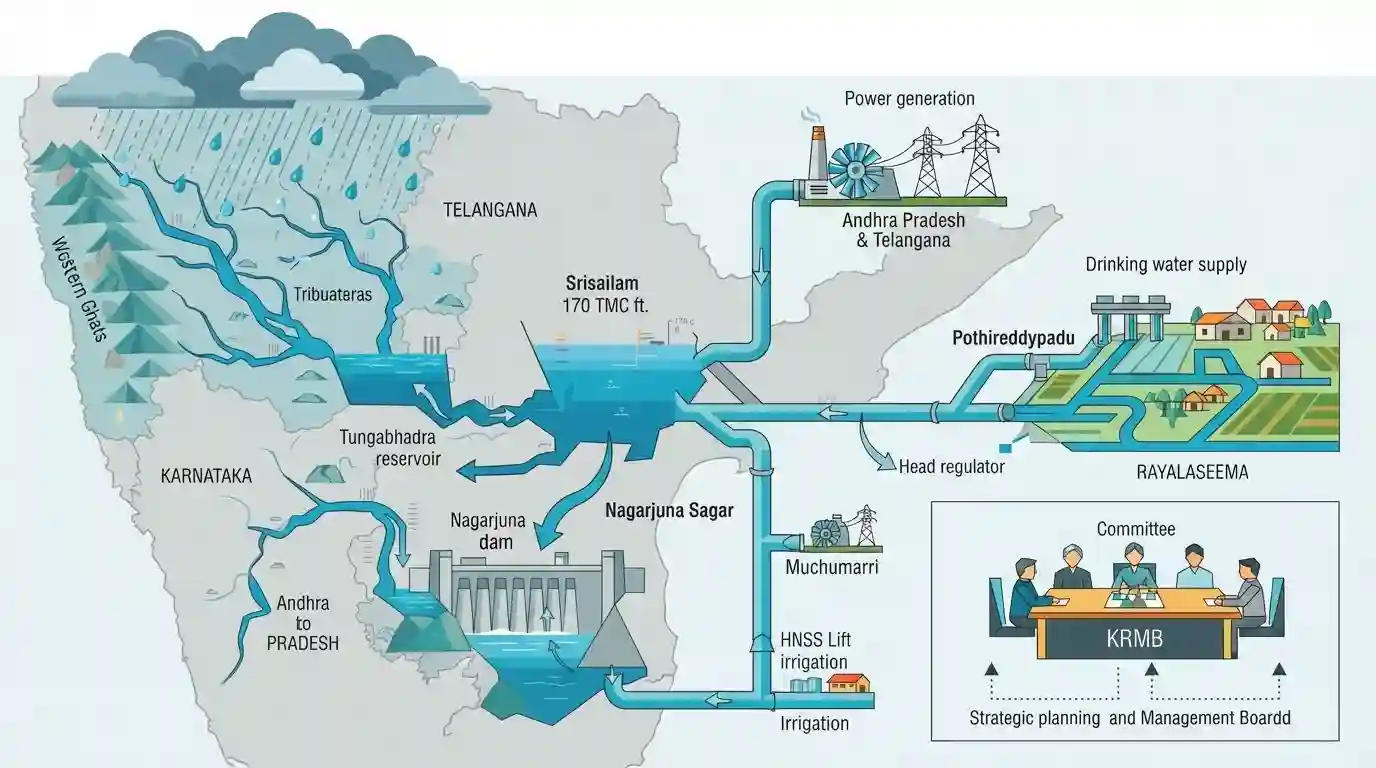
The Srisailam reservoir in Andhra Pradesh is experiencing a slight dip in inflows but maintains robust storage nearing 170 TMC ft, largely fed by upstream releases from the Jurala project. The accumulated water is actively being utilised by both Andhra Pradesh and Telangana for hydroelectric power generation, while releases to the Pothireddypadu head regulator, Muchumarri, and HNSS lift irrigation systems are ensuring drinking water supplies for the Rayalaseema region. The broader Krishna River basin, including Tungabhadra and Nagarjuna Sagar dams, is also witnessing heavy inflows due to continuous rains in Maharashtra and Karnataka, leading Andhra Pradesh to strategize requests to the Krishna River Management Board (KRMB) for optimal water allocation.
Key Points
- Inflows to the Srisailam reservoir have slightly dipped, though it continues to receive about 3.63 lakh cusecs from the Jurala project.
- The storage capacity at Srisailam has reached 168.12 TMC ft, against a full reservoir capacity of 215.80 TMC ft.
- Andhra Pradesh and Telangana have utilised the water for significant hydroelectric power generation (7.910 MU and 12.336 MU respectively).
- Water is being released into the Pothireddypadu head regulator and lift irrigation schemes like Muchumarri and HNSS to meet the drinking water needs of Rayalaseema.
- With heavy inflows from upstream areas in Maharashtra and Karnataka, other major dams like Tungabhadra and Nagarjuna Sagar are also receiving substantial water, prompting AP authorities to plan requests to the KRMB for further allocations.
Important Terms
Krishna River Management Board (KRMB)

A statutory body established under the Andhra Pradesh Reorganisation Act, 2014, responsible for the administration, regulation, and equitable distribution of Krishna River waters between Andhra Pradesh and Telangana.
UPSC context
GS Paper 2 (Statutory Bodies/Inter-State Relations). Tests knowledge of inter-state river water dispute mechanisms and regulatory boards.
Handri-Neeva Sujala Sravanthi (HNSS) Lift Irrigation
A major lift irrigation project in Andhra Pradesh drawing floodwater from the Srisailam reservoir to provide reliable drinking water and irrigation to the drought-prone Rayalaseema districts.
UPSC context
GS Paper 1 & 3 (Geography/Water Resources). Tests awareness of major Indian irrigation projects addressing regional water scarcity and drought.
Muchumarri Lift Irrigation
An irrigation scheme in Andhra Pradesh that lifts floodwaters from the Srisailam reservoir into the Kurnool-Cuddapah (KC) Canal, ensuring steady water supply and enhancing water security for the Rayalaseema region.
UPSC context
GS Paper 1 & 3 (Geography/Agriculture). Relevant for understanding intra-state water transfers, lift irrigation mechanisms, and drought mitigation strategies.
Prelims Trap
"The Krishna River Management Board (KRMB) is an adjudicatory tribunal formed under the Inter-State River Water Disputes Act, 1956."
KRMB is a statutory body constituted specifically under the Andhra Pradesh Reorganisation Act, 2014, to manage water distribution, distinct from a 1956 Act tribunal.
Static Concepts Connected
What is the geographical profile and infrastructure of the Krishna River basin?
- Origin: Rises from a spring near Mahabaleshwar in the Western Ghats (Maharashtra) and flows east into the Bay of Bengal.
- Key Tributaries: Tungabhadra, Bhima, Musi, Ghataprabha, Malaprabha, and Munneru are critical tributaries.
- Major Dams: Almatti (Karnataka), Jurala (Telangana), Srisailam, and Nagarjuna Sagar (AP/Telangana border).
What are the Constitutional and statutory provisions for inter-state river water disputes?
- Article 262: Empowers Parliament to provide for the adjudication of any dispute or complaint regarding inter-state rivers or river valleys.
- Statutory Framework: The Inter-State Water Disputes Act (1956) allows the Centre to set up ad-hoc tribunals, while the River Boards Act (1956) is advisory.
- Judicial Bar: Under Article 262(2), Parliament may bar the Supreme Court or any other court from exercising jurisdiction over such water disputes.
Cross-Topic Patterns
Lift Irrigation in Rain-Shadow Zones
Projects like HNSS and Kaleshwaram are frequently cited in Mains answers connecting technological interventions (lift irrigation) to drought mitigation in the semi-arid, rain-shadow regions of the Deccan plateau.
Reorganisation Acts & Resource Governance
The AP Reorganisation Act 2014 uniquely created permanent statutory boards (KRMB, GRMB) for resource management, offering a distinct model of federal water governance compared to standard ad-hoc tribunals.

West-to-East sequence mapping of Krishna basin dams (Almatti, Jurala, Srisailam, Nagarjuna Sagar) is a prime candidate for 2026 Prelims.
Linked PYQs · 3
Linked PYQs · 3
- 2019APPSC_PRELIMSGS1
Which one of the following pairs is not correctly matched ? Dam/Lake / River
- 2023APPSC_PRELIMSGS1
Match the following Irrigation Projects and their States (location): | Irrigation Projects | States | |---|---| | a. Parwan Multipurpose Project | I. Madhya Pradesh | | b. Renukaji Dam Project | II. Uttarakhand | | c. Lakhwar | III. Himachal Pradesh | | d. Ken-Betwa Link Project | IV. Rajasthan | Choose the correct answer using the codes given below: Code: a b c d
- 2023APPSC_PRELIMSGS1
Apex Council of Godavari and Krishna river water resources and their management consists of
