Andhra Pradesh Special Electoral Revision Process Underway
Source:economic-times ↗
Why It Matters
Maintaining accurate and updated electoral rolls is essential for ensuring free, fair, and credible elections. The Special Intensive Revision (SIR) reflects the Election Commission of India's constitutional mandate under Article 324 and the execution of the Representation of the People Act.
Summary
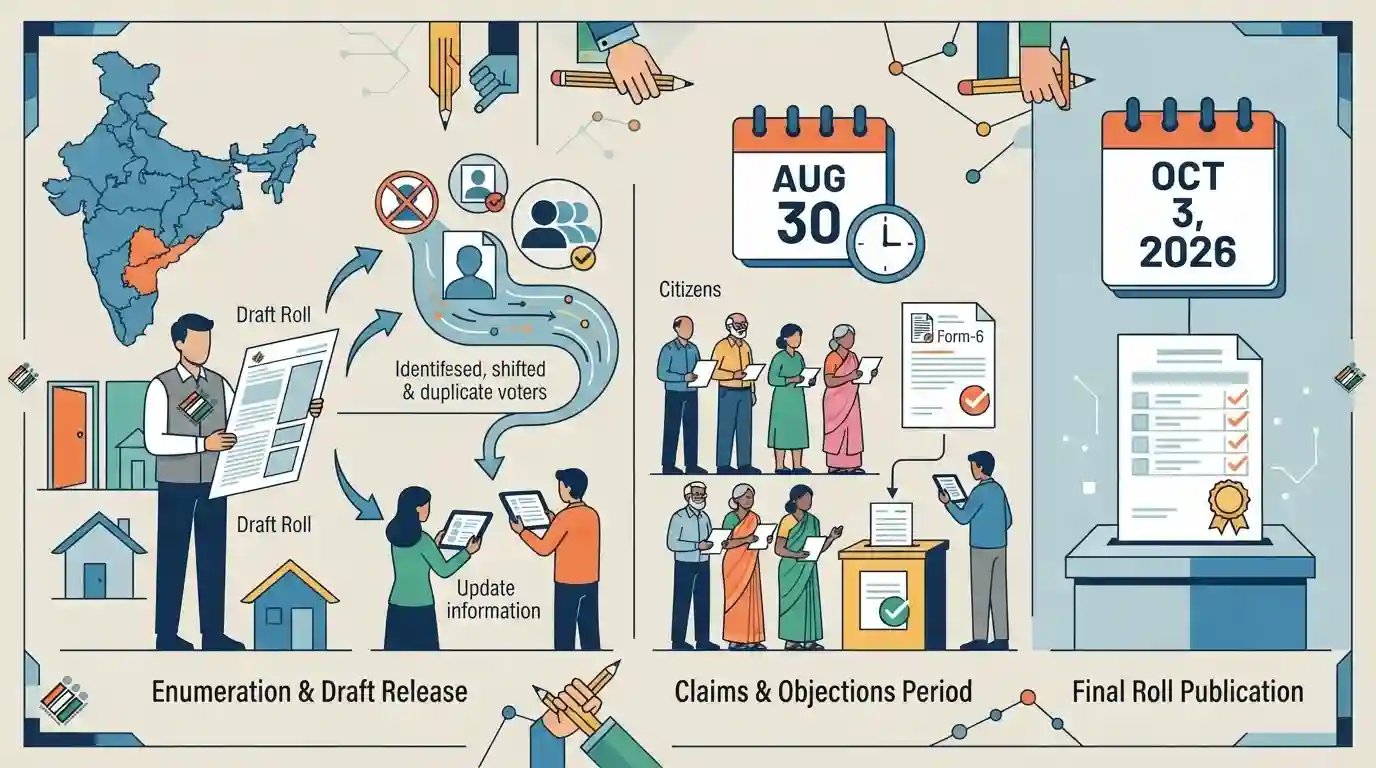
The Election Commission of India (ECI) has released the draft electoral rolls for Andhra Pradesh after concluding the enumeration phase of the Special Intensive Revision (SIR). The exercise successfully identified deceased, shifted, and duplicate voters to ensure accuracy. Eligible citizens have until August 30 to submit claims and objections using Form-6, before the final electoral roll is published on October 3, 2026.
Key Points
- The ECI has published draft electoral rolls in Andhra Pradesh following the enumeration phase of the Special Intensive Revision (SIR).
- Over 3.71 crore enumeration forms were submitted, identifying 15.22 lakh deceased voters and 22.30 lakh permanently shifted or absent electors.
- Over 7.37 lakh electors were found to be enrolled at multiple locations, which the ECI will correct to retain them at a single location.
- Citizens can use Form-6 to file claims, register, or raise objections regarding the draft electoral roll until August 30.
- The final, revised electoral roll for the state will be published on October 3, 2026.
Important Terms
Special Intensive Revision (SIR)

A comprehensive, phased exercise by the ECI involving door-to-door verification, cross-checks, and public scrutiny to clean electoral rolls of deceased, shifted, or duplicate voters and include eligible citizens.
UPSC context
Crucial for GS Paper II (Electoral Reforms, RP Act). Tests knowledge of voter registration mechanisms, democratic inclusion, and ECI functions.
Form-6
The statutory application form prescribed by the Election Commission of India for new voters seeking inclusion in the electoral roll.
UPSC context
Relevant to GS Paper II (Electoral Processes). Tests awareness of the specific procedural tools for executing the Representation of the People Act.
Election Commission of India (ECI)
The constitutional authority established under Article 324 responsible for administering and overseeing all electoral processes in India, including roll preparation.
UPSC context
Core GS Paper II topic (Constitutional Bodies). Regularly tested in Prelims and Mains on its mandate, independence, and role in ensuring free elections.
Booth Level Officers (BLOs)
Grassroots-level officials (often teachers or local workers) appointed by the ECI to maintain and update the electoral roll at the specific polling booth level.
UPSC context
Important for GS Paper II (Governance/Elections). Highlights the decentralised administrative machinery ensuring accurate voter registration under the RP Act.
Electoral Registration Officers (EROs)
Statutory officers responsible for compiling and maintaining accurate electoral rolls for their designated constituencies under the supervision of the ECI.
UPSC context
Links to GS Paper II (Electoral Processes). Demonstrates the formal hierarchy of election administration outlined in the Representation of the People Act.
Prelims Trap
"The preparation, revision, and maintenance of electoral rolls are governed by the Representation of the People Act, 1951."
RPA 1950 deals specifically with the preparation of electoral rolls, delimitation, and voter qualifications. RPA 1951 governs the actual conduct of elections and candidate disqualifications.
Static Concepts Connected
What are the core differences between RPA 1950 and RPA 1951?
- RPA 1950: Governs the allocation of seats, delimitation of constituencies, voter qualifications, and the preparation of electoral rolls.
- RPA 1951: Regulates the actual conduct of elections, qualifications and disqualifications for MPs/MLAs, corrupt practices, and electoral offences.
What is the legal nature of the Right to Vote in India?
- Statutory Right: The Supreme Court classifies voting as a statutory right derived from Section 62 of the RPA 1951, rather than a Fundamental Right under Part III.
- Constitutional Basis: While Article 326 mandates elections on the basis of universal adult suffrage, the specific right to vote and its conditions are dictated by parliamentary statutes.
Cross-Topic Patterns
Deduplication & Aadhaar linkage
The ECI's intensive drive to remove duplicate voters connects to the Election Laws (Amendment) Act, 2021, which authorized the voluntary linking of Aadhaar to electoral rolls for deduplication purposes.
One Nation, One Election linkage
Harmonizing electoral rolls is a prerequisite for simultaneous elections. Currently, states have separate rolls for local body elections, complicating the administrative feasibility of the 'One Nation, One Election' proposal.

Expect a 2026 prelims question contrasting RPA 1950 (electoral rolls) with RPA 1951 (conduct) alongside Aadhaar-voter ID linkage rules.
Linked PYQs · 2
Linked PYQs · 2
- 2024APPSC_PRELIMSGS1
Consider the following statements with reference to the Election Commission of India : I. The Constitution of India has debarred the retiring Election Commissioners from any further appointment by the government. II. In 'Anoop Baranwal Case' (2023), the Supreme Court has directed the Government to treat the Regional Commissioners on par with the Election Commissioners (other than the Chief Election Commissioner), as far as removal from office is concerned. III. Since its inception, the Election Commission had functioned as a multi-member body. IV. The power of superintendence, direction and control of elections to the office of Vice-President of India is vested in the Election Commission. Which of the above statement/statements is/are valid ?
- 2023APPSC_PRELIMSGS1
The powers of the Election Commission include which of the following? I. The Election Commission takes decisions on every aspect of conduct and control of elections from the announcement of elections to the declaration of results. II. During the election period, the Election Commission can order the Government to dismiss some government officials. III. When on election duty, Government officers work under the control of the Election Commission. Choose the correct answer using the codes given below:
