Andhra Pradesh signs urban development MoU with UN Habitat
Source:The Hindu ↗
Why It Matters
This article is highly relevant for APPSC exams due to its focus on key AP state government initiatives (SURGE AP, RISE AP, UPLIFT AP), urban planning for the capital Amaravati, and international collaborations (UN-Habitat). It ties directly to governance, public policy, and sustainable development.
Summary
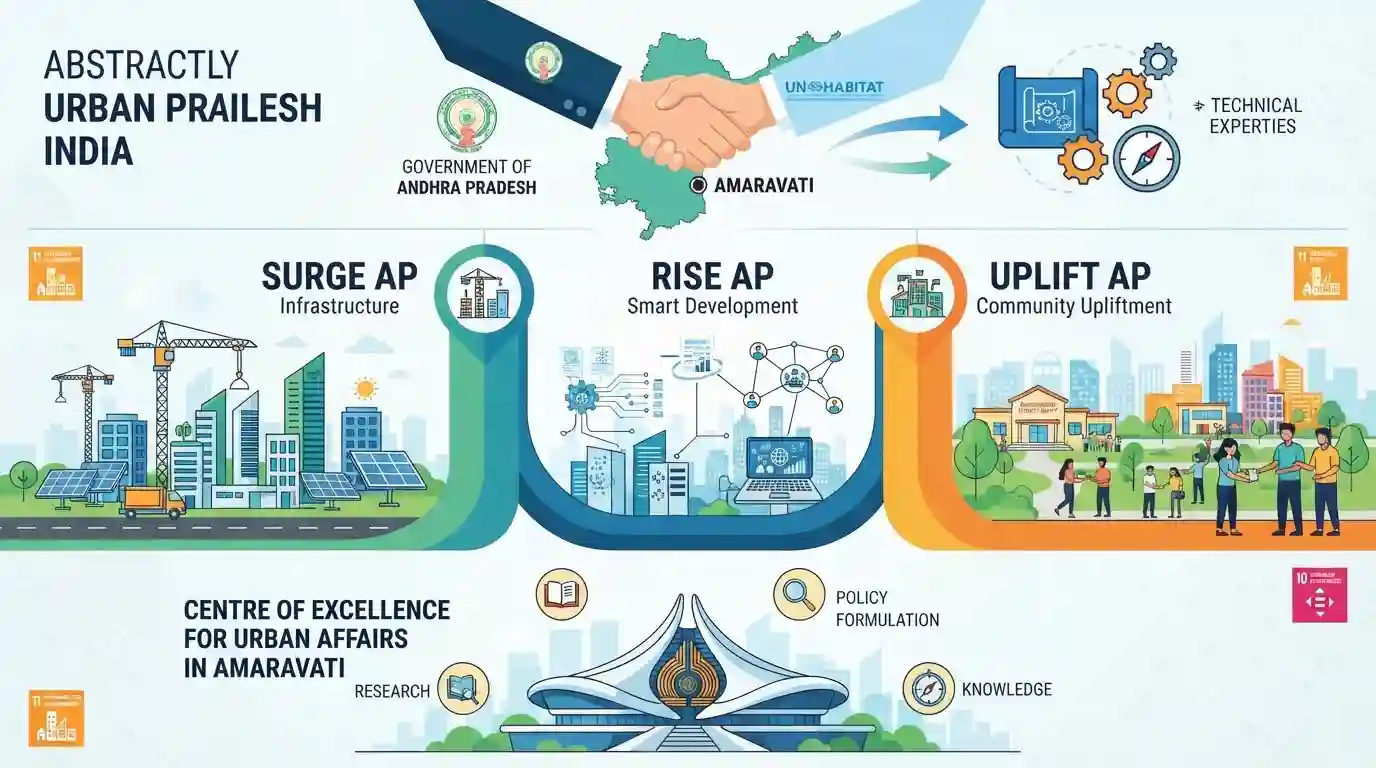
The Government of Andhra Pradesh has partnered with UN-Habitat to advance inclusive, sustainable, and smart urban development across the State, including the capital, Amaravati. Under the MoU, UN-Habitat will provide technical expertise to enhance spatial planning and urban governance. The State also unveiled three major urban initiatives—SURGE AP, RISE AP, and UPLIFT AP—to upgrade municipal infrastructure and alleviate urban poverty. A Centre of Excellence for Urban Affairs will be established in Amaravati to formulate forward-looking urban policies.
Key Points
- The Andhra Pradesh government signed a Memorandum of Understanding (MoU) with UN-Habitat to promote inclusive and sustainable urban development.
- The state plans to establish a Centre of Excellence for Urban Affairs in Amaravati with international support.
- The AP government introduced three key initiatives: SURGE AP (focusing on fast-tracking basic urban infrastructure), RISE AP (addressing integrated urban ecosystems), and UPLIFT AP (targeting urban poverty eradication).
- The MoU focuses on leveraging UN-Habitat’s global expertise for technical capacity building, spatial planning, and improving urban governance in AP.
Important Terms
UN-Habitat

The United Nations Human Settlements Programme, established in 1978 to promote socially and environmentally sustainable human settlements, focusing on sustainable urbanization, adequate shelter, and resilient cities.
UPSC context
GS Paper II/III: International organizations & urbanization. Tests understanding of global frameworks in municipal planning.
SURGE AP
An urban development initiative launched by Andhra Pradesh to upgrade municipal infrastructure, enhance public utility service delivery, and build sustainable urban ecosystems.
UPSC context
GS Paper II/III: State policies & infrastructure. Tests local strategies for regional urban development and modernization.
RISE AP
A state-level strategic initiative in Andhra Pradesh aimed at fostering regional economic growth, strengthening municipal governance, and improving sustainable livelihood opportunities.
UPSC context
GS Paper II/III: Governance & economic development. Tests frameworks for decentralized municipal growth and urban employment.
UPLIFT AP
An Andhra Pradesh welfare and development initiative focused on urban poverty alleviation, targetting enhanced living standards and livelihood security for marginalized urban populations.
UPSC context
GS Paper II: Welfare schemes for vulnerable sections. Tests state policies targeting poverty eradication and social inclusion.
Centre of Excellence for Urban Affairs
A research and policy formulation body in Amaravati, established under the AP-UN-Habitat partnership to develop advanced urban policies, digital governance, and sustainable planning models.
UPSC context
GS Paper II/III: Institutional governance & urban planning. Tests administrative capacity building and scientific policy-making.
Sustainable Development Goals (SDGs)
A framework of 17 global goals adopted by the UN in 2015 to end poverty, protect the environment, and ensure prosperity, prominently featuring Goal 11 (Sustainable Cities and Communities).
UPSC context
GS Paper III: Sustainable development. Tests integration of international environmental and developmental standards into state policies.
Prelims Trap
UN-Habitat is restricted to signing technical bilateral agreements with national sovereign governments.
UN-Habitat actively collaborates with sub-national states, provincial governments, municipal authorities, and civil society to implement localized urban solutions and capacity-building.
Static Concepts Connected
What is UN-Habitat and its core global mandate?
- Establishment & HQ: Established in 1978 and headquartered in Nairobi, Kenya, as the lead agency for sustainable human settlements.
- Governing body: Governed by the UN-Habitat Assembly (which replaced the Governing Council), meeting every four years to set policy.
- Guiding Agenda: Coordinates the implementation of the New Urban Agenda adopted at Habitat III (Quito, 2016) alongside SDG 11.
How does the 74th Amendment mandate urban planning in India?
- Constitutional Status: Introduced Part IXA and the 12th Schedule, listing 18 functional items including urban planning and slum improvement.
- Planning Committees: Mandates Metropolitan Planning Committees (Art 243ZE) to prepare draft development plans for metropolitan areas.
- Financial Devolution: State Finance Commissions (Art 243Y) recommend financial devolution to empower municipalities for infrastructure.
Cross-Topic Patterns
Paradiplomacy in sustainable development
States directly partnering with UN bodies demonstrates sub-national diplomacy (paradiplomacy), bypassing federal-only channels to accelerate localized implementation of SDG 11.
Climate resilient spatial planning
Technical spatial planning by international bodies integrates with India's disaster management framework to mitigate localized risks like urban flooding and Urban Heat Islands.

Prelims 2026 may test UN-Habitat's institutional mandate, its Nairobi HQ, and its linkage with the 2016 New Urban Agenda.
Linked PYQs · 3
Linked PYQs · 3
- 2019APPSC_PRELIMSGS1
"Sustainable Development is the development that meets the needs of the present without compromising on the ability of future generations to meet their own needs." Who has given this definition ?
- 2024APPSC_PRELIMSGS1
Which of the following statement/statements is/are valid in connection with Sustainable Development Goals (SDGs) ? I. Achieving Goal 10 will require an entire reform of the financial system that promotes equitable pay and decent work for young people. II. NITI Aayog has developed the National Indicator Framework (NIF) for facilitating monitoring of SDGs in India. III. 'Mission LiFE' aims to influence government and industrial policy to support both sustainable consumption and production. IV. The concept of global citizenship embedded in Sustainable Development Goal 4 (SDG 4) is a reference term that indicates flexible citizenship rights across countries, for the purpose of facilitating better labour markets. Select the correct answer using the codes given below :
- 2023APPSC_PRELIMSGS1
The following App developed by Government of Andhra Pradesh is an SOS service for women in distress or danger.
