Aadhaar enabled student welfare reforms showcased at Delhi event
Source:elets-online ↗
ఇది ఎందుకు ముఖ్యం
The integration of biometric identity systems (like Aadhaar) with public welfare delivery systems is a critical aspect of e-governance. It highlights the state's transition towards transparent public service delivery, reduction of fiscal leakages, and data-driven policymaking—themes highly relevant to APPSC GS Papers.
సారాంశం
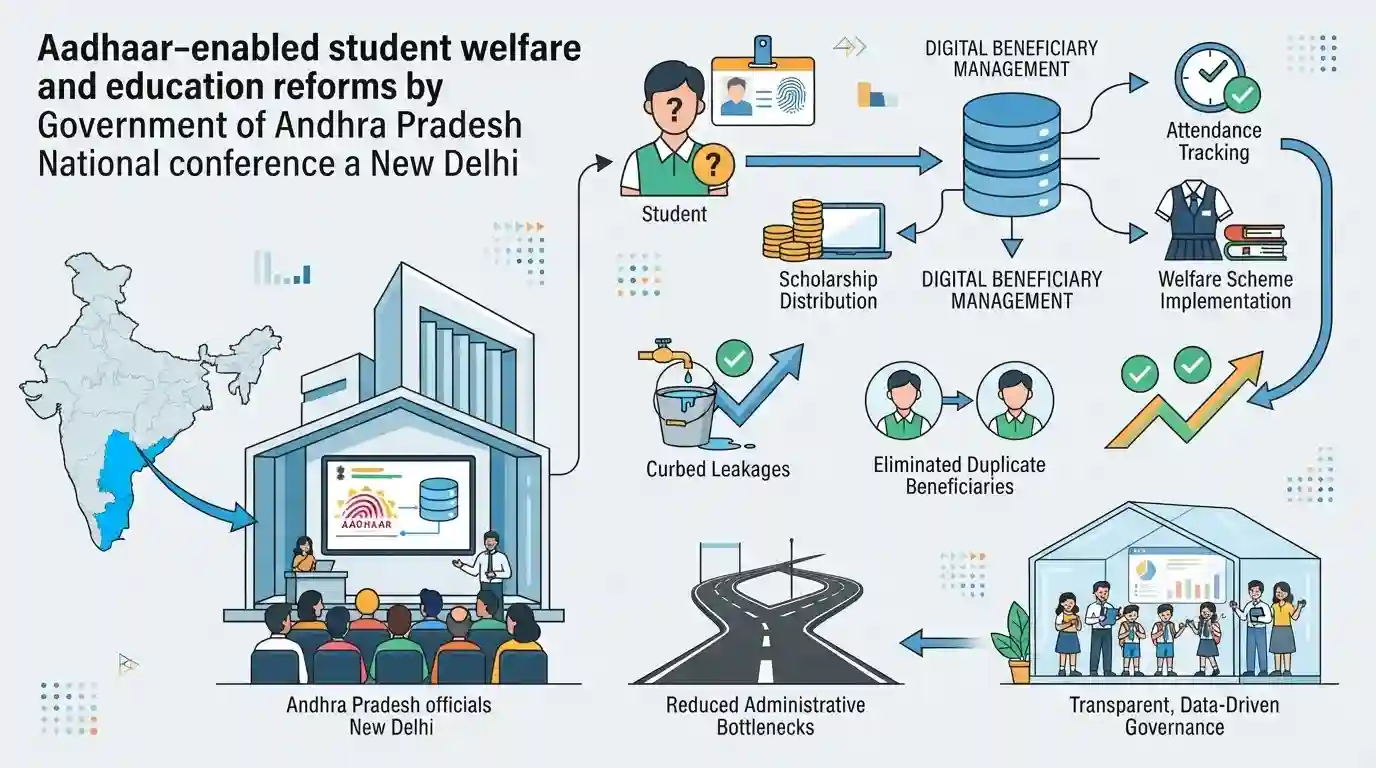
At a national conference in New Delhi, the Government of Andhra Pradesh highlighted its Aadhaar-enabled student welfare and education reforms. By integrating Aadhaar-based biometric authentication and digital databases, the state has streamlined critical processes including scholarship distribution, attendance tracking, and student welfare scheme implementation. These technological interventions are designed to curb leakages, eliminate duplicate beneficiaries, and reduce administrative bottlenecks, establishing a model for transparent, data-driven governance in the education sector.
ముఖ్య అంశాలు
- The Government of Andhra Pradesh presented its Aadhaar-enabled student welfare initiatives at a national conference in New Delhi.
- The showcased reforms leverage Aadhaar authentication and integrated digital platforms to streamline scholarship distribution, monitor student attendance, and execute beneficiary verification.
- The digital transition aims to eliminate duplication (ghost beneficiaries), minimize administrative delays, and ensure direct delivery of welfare benefits to eligible students.
- These reforms are part of Andhra Pradesh's broader digital governance agenda to foster public accountability, data-driven decision-making, and improved learning outcomes in the education sector.
ముఖ్యమైన పదాలు
One Student-One Aadhaar

An Andhra Pradesh initiative establishing an integrated digital database linked to Aadhaar to streamline student welfare schemes, prevent beneficiary duplication, and ensure end-to-end transparent service delivery.
UPSC context
GS Paper II (e-Governance/Welfare Schemes), testing digital solutions for transparent public service delivery in social sectors.
Digital Public Infrastructure (DPI)
Shared digital systems—such as Aadhaar, UPI, and data exchange platforms—that enable nations to deliver essential public services, foster innovation, and promote inclusion.
UPSC context
GS Paper III (Science and Technology/IT), testing understanding of digital networks as pillars for inclusive national growth.
Direct Benefit Transfer (DBT)
A mechanism to transfer government subsidies and welfare benefits directly into the bank accounts of beneficiaries, reducing leakages, intermediaries, and administrative costs.
UPSC context
GS Paper II/III (Government Policies/Economy), testing mechanisms for efficient welfare delivery and fiscal management.
Samagra Shiksha
An overarching Centrally Sponsored Scheme for school education from pre-school to Class 12, aiming to ensure inclusive, equitable quality education and improve learning outcomes.
UPSC context
GS Paper II (Issues relating to Education/Welfare), testing core school education reforms and federal-state implementation schemes.
e-Governance
The application of Information and Communication Technology (ICT) to deliver government services, exchange information, and integrate various stand-alone systems for efficient public administration.
UPSC context
GS Paper II (e-Governance applications), testing administrative efficiency, transparency, and technology integration in public service delivery.
ప్రిలిమ్స్ ఉచ్చు
Aadhaar authentication is constitutionally mandatory for all school enrollments and board exam applications across Indian states.
The Supreme Court's 2018 Puttaswamy verdict declared Aadhaar mandatory for welfare benefits funded by government coffers, but unconstitutional for school admissions and national board exams.
అనుసంధానమైన స్థిర భావనలు
What is the legal scope of Aadhaar under Section 7 of the Aadhaar Act?
- Consolidated Fund mandate: Allows central and state governments to make Aadhaar mandatory for accessing subsidies, benefits, or services funded by the Consolidated Fund.
- Mitigating exclusion: Aspirants must be provided viable alternative identification means if biometric authentication fails to prevent denial of essential services.
What is APAAR (One Nation, One Student ID) under the NEP 2020?
- Registry purpose: A lifelong, 12-digit digital identity created by the Ministry of Education to track students' academic achievements, transfers, and co-curricular milestones.
- DigiLocker linkage: Interoperates directly with DigiLocker to store and verify academic certificates, transfer certificates, and digital credits.
అంతర-అంశ నమూనాలు
DPI + Right to Education
Aligns digital identity tracking with Article 21A, ensuring state-level biometric requirements do not inadvertently disenfranchise students from their fundamental right to education.
Federalism + EdTech Integration
Examines how state-specific digital registries (like Jnanabhumi) integrate with national platforms like APAAR, creating a unified federal database for tracking student demographics and outcomes.

2026 Prelims may test Aadhaar limits: mandatory for DBT welfare benefits (Section 7) vs. illegal for general school/exam admissions.
అనుసంధాన PYQలు · 2
అనుసంధాన PYQలు · 2
- 2024APPSC_PRELIMSGS1
Consider the following Assertion (A) and Reason (R) and choose the correct code: Assertion (A): 'India Stack' has enabled an online, paperless and cashless digital access to various public and private services. This has reduced the cost of conducting e-KYC. Reason (R): India Stack consists of two interconnected layers, and of these, the 'Payment Layer' has reduced the cost of conducting e-KYC. Code:
- 2023APPSC_PRELIMSGS1
One of the following welfare programmes implemented by Government of Andhra Pradesh is not part of Navaratnalu.
