Andhra Pradesh Smart Streetlight Network and Urban E-Governance
Source:elets-online ↗
ఇది ఎందుకు ముఖ్యం
This highlights a practical convergence of urban governance, energy conservation, and digital technology (AI/GIS). APPSC frequently tests knowledge of state-specific e-governance initiatives and schemes targeted at reforming Urban Local Bodies (ULBs).
సారాంశం
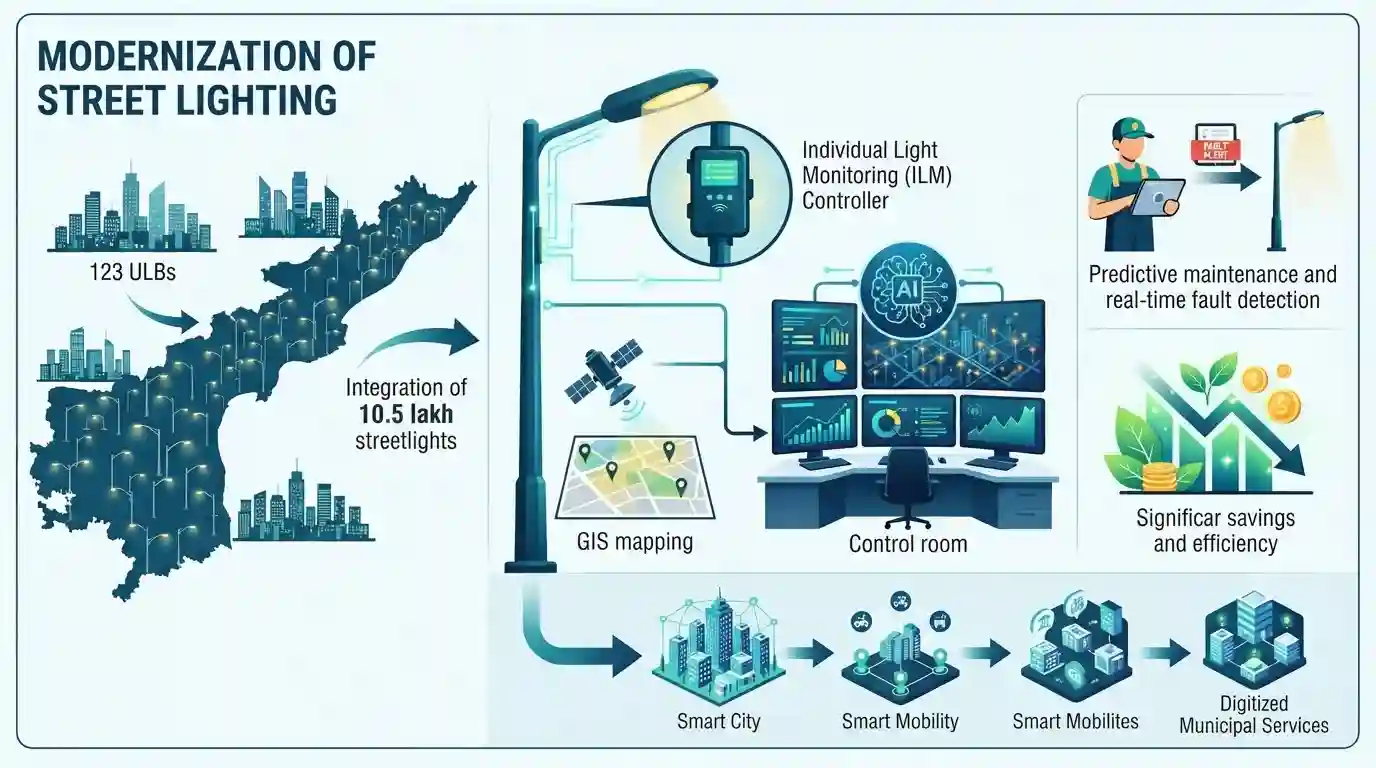
Andhra Pradesh has initiated a major urban infrastructure and energy efficiency project to integrate 10.5 lakh streetlights across 123 Urban Local Bodies (ULBs) into an AI-enabled centralized monitoring system. Implemented by Energy Efficiency Services Limited (EESL) alongside the state's Municipal Administration Department, the project leverages Individual Light Monitoring (ILM) controllers and GIS mapping. It builds on the Street Lighting National Programme (SLNP) to offer real-time fault detection, predictive maintenance, and significant energy savings, representing a significant stride in state-level e-governance and smart city management.
ముఖ్య అంశాలు
- Andhra Pradesh is upgrading 10.5 lakh streetlights across 123 Urban Local Bodies (ULBs) into a centrally connected smart network.
- The initiative is being implemented through a tripartite arrangement involving the State Government, Urban Local Bodies (ULBs), and Energy Efficiency Services Limited (EESL).
- The system utilizes Individual Light Monitoring (ILM) controllers combined with Artificial Intelligence (AI) to enable real-time tracking, remote operations, and GIS-based asset mapping.
- Key benefits include automated fault detection, predictive maintenance, reduced energy waste, and transparent tracking of operations via centralized dashboards.
- The initiative directly builds upon and enhances the impact of the central government's Street Lighting National Programme (SLNP).
ముఖ్యమైన పదాలు
Street Lighting National Programme (SLNP)

Launched in 2015, SLNP is a central initiative to replace conventional streetlights with energy-efficient LEDs nationwide. It reduces energy consumption, curbs greenhouse gas emissions, and lowers municipal operational costs without upfront capital investment.
UPSC context
Important for GS-3 (Energy/Infrastructure). Highlights India's commitment to climate change mitigation and energy efficiency in public services.
Energy Efficiency Services Limited (EESL)
A joint venture of four power-sector PSUs under the Ministry of Power. EESL acts as an Energy Service Company (ESCO) to drive large-scale, market-driven energy efficiency projects like UJALA and SLNP globally.
UPSC context
Relevant for GS-3 (Energy) and GS-2 (Statutory/Executive Bodies). Tests knowledge of agencies executing India’s climate action and energy transition programs.
Urban Local Bodies (ULBs)
Democratically elected local self-government institutions for urban areas, institutionalized by the 74th Constitutional Amendment Act. They handle civic administration, infrastructure planning, and essential services like water supply and public lighting.
UPSC context
Core topic in GS-2 (Polity & Governance). Regularly tested regarding decentralization, the 74th Amendment Act, and urban governance challenges.
Individual Light Monitoring (ILM) controller
A smart IoT hardware device integrated into LED streetlights. It enables remote operations, real-time energy measurement, automated fault detection, and predictive maintenance via a centralized, AI-enabled control system.
UPSC context
Relevant for GS-3 (Science & Tech, E-Governance). Demonstrates the application of IoT, AI, and smart technologies in public utility management.
ప్రిలిమ్స్ ఉచ్చు
"EESL is a statutory body under the Ministry of New and Renewable Energy (MNRE)."
EESL is not a statutory body; it is a Joint Venture of four central PSUs (NTPC, PFC, REC, POWERGRID) under the Ministry of Power.
అనుసంధానమైన స్థిర భావనలు
What are the core functional responsibilities of ULBs under the 12th Schedule?
- Constitutional Basis: Added by the 74th Amendment Act (1992), it contains 18 functional items devolved to municipalities.
- Public Amenities: Explicitly includes the provision of street lighting, parking lots, bus stops, and public conveniences (Item 17).
- Other Key Areas: Covers urban planning, regulation of land use, public health, sanitation, solid waste management, and urban poverty alleviation.
How does the ESCO (Energy Service Company) financial model work?
- Zero Upfront Cost: The ESCO (like EESL) finances and implements the energy efficiency project without requiring initial capital investment from the client (e.g., municipalities).
- Pay-As-You-Save: Clients repay the ESCO over a contracted period using a portion of the guaranteed financial savings generated by the reduced energy bills.
అంతర-అంశ నమూనాలు
IoT and Urban Local Bodies
Integrating AI and GIS into street lighting showcases the shift towards predictive maintenance in public utilities, a core technological pillar of the Smart Cities Mission.
Fiscal Health of State Discoms
Energy savings in ULBs directly reduce municipal electricity bills, helping clear pending government dues to financially stressed power distribution companies (Discoms).

Expect a multi-statement Prelims question mixing EESL's unique PSU-JV structure (under MoPower, not MNRE) with the 12th Schedule.
అనుసంధాన PYQలు · 1
అనుసంధాన PYQలు · 1
- 2019APPSC_PRELIMSGS1
What is the name of the project launched with the objective of computerization of Urban, Local bodies ?
