Andhra Pradesh Secures Capital Investment Loans Under SASCI
Source:ommcomnews ↗
Why It Matters
The financial allocations under SASCI and the resolution of the 2014-15 bifurcation revenue deficit are crucial components of Andhra Pradesh's economic governance and Centre-State relations, highly relevant for APPSC questions on state finances and the AP Reorganisation Act.
Summary
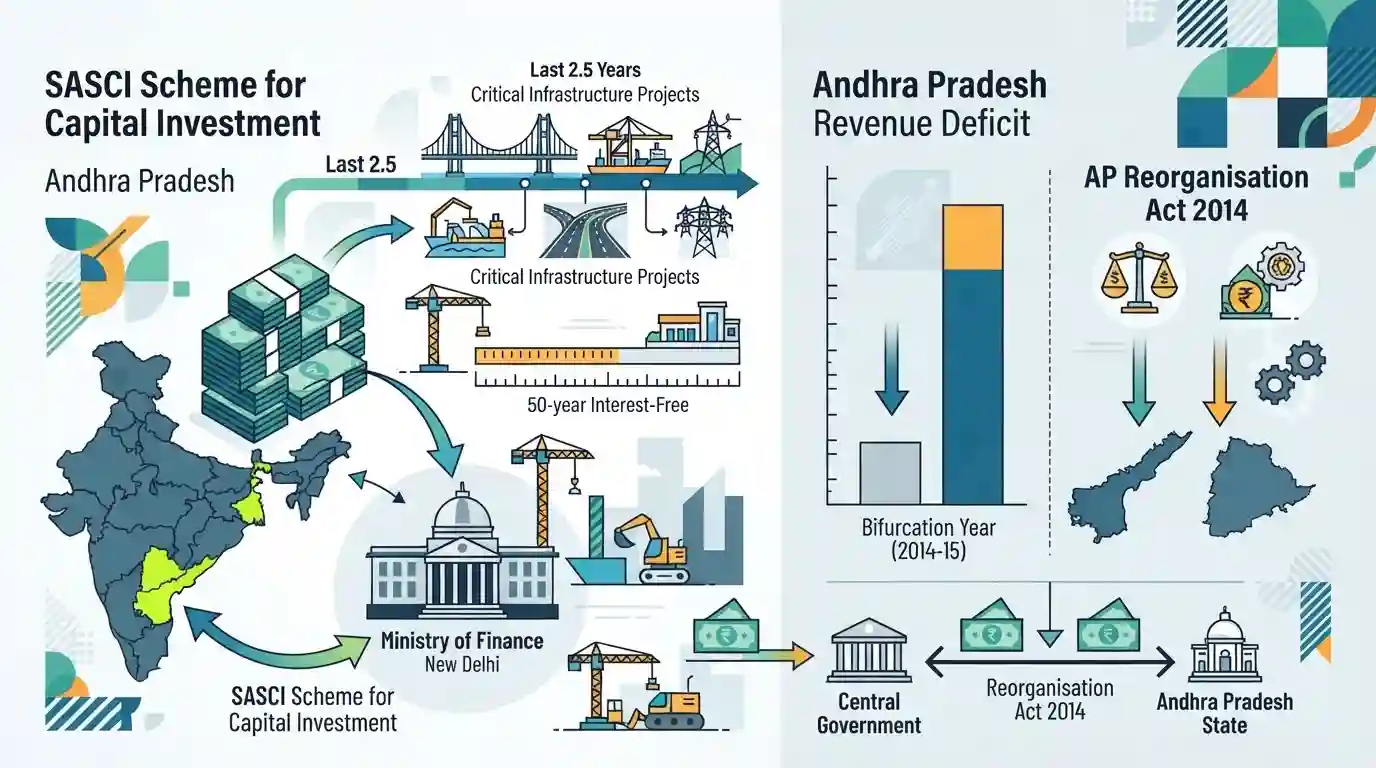
The Union Ministry of Finance reported in the Lok Sabha that Andhra Pradesh secured Rs 19,619 crore under the Special Assistance to States for Capital Investment (SASCI) scheme over the last two-and-a-half years. This scheme, offering 50-year interest-free loans, enables states to undertake critical infrastructure projects. Furthermore, it was confirmed that the revenue deficit for Andhra Pradesh during the bifurcation year (2014-15) was officially assessed at Rs 16,078.76 crore, highlighting ongoing financial resolutions under the AP Reorganisation Act.
Key Points
- Andhra Pradesh received Rs 19,619 crore under the Special Assistance to States for Capital Investment (SASCI) scheme during 2024-2026.
- The SASCI scheme provides 50-year interest-free capital loans to state governments to boost capital expenditure and infrastructure development.
- The total amount received by AP under SASCI since 2020-21 stands at Rs 31,005.47 crore.
- The Union Finance Minister confirmed in the Lok Sabha that the audited revenue deficit for Andhra Pradesh for the bifurcation year of 2014-15 was assessed at Rs 16,078.76 crore by the respective Accountants General of AP and Telangana.
Important Terms
Special Assistance to States for Capital Investment (SASCI) Scheme

A Central Government scheme offering 50-year interest-free loans to state governments to boost capital expenditure, infrastructure development, and overall economic growth.
UPSC context
GS Paper III (Indian Economy); tests knowledge of centre-state financial relations, capital budgeting, and fiscal federalism.
Andhra Pradesh Reorganisation Act, 2014
An Act of Indian Parliament that bifurcated the state of Andhra Pradesh into Telangana and the residual state of Andhra Pradesh, specifying asset division and financial support.
UPSC context
GS Paper II (Federalism & State Reorganisation); tests understanding of constitutional provisions (Article 3) and administrative restructuring.
Capital Expenditure (CapEx)
Funds spent by the government to acquire, build, or upgrade long-term physical assets like infrastructure, which enhance the economy's productive capacity.
UPSC context
GS Paper III (Government Budgeting); tests core fiscal concepts and their macroeconomic impacts.
Revenue Deficit
A fiscal scenario where the government's revenue expenditure exceeds its revenue receipts, indicating that current earnings cannot cover day-to-day operational expenses.
UPSC context
GS Paper III (Government Budgeting); tests understanding of fiscal health, budget deficits, and FRBM Act targets.
Accountant General (Accounts and Entitlement)
An office under the Comptroller and Auditor General (CAG) of India responsible for maintaining state government accounts, compiling civil accounts, and managing pension/GPF entitlements.
UPSC context
GS Paper II (Constitutional Bodies - CAG); tests institutional mechanisms of public financial management and state audit structures.
Prelims Trap
Disbursements under the SASCI scheme are counted within the state's annual Net Borrowing Ceiling under Article 293.
SASCI disbursements are strictly 'over and above' the Net Borrowing Ceiling to avoid squeezing the states' standard annual borrowing space.
Static Concepts Connected
What are the constitutional provisions governing state borrowing under Article 293?
- Territorial limit: State borrowing is restricted to domestic markets and secured against the Consolidated Fund of the State.
- Central consent: A state cannot raise any loan without Central consent if any part of a previous Union loan remains outstanding.
- Union guarantees: The Union government can make loans to states or guarantee state-raised loans within Parliamentary limits.
How is the Net Borrowing Ceiling (NBC) of states regulated?
- FRBM alignment: The NBC is fixed annually by the Union Finance Ministry based on fiscal deficit targets recommended by the Finance Commission.
- GSDP linkage: The ceiling is pegged to a specific percentage of the Gross State Domestic Product (GSDP).
- Off-budget inclusion: Off-budget borrowings by state entities backed by state guarantees are factored into the NBC to prevent fiscal masking.
Cross-Topic Patterns
Cooperative Federalism vs Fiscal Centralisation
Schemes like SASCI bypass normal Article 293 limits but tie funds to central reform priorities, shifting state expenditure toward Union-aligned infrastructure targets.
Bifurcation Economics & Regional Development
AP Reorganisation Act provisions show how statutory division-era liabilities persist over decades, making states structurally dependent on discretionary central special assistance.

2026 Prelims may test if SASCI loans are counted within the Article 293 Net Borrowing Ceiling or conditional on horizontal devolution.
Linked PYQs · 3
Linked PYQs · 3
- 2023APPSC_PRELIMSGS1
Part V of the Andhra Pradesh Reorganisation Act deals with
- 2019APPSC_PRELIMSGS1
According to 2014 Reorganization Act, after the bifurcation of the State how many revenue divisions are there in Andhra Pradesh ?
- 2024APPSC_PRELIMSGS1
Which of the following source/sources of revenue qualifies/qualify for being given to the Panchayats? I. The tax proceeds that are assigned to the States from the Centre may be again re-distributed to the Panchayats as recommended by the Central Finance Commission. II. Loans from the State Government. III. Under Article 243-I of the Constitution of India, the State Government is empowered to devolve its own funds to the Panchayats even in the absence of the State Finance Commission's recommendations. IV. Internal Resource Generation is facilitated only in the case of Panchayats situated in Scheduled Areas as per the Fifth Schedule. Select the correct answer using the codes given below:
