AP Reorganisation Amendment Bill 2026 provisions and federal impact
Source:understandupsc ↗
Why It Matters
Crucial for APPSC aspirants to understand statutory updates, post-bifurcation legal frameworks, and amendments to the AP Reorganisation Act, 2014 impacting inter-state dynamics between AP and Telangana.
Summary
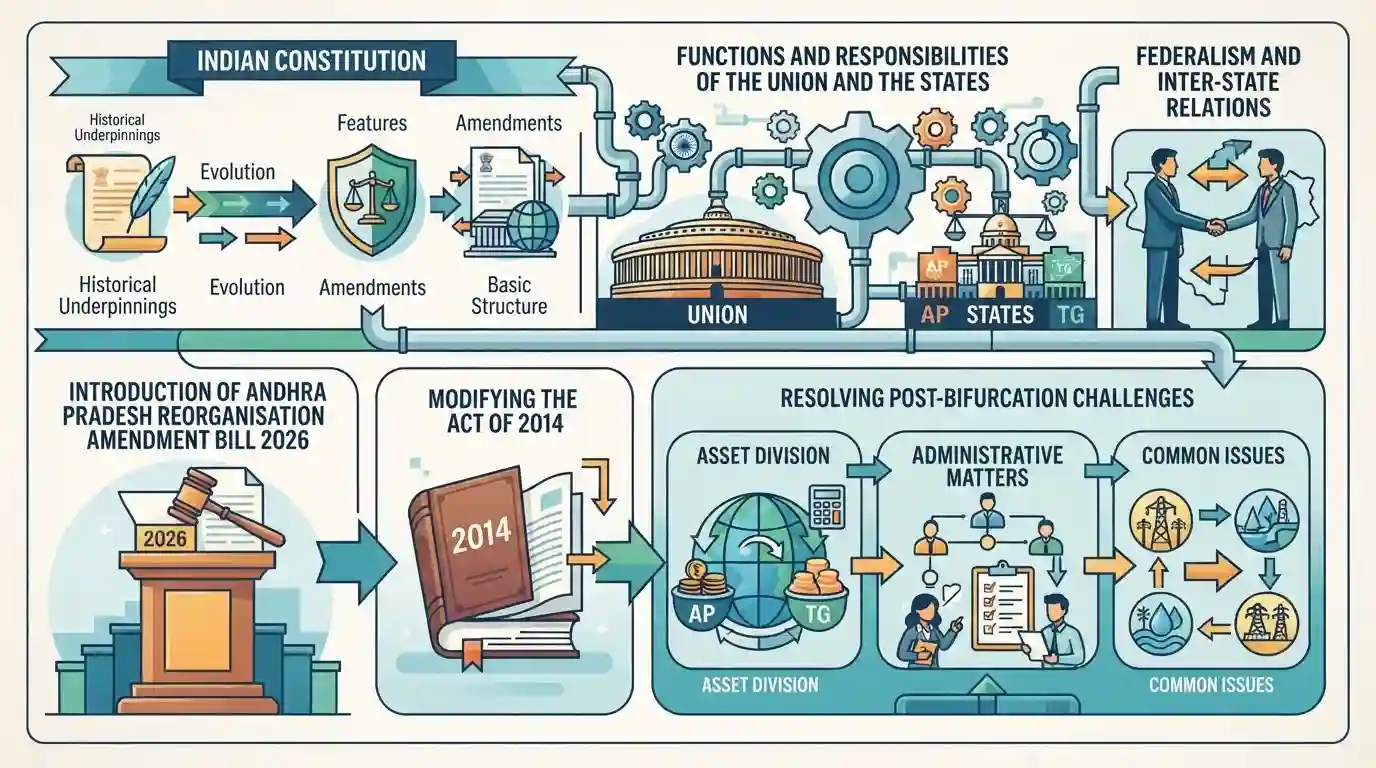
The article discusses the introduction and significance of the Andhra Pradesh Reorganisation Amendment Bill 2026, aimed at modifying the Andhra Pradesh Reorganisation Act, 2014 to resolve post-bifurcation challenges, asset division, and administrative matters between Andhra Pradesh and Telangana.
Key Points
- The Andhra Pradesh Reorganisation Amendment Bill 2026 seeks to amend specific provisions of the Andhra Pradesh Reorganisation Act, 2014.
- It addresses long-standing administrative, financial, and resource-sharing issues between the successor states of Andhra Pradesh and Telangana.
- Highlights the constitutional scope of parliamentary legislation under Articles 3 and 4 regarding state reorganization and consequential amendments.
Important Terms
Andhra Pradesh Reorganisation Amendment Bill 2026

A legislative measure introduced to amend the Andhra Pradesh Reorganisation Act, 2014, specifically providing statutory clarity to establish Amaravati as the official and permanent capital of Andhra Pradesh with retrospective effect.
UPSC context
Crucial for APPSC Group 1 & 2 (Andhra Pradesh History, Polity, and Reorganisation issues). Tests knowledge of post-bifurcation legislative changes and state capital status.
Andhra Pradesh Reorganisation Act 2014
The landmark legislation enacted by the Parliament of India in 2014 that bifurcated the state of Andhra Pradesh into Telangana and the residuary state of Andhra Pradesh, establishing initial capital arrangements and asset division frameworks.
UPSC context
Essential for APPSC Polity and AP History paper. Tests understanding of state reorganization under Article 3 of the Indian Constitution.
Parliament of India
The supreme legislative body of India comprising the President, Lok Sabha, and Rajya Sabha, empowered under Article 3 to form new states and alter areas, boundaries, or names of existing states.
UPSC context
Important for Indian Polity and Constitution (Union Legislature, Federalism). Tests powers of Parliament regarding territorial changes of states.
Union Cabinet
The executive decision-making body of the Union government, consisting of the Prime Minister and senior cabinet ministers, responsible for approving major policy initiatives and bills before parliamentary introduction.
UPSC context
Important for Indian Polity (Central Government Machinery). Tests the executive role in legislative proposals and policy formulation.
Prelims Trap
Views of the concerned state legislature obtained under Article 3 are constitutionally binding on Parliament before passing a reorganisation bill.
Aspirants often assume state legislatures can veto or legally block central bifurcation or reorganisation bills because their views are sought under Article 3. In reality, state views are purely advisory and not binding on Parliament.
Static Concepts Connected
What are the constitutional provisions governing the formation and reorganisation of States under the Indian Constitution?
- Article 3 Power: Empowers Parliament to form new states, alter areas, boundaries, or names of existing states by law (Article 3).
- Article 4 Exemption: Explicitly states that laws made under Articles 2 and 3 are not considered Constitutional Amendments under Article 368, requiring only a simple majority.
- Procedural Safeguards: Mandates prior recommendation of the President and reference to state legislatures for views (which are non-binding).
Cross-Topic Patterns
Bifurcation Laws + Article 262 Water Tribunals
State bifurcation disputes mirror inter-state water sharing disputes under Article 262, testing the balance of cooperative vs coercive federalism in India.
State Reorganisation + Recommendations of Finance Commission
Financial devolution and asset division under state reorganisation acts directly impact the fiscal federalism parameters overseen by the Finance Commission.

Article 3 vs Article 368 simple majority rule combined with AP Reorganisation Act provisions is a high-yield APPSC polity question.
Linked PYQs · 2
Linked PYQs · 2
- 2023APPSC_PRELIMSGS1
Part V of the Andhra Pradesh Reorganisation Act deals with
- 2023APPSC_PRELIMSGS1
Apex Council of Godavari and Krishna river water resources and their management consists of
