Andhra Pradesh Awaits Supreme Court Verdict On Local Body BC Quota
Source:The Hindu ↗
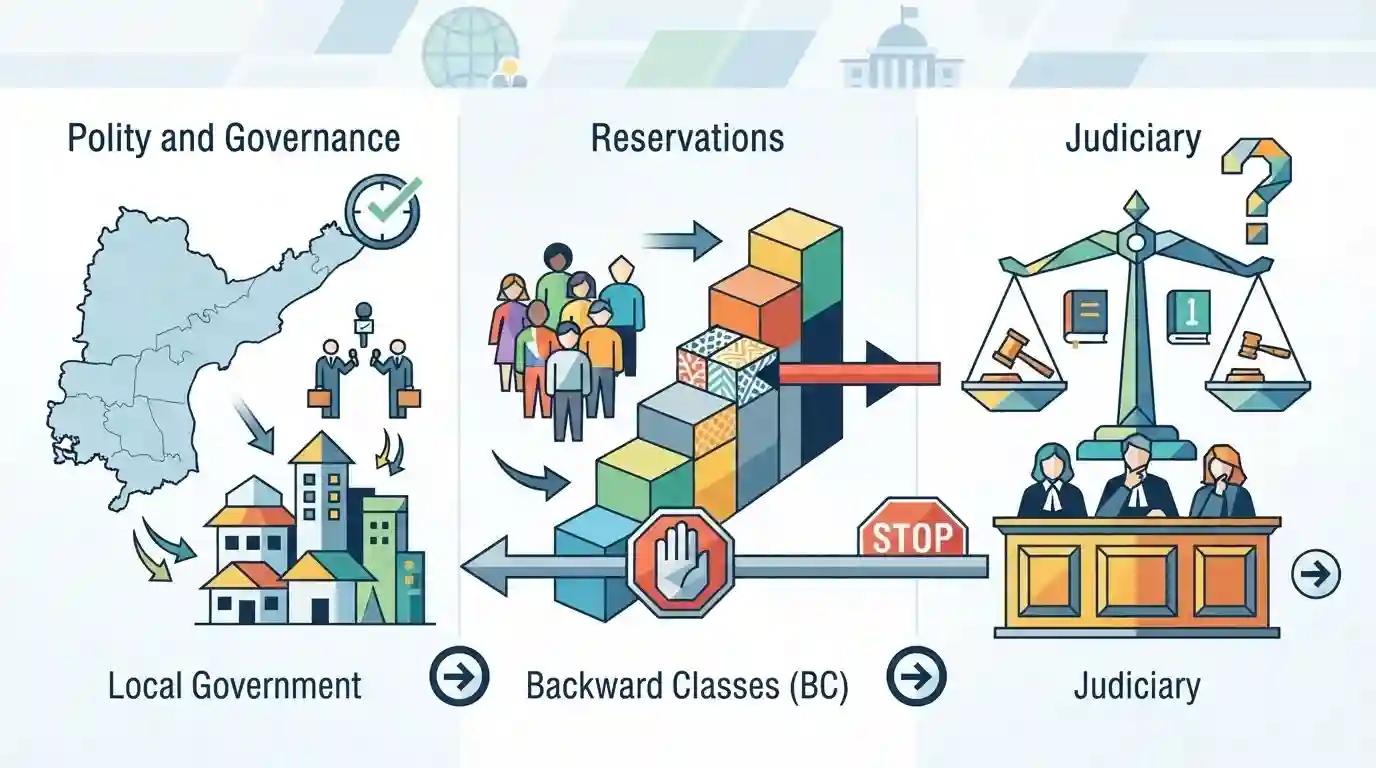
Why It Matters
Directly relevant to decentralization, local body governance, and constitutional reservations for Backward Classes in Andhra Pradesh.
Summary
The Andhra Pradesh government is fully prepared to conduct local body elections, awaiting the Supreme Court verdict on the Backward Classes (BC) quota. Municipal Administration and Urban Development Minister P. Narayana highlighted that the polls will proceed immediately following the court's clearance on reservation provisions.
Key Points
- The Andhra Pradesh government announced its readiness to conduct local body elections across the State.
- The polls are currently awaiting the final verdict of the Supreme Court of India regarding the reservation quota for Backward Classes (BC).
- Municipal Administration and Urban Development (MAUD) Minister P. Narayana confirmed that the state administrative machinery is fully prepared to execute the electoral process as soon as judicial clearance is obtained.
Important Terms
Backward Classes (BC) quota regulations

Constitutional provisions and state government orders governing reservation percentages for Backward Classes in local self-government institutions, subject to judicial scrutiny regarding the 50% reservation ceiling.
UPSC context
Important for APPSC Group 1 & 2 (Indian Polity and Governance, Social Justice), testing reservations, local bodies, and judicial reviews.
Supreme Court of India
The highest judicial forum and final court of appeal under the Constitution of India, adjudicating special leave petitions concerning local body poll reservations.
UPSC context
Crucial for APPSC Polity syllabus, testing the Supreme Court's appellate jurisdiction, judicial review, and federal dynamics.
Andhra Pradesh Government
The executive authority of Andhra Pradesh responsible for administering municipal and rural local governance, policy formulation, and conducting grassroots elections.
UPSC context
Essential for APPSC AP Governance and Administration, testing state-level executive functions, decentralization, and local body administration.
Prelims Trap
State governments have absolute discretion in scheduling local body elections regardless of pending judicial verdicts on quotas.
Aspirants often assume local body elections are entirely under state executive control, missing how Supreme Court rulings on reservation ceilings supersede state notifications.
Static Concepts Connected
What are the constitutional provisions and limits governing reservations in local bodies in India?
- Constitutional Mandate: Article 243D and Article 243T mandate reservation of seats for SCs and STs in panchayats and municipalities in proportion to their population.
- 50% Ceiling Rule: The Supreme Court has consistently held that the aggregate of reservations for SCs, STs, and BCs/OBCs in local bodies cannot exceed the 50% ceiling rule.
- Empirical Inquiry: States must establish dedicated commissions to empirically assess backwardness before fixing quotas for Backward Classes in local elections, as per the Supreme Court's K. Krishna Murthy judgment.
Cross-Topic Patterns
Local Body Polls + Judicial Review on Quotas
Andhra Pradesh's local body elections hinge on judicial interpretation of the 50% reservation ceiling, tying administrative decentralization directly to constitutional benches.

APPSC Group 1/2 mains often test the financial consequences of delayed local polls, specifically Finance Commission grant forfeitures.
Linked PYQs · 2
Linked PYQs · 2
- 2024APPSC_PRELIMSGS1
Which of the following source/sources of revenue qualifies/qualify for being given to the Panchayats? I. The tax proceeds that are assigned to the States from the Centre may be again re-distributed to the Panchayats as recommended by the Central Finance Commission. II. Loans from the State Government. III. Under Article 243-I of the Constitution of India, the State Government is empowered to devolve its own funds to the Panchayats even in the absence of the State Finance Commission's recommendations. IV. Internal Resource Generation is facilitated only in the case of Panchayats situated in Scheduled Areas as per the Fifth Schedule. Select the correct answer using the codes given below:
- 2024APPSC_PRELIMSGS1
Consider the following Assertion (A) and Reason (R) and choose the correct code : Assertion (A) : In connection with their own resource collection, the Panchayats at the village level are better placed than the Panchayats at the Intermediate and the District levels. Reason (R) : The Gram Panchayats have their own tax domain whereas the other two tiers have to depend only on tolls, fees and non-tax revenue for internal resource generation. Code :
