Andhra Pradesh PPP Urban Infrastructure Development Push
Source:The Hindu ↗
Why It Matters
It provides a practical case study for GS-3 (Infrastructure/Investment Models) and GS-2 (Local Self-Government), illustrating how states are navigating fiscal constraints by leveraging PPPs and institutional finance to meet growing urban infrastructural demands without resorting to outright privatization.
Summary
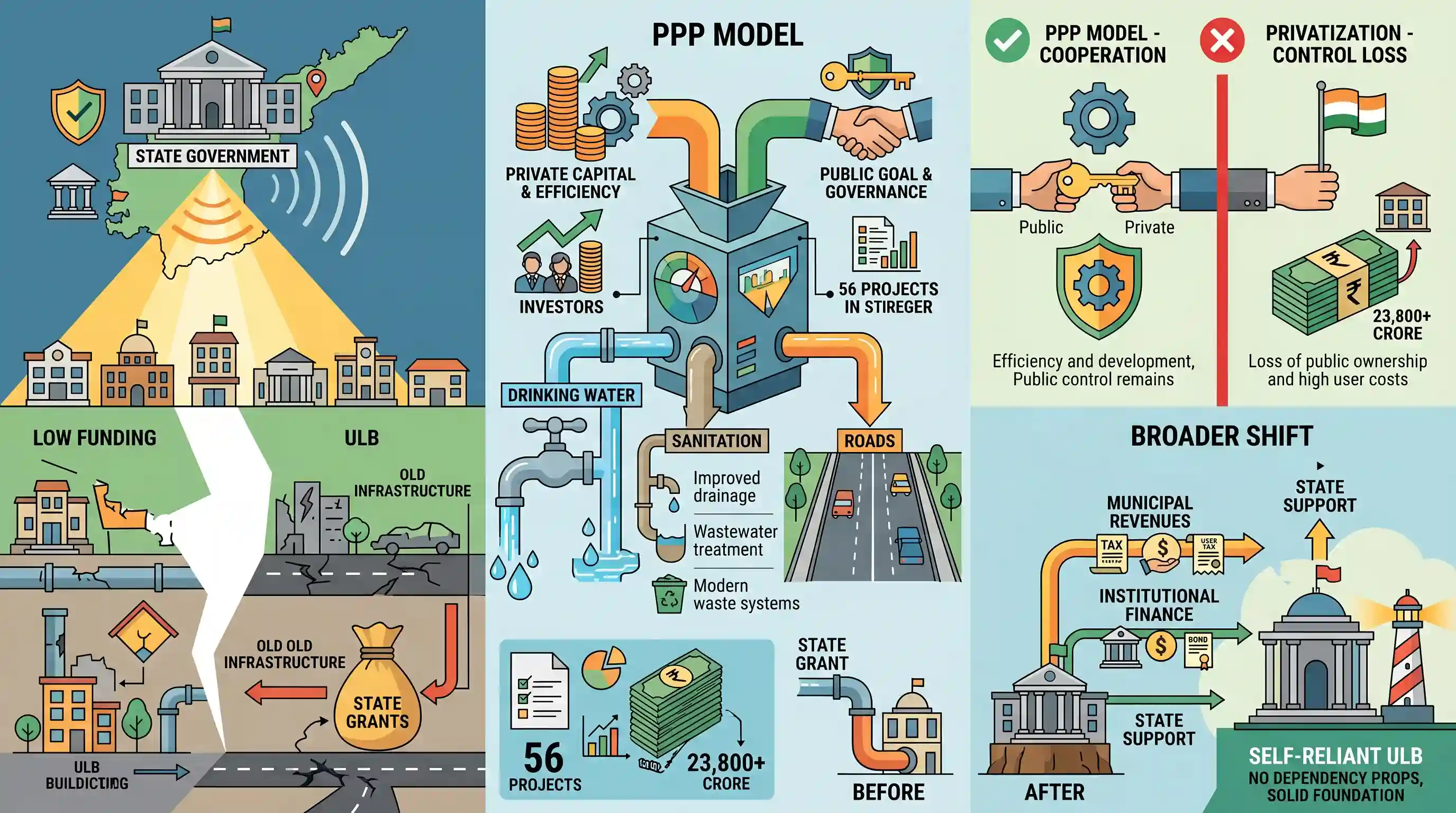
The Andhra Pradesh government is urging Urban Local Bodies (ULBs) to adopt Public-Private Partnership (PPP) models to finance and develop crucial urban infrastructure projects. Facing substantial funding requirements for amenities like drinking water, sanitation, and roads, the State aims to implement 56 PPP projects worth over ₹23,800 crore. Officials stressed that PPPs are distinct from privatization, serving instead as a vital tool to attract private capital and operational efficiency while maintaining state ownership. The move also signals a broader shift encouraging ULBs to pursue financial self-reliance through institutional finance and improved municipal revenues rather than depending solely on state budgets.
Key Points
- Andhra Pradesh is actively pushing Urban Local Bodies (ULBs) to adopt Public-Private Partnerships (PPP) to bridge massive urban infrastructure gaps.
- The State has identified a pipeline of 56 PPP projects with an estimated value of ₹23,801.21 crore, focusing on drinking water, sewerage, storm water drainage, roads, and solid waste management.
- Authorities clarified that PPP models should not be confused with privatization, emphasizing that the government retains ownership while leveraging private investment and expertise.
- ULBs are being advised to reduce reliance on the State budget and explore alternative funding mechanisms, including institutional finance, HUDCO loans, and enhanced municipal revenues, to create bankable urban projects.
Important Terms
Public-Private Partnership (PPP) model

A long-term contract between a private party and a government entity for providing a public asset or service, where the private party bears significant risk and management responsibility.
UPSC context
GS Paper III (Investment Models); essential for understanding infrastructure financing and private sector's role in public service delivery.
Urban Local Bodies (ULBs)
Local self-government institutions (Municipal Corporations, Councils, Nagar Panchayats) established to manage urban areas, empowered by state laws and the 74th Constitutional Amendment.
UPSC context
GS Paper II (Governance/Polity); tests understanding of the third tier of government and decentralized urban governance.
Housing and Urban Development Corporation (HUDCO)
A Navratna public sector enterprise that provides long-term finance and techno-financial consultancy for housing and urban infrastructure projects across India.
UPSC context
GS Paper III (Infrastructure); relevant for institutional financing of municipal projects and urban developmental schemes.
74th Constitutional Amendment Act
The 1992 legislation that granted constitutional status to ULBs, introducing Part IXA and the Twelfth Schedule (18 functional items) to the Constitution of India.
UPSC context
GS Paper II (Polity); fundamental for questions on local self-government, federalism, and democratic decentralization.
Viability Gap Funding (VGF)
A financial grant provided by the government to bridge the gap between the cost of an infrastructure project and its financial viability for private investors.
UPSC context
GS Paper III (Economy); crucial for understanding how the state incentivizes private participation in capital-intensive public works.
Prelims Trap
"Under the PPP model for infrastructure, the ultimate ownership of the public asset is transferred to the private sector."
PPPs involve sharing risks, capital, and operations through a long-term contract, but the government retains ultimate ownership. It is not an outright sale (privatization).
Static Concepts Connected
What are the primary sources of revenue for Urban Local Bodies (ULBs)?
- Own-Source Revenue: Taxes (property, profession, advertisement) and non-tax levies (user charges for water, sanitation, building permissions).
- Fiscal Transfers: Grants-in-aid and devolution of a share of state/central taxes as recommended by State and Central Finance Commissions.
- Market Borrowings: Loans from institutions (like HUDCO) or issuance of Municipal Bonds, typically requiring State government approval.
What is the Viability Gap Funding (VGF) mechanism for PPP projects?
- Core Purpose: It provides financial support to infrastructure projects that are economically justified but commercially unviable without state intervention.
- Quantum of Grant: Support is provided as a one-time capital grant during the construction phase, traditionally up to 20% of the total project cost (with state matching).
- Eligible Sectors: Used heavily in sectors with long gestation periods and capped user charges, like solid waste management, water supply, and highways.
Cross-Topic Patterns
15th FC Grants & Property Tax reforms
The 15th Finance Commission tied performance-based grants for ULBs to the notification of property tax floor rates and audited accounts, directly reinforcing this push for municipal self-reliance.
Municipal Bonds & ULB Credit Ratings
The shift from state grants to institutional finance requires ULBs to secure credit ratings and issue Municipal Bonds, a trend successfully tested by Indore, Pune, and Vadodara.

Expect a 2026 multi-statement Prelims question mixing VGF limits, PPP vs Privatization distinctions, and ULB market borrowing powers.
Linked PYQs · 4
Linked PYQs · 4
- 2022MainsGS3
Why is Public Private Partnership (PPP) required in infrastructural projects ? Examine the role of PPP model in the redevelopment of Railway Stations in India.
- 2013MainsGS3
Adoption of PPP model for infrastructure development of the country has not been free of criticism. Critically discuss pros and cons of the model.
- 2024MainsGS2
Analyse the role of local bodies in providing good governance at local level and bring out the pros and cons merging the rural local bodies with the urban local bodies.
- 2017PrelimsGS1
Local self-government can be best explained as an exercise in
