Andhra Pradesh Action Plan to Revive Sugar Industry
Source:chinimandi ↗
Why It Matters
This article connects regional agricultural challenges in Andhra Pradesh (high raw material deficits, mill closures, farmer incentive demands) with larger national debates on sustainable cropping (sugarcane vs. paddy water footprints), state support mechanisms, and energy security through sugarcane-to-ethanol pathways.
Summary
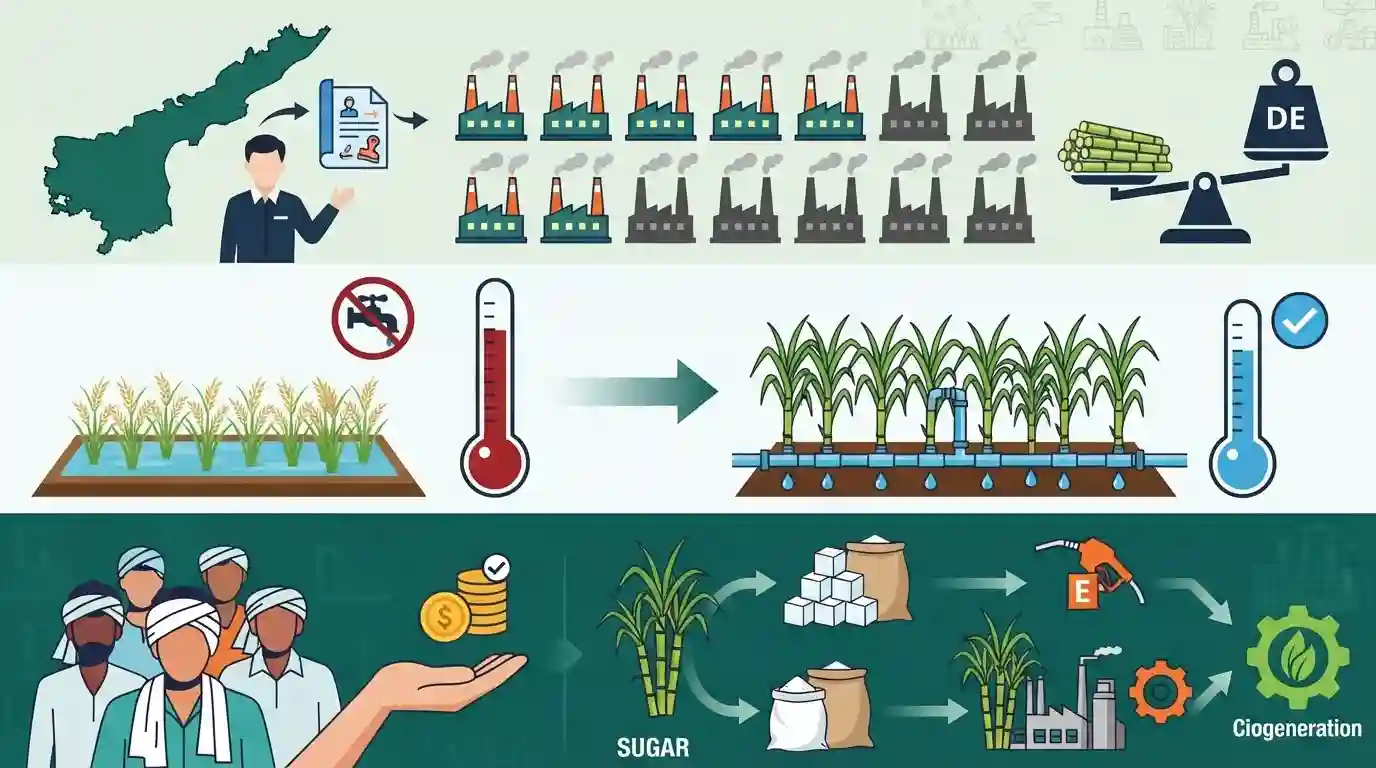
Andhra Pradesh Chief Secretary Sanjay Jaju has tasked officials with drafting a comprehensive action plan under G.O. No. 86 to revive the state's sugar industry and expand sugarcane cultivation. Currently, only 7 out of 12 sugar mills are operational due to a massive raw material shortage—facing a 30 lakh metric tonne deficit. To encourage cultivation, the government highlights sugarcane's lower water consumption compared to paddy and promotes drip irrigation. Simultaneously, farmers are demanding a ₹500 per tonne incentive to offset high costs, highlighting sugarcane's growing dual-use value as a bioenergy source for ethanol blending and cogeneration.
Key Points
- Andhra Pradesh Chief Secretary Sanjay Jaju directed officials to prepare a comprehensive action plan under G.O. No. 86 to expand sugarcane cultivation and revive the state's struggling sugar industry.
- Out of the 12 sugar mills in Andhra Pradesh, only 7 are currently operational. They require 50 lakh metric tonnes of sugarcane annually to operate at full capacity, but current state production is only 20 lakh metric tonnes, resulting in a 30 lakh metric tonne deficit.
- During the 2026-27 crop season, about 19,000 farmers are cultivating sugarcane across 26,000 hectares in the state, showing a decline due to rising cultivation costs and labor shortages.
- Chief Secretary Jaju noted that sugarcane consumes less water than paddy, and adopting modern farming practices like drip irrigation can lower cultivation costs and improve yields.
- Farmer representatives have demanded an incentive of ₹500 per tonne for sugarcane, similar to the support provided to paddy growers, to encourage acreage expansion.
- Sugarcane is increasingly critical for national bioenergy goals, serving as a vital feedstock for ethanol production and electricity cogeneration.
Important Terms
Ethanol Blended Petrol (EBP) Programme

A Central Government initiative launched in 2003 that promotes blending ethanol (primarily sugarcane-derived) with petrol to reduce crude imports, lower vehicular emissions, and boost farmers' incomes.
UPSC context
GS Paper III (Infrastructure: Energy); tests biofuel policies, renewable energy targets, and agricultural value addition.
Agro-based Industries
Industries that utilize raw agricultural materials to manufacture finished products, serving as a critical economic bridge between rural farming and the industrial sector.
UPSC context
GS Paper III (Food Processing & Industries); tests concepts of rural employment, value addition, and crop supply chains.
Drip Irrigation
A micro-irrigation system that applies water directly to plant roots through emitters, optimizing water-use efficiency, reducing evaporation, and conserving soil nutrients.
UPSC context
GS Paper III (Agriculture & Irrigation); tests micro-irrigation schemes, water conservation, and climate-resilient farming.
Cogeneration
The simultaneous production of electricity and useful thermal energy (steam) from bagasse in sugar mills, enhancing their financial viability and generating green power.
UPSC context
GS Paper III (Renewable Energy); tests concepts of biomass utilization, waste-to-energy, and sustainable industrial practices.
G.O. No. 86 (Andhra Pradesh)
An executive order by the Andhra Pradesh government establishing a dedicated committee to plan the revival of the state's sugar industry and expand sugarcane cultivation.
UPSC context
GS Paper III (State Agricultural Policies); tests regional crop diversification, agro-industrial revival, and state-specific economic interventions.
Prelims Trap
"Sugarcane is covered under the standard Minimum Support Price (MSP) regime alongside paddy and wheat."
Sugarcane is not under MSP. It is governed by a Statutory Minimum Price called the Fair and Remunerative Price (FRP), plus state-level SAPs.
Static Concepts Connected
How does sugarcane pricing differ from standard MSP crops?
- FRP Mechanism: The Centre declares FRP based on CACP recommendations under the Sugarcane (Control) Order, 1966.
- SAP Override: State governments can announce a State Advised Price (SAP) which overrides FRP, forcing local mills to pay the higher rate.
- Private Procurement: Unlike MSP where government procures the crop, FRP/SAP is the legally binding price that private sugar mills must pay farmers.
Why has the sugar industry geographically shifted toward Peninsular India?
- Climate Advantage: Tropical climate (without frost) ensures higher sucrose content and thicker canes compared to the sub-tropical North.
- Longer Season: The crushing season is significantly longer in the South (7-8 months) versus the North (3-4 months).
- Cooperative Success: Historically better-managed cooperative sugar mills in states like Maharashtra and Karnataka aided this structural shift.
Cross-Topic Patterns
Ethanol Blending vs Sugar Inflation
Using B-heavy molasses and cane juice for India's E20 target boosts mill revenues but periodically forces government bans to stabilize domestic sugar prices and inflation.
Water-guzzling crops & agrarian policy
Promoting sugarcane in semi-arid regions exacerbates groundwater depletion, highlighting the policy clash between political pricing (SAP/FRP) and climate-resilient agriculture goals.

Expect a multi-statement question in 2026 contrasting sugarcane and paddy on water efficiency, pricing mechanisms (FRP), and bioenergy.
Linked PYQs · 3
Linked PYQs · 3
- 2023APPSC_PRELIMSGS1
Which of the following factors are responsible for the higher Sugarcane production in tropical regions as compared to sub-tropical regions of India ? I. Cool nights with clear skies II. Latitudinal position III. Long hours of sunshine IV. High temperature disparity Choose the correct answer using the codes given below :
- 2024APPSC_PRELIMSGS1
The Interim Union Budget (FY25) has proposed initiatives to boost India's Green Energy Sector. Which of the following proposals are connected with developing India's Green Energy ? I. Viability Gap Funding (VGF) for utilizing solar energy projects II. To set up coal gasification and liquefaction capacity of 100MT by 2030 III. Optional blending of Compressed Bio Gas (CBG) in Compressed Natural Gas (CNG) for transport and Piped Natural Gas (PNG) for domestic purposes IV. Provision of financial assistance for procurement of biomass aggregation machinery V. Setting up of a payment security system for expanding the bio-manufacturing system in the country Select the correct answer using the codes given below :
- 2019APPSC_PRELIMSGS1
Which of the following statements is incorrect?
