AP Rare Earth Corporation: Beach Sand Mineral Extraction
Source:etvbharat ↗
Why It Matters
This development connects physical geography (distribution of beach sand minerals like monazite, ilmenite, and rutile) with state economic policy. It highlights the strategic importance of Andhra Pradesh's coastline in India's rare earth and nuclear (thorium) supply chains, making it highly relevant for APPSC Geography and Economy questions.
Summary
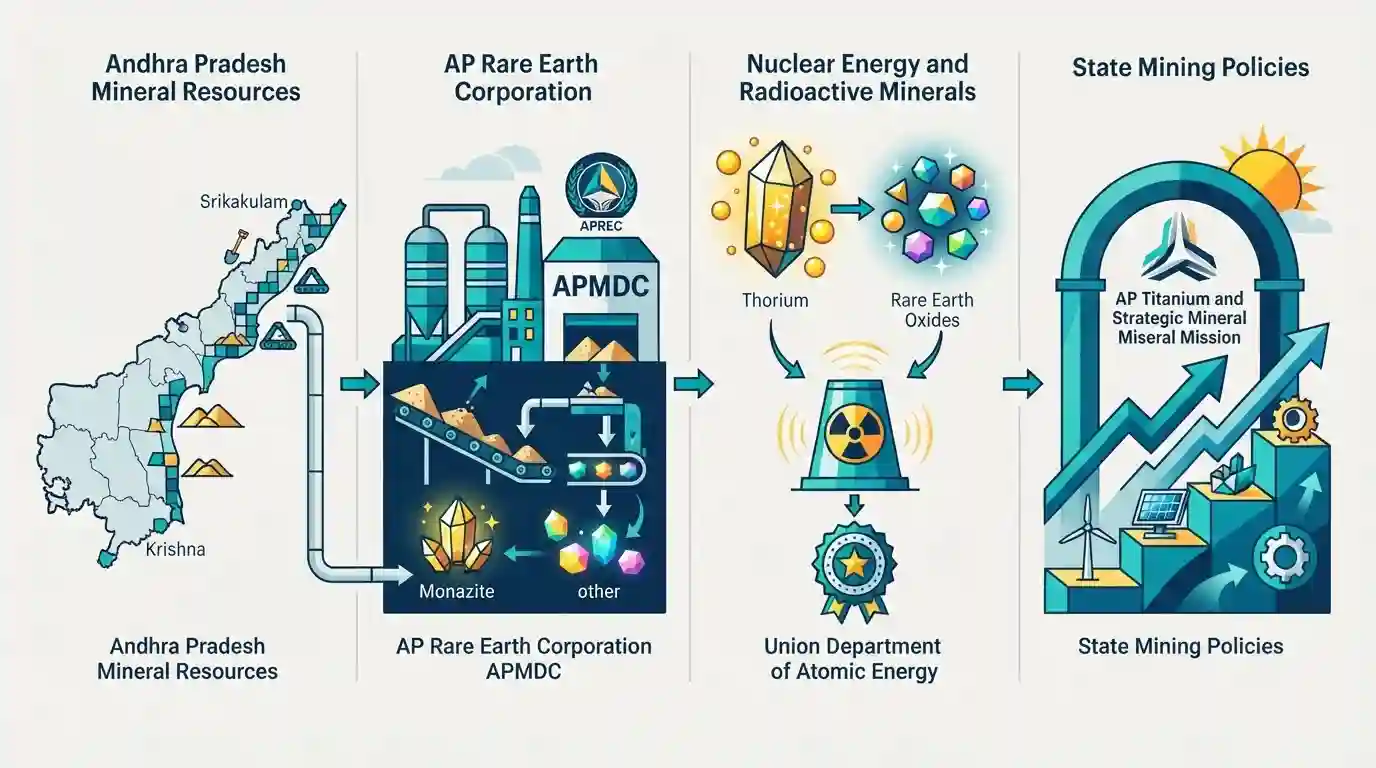
Andhra Pradesh is establishing a new public sector unit, the AP Rare Earth Corporation, under the state's Mineral Development Corporation (APMDC) to manage and process coastal beach sand minerals. The initiative targets strategic elements, particularly monazite, which yields thorium and rare earth oxides. Because monazite is radioactive, its extraction involves regulations from the Union Department of Atomic Energy. The move is part of the upcoming 'AP Titanium and Strategic Mineral Mission' designed to unlock the economic potential of 17 beach sand lease blocks spanning from Srikakulam to Krishna district.
Key Points
- The Andhra Pradesh government plans to set up 'AP Rare Earth Corporation' as a subsidiary of APMDC to extract and process rare earth and beach sand minerals.
- Monazite, found in beach sands, is radioactive and thus falls under the regulatory purview of the Union Department of Atomic Energy.
- Monazite processing is crucial as it yields valuable rare earth oxides and thorium.
- The state identified 17 beach sand lease areas across Srikakulam to Krishna districts, containing minerals like ilmenite, rutile, sillimanite, zircon, and garnet.
- The government is formalizing a dedicated policy named 'AP Titanium and Strategic Mineral Mission' leveraging PDO/MDO operational models.
Important Terms
AP Titanium and Strategic Mineral Mission

A proposed state policy governing beach sand mining and critical minerals. It introduces PDO and MDO operational models and oversees establishing a dedicated rare-earth entity to process strategic minerals like monazite.
UPSC context
Crucial for APPSC Group-I (Economy & Development) to test knowledge of state initiatives on strategic/critical mineral self-reliance.
AP Rare Earth Corporation (APREC)
A proposed subsidiary of the APMDC focused on handling, processing, and adding value to radioactive monazite. It aims to produce rare earth oxides and thorium for nuclear and strategic applications.
UPSC context
Important for APPSC Group-I/II (AP Economy) evaluating awareness of new public sector undertakings and state REE supply chain efforts.
Andhra Pradesh Mineral Development Corporation (APMDC)
The nodal state-owned mining agency responsible for exploring and exploiting AP's mineral resources. It currently holds 16 of the 17 coastal beach sand mining leases to develop heavy rare-earth minerals.
UPSC context
Foundational for AP Geography and Economy. Tests knowledge of the agency managing state mineral assets and public-private mining partnerships.
Union Department of Atomic Energy (DAE)
The central government body regulating "prescribed substances" under the Atomic Energy Act, 1962. It controls the extraction, processing, and trade of radioactive, thorium-bearing minerals like monazite found in AP sands.
UPSC context
Important for Science & Tech. Tests knowledge of federal regulatory controls over atomic/radioactive minerals and center-state resource management.
Atomic Minerals Directorate for Exploration and Research (AMD)
A constituent unit of the DAE responsible for surveying and identifying atomic mineral resources in India, including estimating monazite and rare earth element deposits across AP's coastal and inland sands.
UPSC context
Tests knowledge of central scientific institutions and exploration bodies for nuclear and rare-earth materials under Science & Technology.
Prelims Trap
State governments have exclusive regulatory authority over beach sand minerals found in their territory.
Monazite is a prescribed radioactive substance under the Atomic Energy Act. Its extraction requires mandatory clearance from the Union Department of Atomic Energy, overriding state autonomy.
Static Concepts Connected
What are the major Beach Sand Minerals (BSM) found in Andhra Pradesh?
- Mineral Types: AP holds nearly 25% of India's reserves, including Ilmenite, Rutile, Zircon, Sillimanite, Garnet, and Monazite.
- Geographic Distribution: Extensive deposits are primarily concentrated along the coastal stretches spanning from Srikakulam to Krishna districts.
- Strategic Importance: Monazite is particularly critical as it is a natural source of Rare Earth Elements (REEs) and Thorium.
How does Monazite link to India's Three-Stage Nuclear Programme?
- Stage III Fuel: Monazite sand is processed to extract Thorium-232, which is the foundational fuel for the third stage of India's nuclear strategy.
- Reactor Technology: Advanced Heavy Water Reactors (AHWRs) are designed to utilize Thorium, converting it into fissile Uranium-233 for power generation.
- Energy Security: Utilizing domestic coastal Monazite reserves reduces India's reliance on imported Uranium for long-term nuclear energy.
Cross-Topic Patterns
State Mining vs. Union Regulation
Highlights the federal nuances of mineral regulation. While the state executes extraction via APMDC, radioactive elements (Monazite/Thorium) firmly trigger Union jurisdiction under the Atomic Energy Act.
Coastal Geography + Strategic S&T
AP's Srikakulam-Krishna coastline transcends being a mere state economic asset; it is critical for India's transition to Stage-III nuclear energy via its abundant Thorium reserves.

Expect multi-statement MCQs fusing AP coastal mineral geography (Srikakulam/Krishna), Thorium properties, and Union DAE's regulatory role.
Linked PYQs · 2
Linked PYQs · 2
- 2023APPSC_PRELIMSGS1
Andhra Pradesh is the sole producer of
- 2024APPSC_PRELIMSGS1
In Andhra Pradesh, Dharwar types of rocks are found in:
