One Health Framework Outbreak Response Drills Across Andhra Pradesh
Source:newindianexpress ↗
Why It Matters
Understanding the state's public health infrastructure and disaster management protocols is crucial for administrative roles. The 'One Health' framework is an important governance and scientific concept addressing the interconnectedness of human, animal, and environmental health, relevant for both current affairs and science/health-related questions in the APPSC exams.
Summary
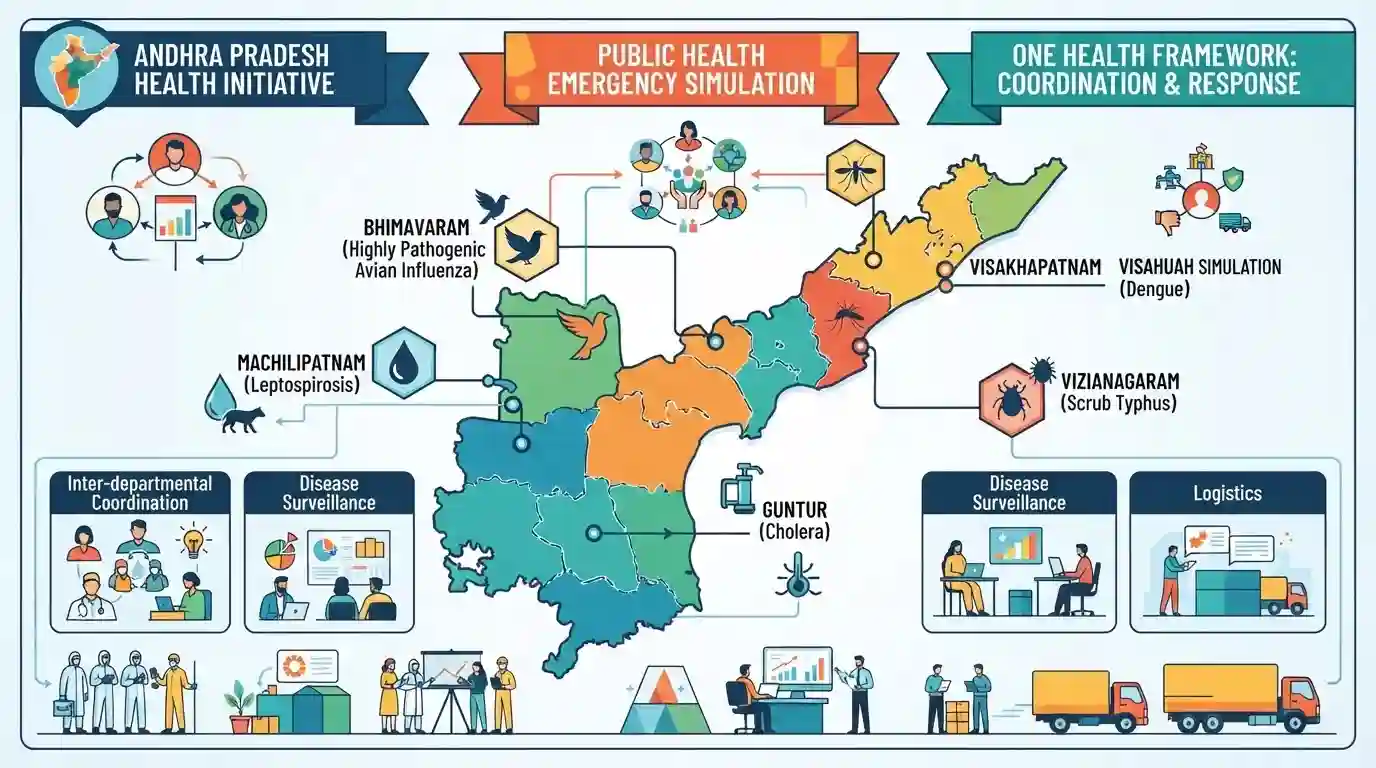
The Andhra Pradesh Health and Family Welfare Department is initiating a series of simulation exercises across select districts to assess and enhance the state's outbreak response for public health emergencies. Operating under a 'One Health' framework, the drills will test inter-departmental coordination, disease surveillance, and logistics. The exercises will focus on five specific diseases in designated districts: Leptospirosis (Machilipatnam), Highly Pathogenic Avian Influenza (Bhimavaram), Dengue (Visakhapatnam), Scrub Typhus (Vizianagaram), and Cholera (Guntur).
Key Points
- Andhra Pradesh is launching simulation exercises to test and strengthen its outbreak response mechanisms for public health emergencies.
- The drills will evaluate the entire public health machinery, including disease surveillance, inter-departmental communication, lab logistics, supply chains, and public communication.
- The exercises focus on vector-borne, zoonotic, and waterborne diseases, specifically Leptospirosis, Highly Pathogenic Avian Influenza (HPAI), Dengue, Scrub Typhus, and Cholera across five districts.
- The initiative operates under the global 'One Health' framework, ensuring collaboration between multiple departments such as animal husbandry, food safety, agriculture, forest, municipal, and panchayat raj.
Important Terms
One Health framework

A collaborative, multisectoral, and transdisciplinary approach that integrates human, animal, and environmental health to achieve optimal health outcomes and prevent zoonotic disease outbreaks.
UPSC context
APPSC Group 1 GS Paper III (S&T, Environment). Tests understanding of integrated disease control and public health governance.
Integrated Disease Surveillance Programme (IDSP)
A decentralized, state-based disease surveillance initiative in India launched in 2004 to detect early warning signals of outbreaks and initiate rapid response actions.
UPSC context
APPSC Group 1 & 2 GS Paper II & III (Governance/S&T). Tests knowledge of national health systems and disease tracking.
Department of Health, Medical and Family Welfare (Andhra Pradesh)
The nodal administrative body of the Andhra Pradesh government responsible for planning, executing, and monitoring public healthcare, disease control schemes, and medical infrastructure.
UPSC context
APPSC Group 1 & 2 (AP State Administration). Crucial for questions on state-level policy execution and welfare schemes.
Emergency Operations Centre (EOC)
A physical or virtual command facility that coordinates resources, operational information, and strategic inter-agency responses during public health crises and disasters.
UPSC context
APPSC Group 1 GS Paper III (Disaster Management). Tests administrative preparedness, command structures, and response systems.
Zoonotic Diseases
Infectious diseases that are naturally transmitted from vertebrate animals to humans, representing a major public health challenge addressed by the One Health framework.
UPSC context
APPSC Group 1 GS Paper III (S&T - Diseases). Tests understanding of epidemiology, pathology, and disease transmission.
Prelims Trap
Scrub Typhus is a viral disease transmitted to humans through the bite of infected Aedes mosquitoes.
APPSC often swaps pathogens and vectors. Scrub Typhus is bacterial (Orientia tsutsugamushi) transmitted by mites/chiggers, not viral/mosquito-borne, while Leptospirosis is bacterial (Leptospira) transmitted via contaminated water/urine.
Static Concepts Connected
What is the 'One Health' approach and its institutional focus in India?
- Core Definition: An collaborative, multisectoral, and transdisciplinary approach working at local, sub-national, national, and global levels.
- Interconnection Pervasiveness: Recognizes that the health of people is closely connected to the health of animals and our shared environment.
- India Institutional Lead: Led by the National One Health Mission under the Office of the Principal Scientific Adviser (PSA) to coordinate human, animal, and environmental ministries.
What is the Integrated Disease Surveillance Programme (IDSP) and its structure?
- Origin and Goal: Launched in 2004 with World Bank assistance to detect and respond to early warning signals of infectious disease outbreaks.
- Reporting Format: Operates on a decentralized system collecting weekly data on syndromic (S-form), presumptive (P-form), and laboratory-confirmed (L-form) cases.
- Technological Upgrade: Now integrated into the digital Integrated Health Information Platform (IHIP) for real-time, geo-spatial disease tracking.
Cross-Topic Patterns
Zoonotic outbreaks vs. rural economy
Avian Influenza in Bhimavaram directly threatens Andhra's massive poultry and animal husbandry sector, showing how epidemic surveillance acts as a safeguard for the state's rural GDP and exports.
Epidemics as biological disasters
Under NDMA guidelines, epidemic control is treated as a biological disaster, making these local drills a crucial test of District Disaster Management Authorities (DDMA) and Panchayati Raj integration.

APPSC may use a match-the-following layout pairing the five epidemic-prone diseases directly with their designated AP test districts.
Linked PYQs · 1
Linked PYQs · 1
- 2012APPSC_PRELIMSGS1
Virus diseases include
