Andhra Pradesh Pedestrian Safety and Universal Accessibility Policy
Source:gktoday ↗
Why It Matters
This is a pioneering state policy that directly links urban infrastructure and road safety to Fundamental Rights (Article 21), marking a significant evolution in judicial interpretation and governance accountability in India.
Summary
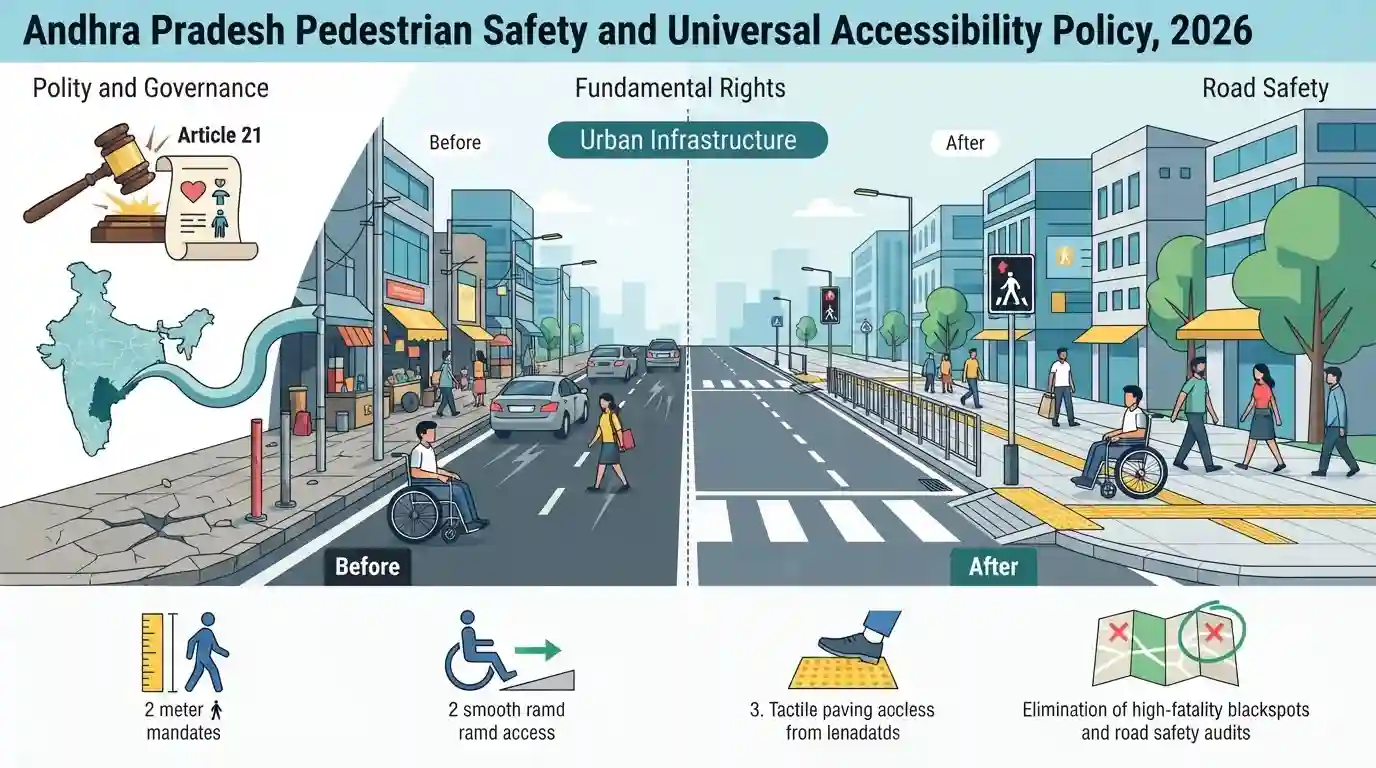
Andhra Pradesh has launched the Pedestrian Safety and Universal Accessibility Policy, 2026, becoming the first state in India to establish an integrated, statutory framework for pedestrian rights. The initiative follows a landmark October 2025 Supreme Court ruling (S. Rajaseekaran vs Union of India) that recognized safe footpaths as part of the fundamental Right to Life under Article 21. The policy mandates strict infrastructure standards—such as 2-meter walking zones, wheelchair ramps, and tactile indicators—and targets high-fatality blackspots while enforcing road safety audits.
Key Points
- Andhra Pradesh has become the first state in India to officially notify a comprehensive Pedestrian Safety and Universal Accessibility Policy (2026).
- The policy was catalyzed by the Supreme Court’s October 2025 ruling in 'S. Rajaseekaran vs Union of India', which interpreted safe and obstruction-free footpaths as intrinsic to the Right to Life under Article 21.
- It mandates universal design elements for all future and retrofitted road projects, including a minimum 2m clear walking zone, slip-resistant surfaces, tactile indicators, wheelchair ramps, and audible traffic signals.
- Initial implementation will prioritize retrofitting at 15 to 20 high-fatality blackspots and conducting road safety audits on 20% of the state's road network in the first year.
Important Terms
Pedestrian Safety and Universal Accessibility Policy, 2026

An Andhra Pradesh statutory framework launched in August 2026 to guarantee pedestrian rights. It mandates accessible infrastructure like two-meter walkways, wheelchair ramps, and tactile paths, shifting focus from vehicle-centric to people-centric urban planning.
UPSC context
Key for GS-2 (Government Policies) and GS-3 (Infrastructure), highlighting state-level innovation in inclusive urban governance.
Article 21 of the Constitution of India
A fundamental right guaranteeing life and personal liberty. The Supreme Court recently expanded its interpretation to explicitly include citizens' right to safe, unobstructed, and accessible pedestrian footpaths.
UPSC context
Critical for GS-2 (Polity). Tests understanding of the evolving scope of Fundamental Rights and judicial interpretation of the Right to Life.
S. Rajaseekaran vs Union of India
A landmark Supreme Court PIL regarding road safety. The Court used this case to declare that safe pedestrian access and timely trauma care are fundamental constitutional rights, directing nationwide infrastructural reforms.
UPSC context
Essential for GS-2 (Judiciary/Governance). Serves as a vital case study for judicial intervention in public safety and infrastructure mandates.
Road Safety Audit
A formal, scientific safety performance examination of road infrastructure. The Andhra Pradesh policy mandates these audits to systematically identify high-fatality blackspots and ensure pedestrian design standards are met.
UPSC context
Relevant for GS-3 (Infrastructure). Demonstrates the application of data-driven governance and proactive risk management in urban planning.
Prelims Trap
The Right to Walk is explicitly enumerated as a distinct Fundamental Right within the text of Part III of the Constitution.
The 'Right to Walk' is an implied right derived via judicial interpretation of Articles 21 and 19, not an explicitly written text in Part III.
Static Concepts Connected
What are implied Fundamental Rights under Article 21?
- Definition: Rights not explicitly written in Part III but declared by the Supreme Court as essential to life with dignity.
- Maneka Gandhi (1978): Established that 'personal liberty' must be interpreted using a fair, just, and reasonable procedure, opening doors to implied rights.
- Key Jurisprudence: Includes right to clean environment (MC Mehta), privacy (Puttaswamy), and now safe passage/right to walk (Rajaseekaran).
What is the Sugamya Bharat Abhiyan (Accessible India)?
- Nodal Ministry: Launched by the Department of Empowerment of Persons with Disabilities, Ministry of Social Justice and Empowerment.
- Three Pillars: Focuses on Built Environment, Transportation, and Information & Communication Technology (ICT) ecosystems.
- Core Mandate: Mandates universal design elements like tactile paths, ramps, and auditory signals to enable independent living for Divyangjan.
Cross-Topic Patterns
Article 21 expansion + Urban planning
Connects judicial expansions of Article 21 directly to municipal town planning, forcing a shift from vehicle-centric highway engineering to pedestrian-first urban designs.
Disability rights + Cooperative federalism
Demonstrates how Central disability rights frameworks (Sugamya Bharat) rely on state-level statutory enactments to translate national guidelines into local, enforceable mandates.

Judicial expansion of Article 21 (Right to Walk) linked with municipal obligations and Sugamya Bharat targets will likely feature in 2026.
Linked PYQs · 3
Linked PYQs · 3
- 2023APPSC_PRELIMSGS1
With child labour being made illegal and right to education becoming a fundamental right for children, this right against exploitation has become more meaningful. Which of the following pairs of Articles provide for right to education and prohibition of child labour respectively?
- 2008APPSC_PRELIMSGS1
The Right to Freedom is contained in the Article:
- 2024APPSC_PRELIMSGS1
Which of the following statement/statements is/are incorrect regarding the Andhra Pradesh Industrial Policy 2023 - 27? I. To achieve a minimum contribution of 25% by industry in the State GDP II. To provide end-to-end facilitation in 2 weeks III. To envisage ten (10) priorities of accomplishment IV. To focus on becoming a 'Plug and Play State' for investments V. Ensuring land allotment by APIIC within a period of 2 weeks upon receipt of application Select the answer using the codes given below :
