AP mandates industries to maintain green cover targets
Source:The Hindu ↗
Why It Matters
State-specific environmental mandates, target percentages for green cover (like 37% by 2030), and collaborative efforts between government bodies (APPCB and Forest Dept) are high-yield facts for APPSC Group 1 Prelims, which frequently tests AP's current policies and sustainable development initiatives.
Summary
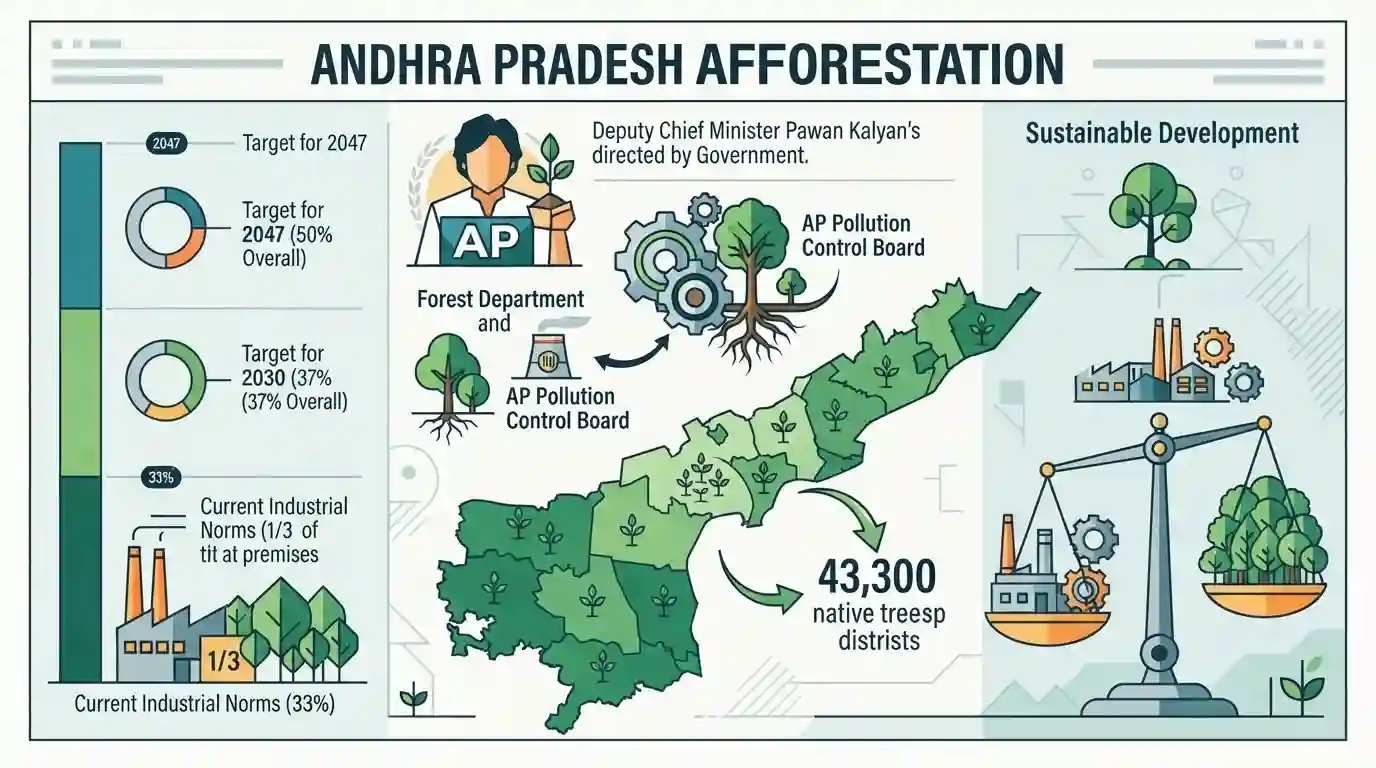
The Andhra Pradesh government has launched an initiative mandating industries to dedicate 33% of their land premises to green cover, aiming to balance industrial growth with environmental sustainability. Driven by Deputy Chief Minister Pawan Kalyan, the program is a joint effort between the Forest Department and the AP Pollution Control Board. The State targets achieving 37% overall green cover by 2030 and 50% by 2047. The initiative strongly encourages planting native and ecologically suitable tree species, marking its first phase with 43,300 saplings planted across 26 districts.
Key Points
- The Andhra Pradesh government mandated that industries must allocate 33% of their premises for green cover.
- The State aims to increase its overall green cover to 37% by 2030 and 50% by 2047.
- The initiative prioritizes planting native, fruit-bearing, and commercially valuable tree species such as neem, cluster bean, drumstick, and coconut.
- The program is jointly executed and monitored by the Forest Department and the AP Pollution Control Board.
- In its initial phase, 26 industries across 26 districts participated by planting 43,300 saplings over 129 acres of land.
Important Terms
33% Industrial Green Cover Mandate

An AP government initiative requiring industries to dedicate 33% of their land premises to greenery. It promotes planting native species to create ecological buffers and balance rapid industrial growth with environmental sustainability.
UPSC context
APPSC General Studies. Tests knowledge of state environmental policies, sustainable industrial development, and corporate ecological responsibilities.
Andhra Pradesh Pollution Control Board (APPCB)
A statutory state body responsible for enforcing environmental laws and regulating pollution. It partners with the Forest Department to ensure industries strictly comply with green cover mandates and adopt eco-friendly practices.
UPSC context
APPSC Paper 4. Highly relevant for questions on environmental governance, statutory regulatory bodies, and state pollution control mechanisms.
AP Green Cover Targets (2030/2047)
Andhra Pradesh's long-term ecological goals to increase the state's overall green cover to 50% by 2047, aligning with Viksit Bharat@2047. It includes an interim milestone of achieving 37% green cover by 2030.
UPSC context
APPSC General Studies. Essential for questions on state-specific sustainable development goals (SDGs) and long-term environmental planning.
Forest Department (Andhra Pradesh)
The primary state agency tasked with managing Andhra Pradesh's forest resources. It spearheads regional afforestation campaigns and collaborates with industries and statutory bodies to expand the state's green cover.
UPSC context
APPSC Paper 4. Important for understanding the administrative framework executing the state's biodiversity conservation and afforestation campaigns.
Prelims Trap
"Andhra Pradesh aims to achieve an overall state green cover of 33% by the year 2030."
Aspirants often confuse the 33% local mandate for industries with the state's overall geographic target, which is 37% by 2030.
Static Concepts Connected
What is the statutory basis of the AP Pollution Control Board (APPCB)?
- Statutory Origin: Constituted under the Water (Prevention and Control of Pollution) Act, 1974 to regulate water pollution at the state level.
- Dual Powers: It is also entrusted with enforcement powers under the Air (Prevention and Control of Pollution) Act, 1981.
- Regulatory Leverage: Issues mandatory "Consent to Establish" (CTE) and "Consent to Operate" (CTO) for industries, functioning as the leverage for the green cover mandate.
How do AP's green cover goals compare to the National Forest Policy?
- National Baseline: The NFP 1988 recommends maintaining 33% of the total geographical area under forest or tree cover.
- State Overreach: AP's goal of 50% by 2047 is highly ambitious, aiming far above the national baseline to build climate resilience.
- Green vs Forest Cover: "Green cover" is broader than "forest cover", including tree cover outside official forests, such as industrial zones, agroforestry, and urban plantations.
Cross-Topic Patterns
Green Cover + Corporate Responsibility
Links AP's new targets with the broader Corporate Environmental Responsibility (CER) framework, pushing private industries beyond mere emissions compliance into active ecological partnerships and local carbon sinking.
AP Vision 2047 + Climate Resilience
The 50% green cover target aligns directly with the "Viksit Andhra 2047" roadmap, demonstrating a policy shift towards integrating rapid industrialization with long-term decarbonization and climate resilience.

Multi-statement question likely confusing the 33% industrial green cover mandate with the 37% (2030) and 50% (2047) state-wide targets.
Linked PYQs · 2
Linked PYQs · 2
- 2024APPSC_PRELIMSGS1
Which of the following statements are valid in connection with Andhra Pradesh Green Hydrogen and Green Ammonia Policy (2023)? I. The objective is to target Green Energy production up to the capacity of 1 MPTA (Million Tonnes Per Annum) or Green Ammonia production up to the capacity of 2-0 MTPA in the next five years. II. New and Renewable Energy Development Corporation of A.P. Ltd (NREDCAP) shall act as a Nodal Agency under this policy. III. All the Ports in the State have infrastructure for storing liquid nitrogen which can then be utilized for storing Green Hydrogen for exporting to other countries. IV. The Policy prohibits the production of Green Hydrogen/Green Ammonia by using Renewable Energy and/or Biomass from 'Third-Party/Power exchange'. Select the correct answer using the codes given below :
- 2023APPSC_PRELIMSGS1
According to the Indian Forest Act, 1927, which of the following is the most appropriate sequence which shows the degree of protection between different forest types ?
