AP National Ranking in MISHTI Scheme for Mangrove Restoration
Source:fmbharat ↗
Why It Matters
Extremely relevant for APPSC Group 1 aspirants focusing on Andhra Pradesh's environmental achievements, state rankings in national schemes, and coastal resource management.
Summary
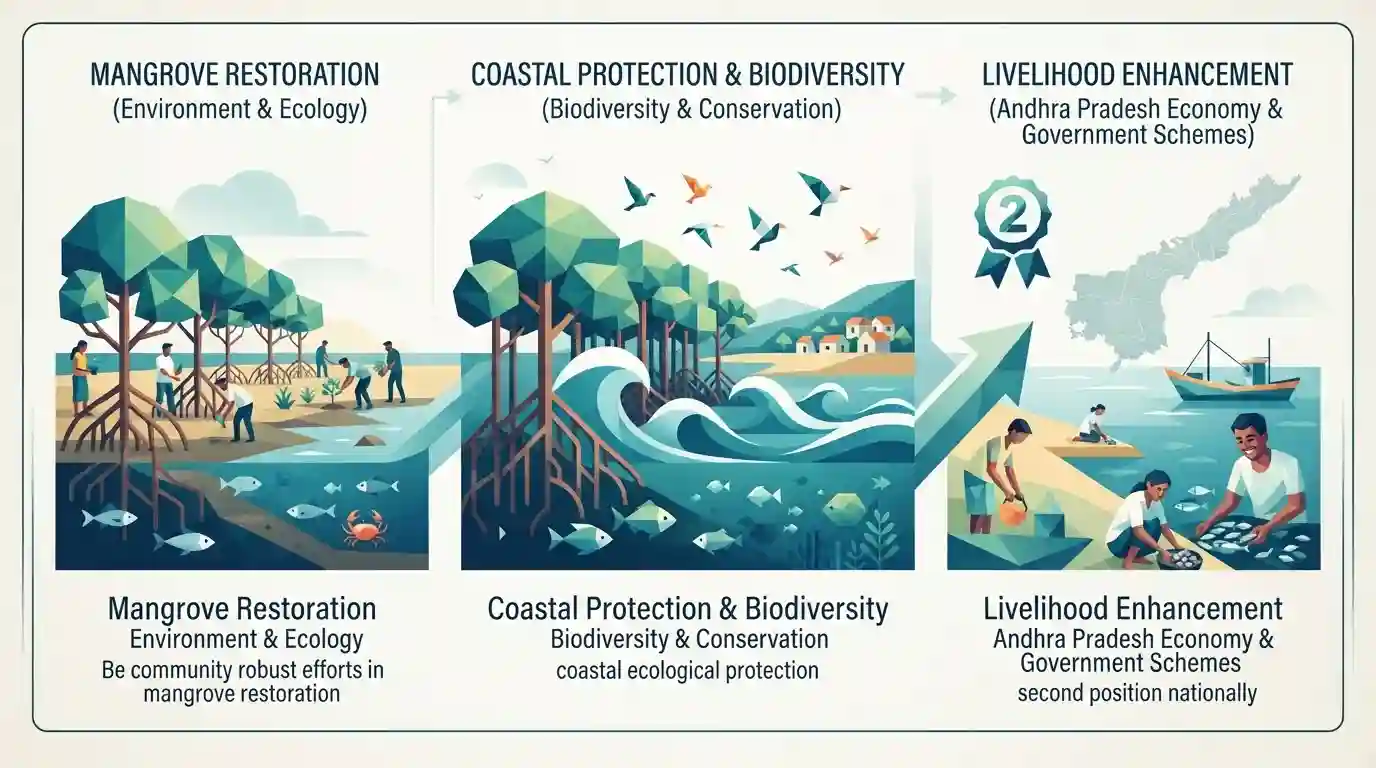
Andhra Pradesh has achieved significant recognition by securing the second position nationally under the MISHTI (Mangrove Initiative for Shoreline Habitats and Tangible Incomes) scheme, highlighting the state's robust efforts in mangrove restoration, coastal ecological protection, and livelihood enhancement.
Key Points
- Andhra Pradesh secured second place nationally under the MISHTI scheme for mangrove restoration.
- The state leads in coastal ecosystem restoration and increasing mangrove cover along its coastline.
- The MISHTI scheme aims to promote mangrove plantation along India's coastline and saline lands.
- Mangrove forests play a crucial role as a natural bio-shield against cyclones and storm surges, which are frequent on the Andhra Pradesh coast.
Important Terms
MISHTI Scheme

A central government initiative launched to promote mangrove plantation along India's coastline and salt-pan lands, aiming for ecological conservation, shoreline protection, and sustainable coastal livelihoods.
UPSC context
Important for APPSC Paper III (Environment, Economy & Government Schemes); tests knowledge of central schemes and coastal biodiversity conservation in Andhra Pradesh.
Prelims Trap
Andhra Pradesh secured the first position nationally under a 100% centrally funded standalone MISHTI mission.
Aspirants may confuse MISHTI as a standalone 100% centrally funded mission without fund convergence, or mistake AP's second rank for first rank nationally.
Static Concepts Connected
What are the key ecological features and funding mechanisms of the MISHTI scheme?
- Launch Context: Announced in Union Budget 2023-24 to take up mangrove plantations along India's coastline and salt-pan lands.
- Fund Convergence: Fund convergence primarily through MGNREGS, CAMPA (Compensatory Afforestation Fund Management and Planning Authority), and other sources.
- Dual Objective: Focuses on both ecological restoration of shorelines and generating tangible incomes for coastal communities.
What are the ecological significance and adaptive adaptations of mangrove forests?
- Bio-Shield Role: Act as natural bio-shields against tropical cyclones, storm surges, and coastal erosion.
- Specialized Adaptations: Possess specialized pneumatophores (breathing roots) and vivipary germination to survive in saline, waterlogged intertidal zones.
- Nursery Function: Serve as critical nursery grounds for marine biodiversity, particularly fish, crustaceans, and molluscs.
Cross-Topic Patterns
MISHTI + MGNREGS + CAMPA Funds Convergence
The MISHTI scheme converges funds through MGNREGS and CAMPA, linking coastal ecological security with rural employment guarantee and compensatory afforestation funds.
Fish Bone Technique + Cyclone Disaster Resilience
Andhra Pradesh's deployment of the Fish Bone Technique in Rajamahendravaram and Guntur links local forestry engineering with state disaster resilience and cyclone preparedness.

MISHTI scheme implementation details, fund convergence (CAMPA/MGNREGS), and AP's second rank are high-yield for APPSC Group 1/2 prelims.
Linked PYQs · 3
Linked PYQs · 3
- 2024APPSC_PRELIMSGS1
In India, Sholas are:
- 2024APPSC_PRELIMSGS1
Match the following Climatic regions of India according to Koeppen's scheme: | List-I(Type of Climate) | List-II.(Areas) | |---|---| | A. Monsoon with short dry season | I. West coast of India, south of Goa | | B. Monsoon with dry summer | II. Coromandel coast of Tamil Nadu | | C. Monsoon with dry winter | III. Most of North-East India | | D. Semi-arid Steppe climate | IV. Northwestern Gujarat | Choose the correct answer using the codes given below: Code: A B C D
- 2024APPSC_PRELIMSGS1
In Andhra Pradesh, Dharwar types of rocks are found in:
