Andhra Pradesh Secures Second Place Nationally Under MISHTI Scheme
Source:ddindia ↗
Why It Matters
Important for APPSC Group 1 aspirants focusing on Andhra Pradesh's state achievements, environmental policies, central welfare/conservation schemes like MISHTI, and climate resilience measures.
Summary
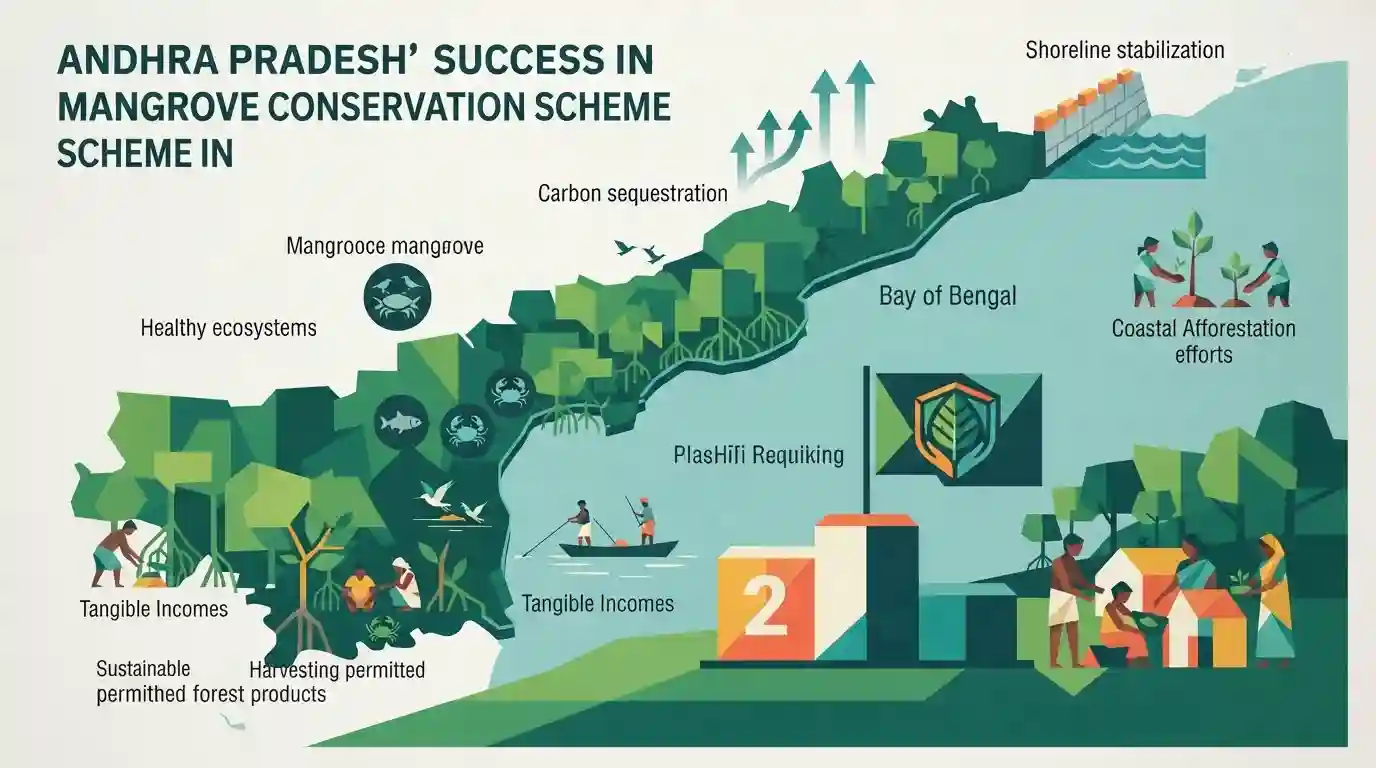
Andhra Pradesh has emerged as a leader in ecological conservation by securing the second position nationally under the MISHTI (Mangrove Initiative for Shoreline Habitats and Tangible Incomes) scheme, reflecting successful mangrove restoration and coastal afforestation efforts.
Key Points
- Andhra Pradesh has secured the second position nationally under the MISHTI (Mangrove Initiative for Shoreline Habitats and Tangible Incomes) scheme, showcasing exemplary performance in mangrove restoration.
- The MISHTI scheme focuses on intensive mangrove afforestation along India's coastline, integrating coastal protection with sustainable livelihood creation for local communities.
- Mangrove ecosystems act as crucial bio-shields against extreme weather events like cyclones, storm surges, and coastal erosion, which are particularly significant for Andhra Pradesh's long coastline.
Important Terms
MISHTI Scheme

A central sector initiative launched to take up mangrove plantation along the coastline and salt pan lands, aiming at shoreline protection, ecological restoration, and sustainable livelihoods.
UPSC context
APPSC Paper III (Environment & Ecology): Tests knowledge of national environmental schemes, coastal management, and climate resilience initiatives.
Ministry of Environment, Forest and Climate Change
The Union ministry responsible for the implementation of environmental and forestry policies, wildlife preservation, and climate change agendas in India.
UPSC context
APPSC Paper III: Important for understanding institutional frameworks governing environmental conservation and central schemes in Andhra Pradesh.
Government of Andhra Pradesh
The state-level governing body that implements policies, environmental initiatives, and central afforestation programs like MISHTI to boost coastal ecosystems.
UPSC context
APPSC Paper II & III: Tests awareness of state administrative achievements, ecological rankings, and regional sustainable development goals.
Static Concepts Connected
What are the ecological adaptations and economic significance of mangrove ecosystems in India?
- Root Adaptations: Pneumatophores (breathing roots) emerge above anoxic mud to facilitate gas exchange in waterlogged coastal soils.
- Reproduction: Viviparous germination allows seeds to sprout on the parent tree before dropping, ensuring survival in shifting tidal flats.
- Ecological Role: Natural bio-shields that dissipate wave energy, protect shorelines from cyclones, and sequester high amounts of blue carbon.
Cross-Topic Patterns
MISHTI Funding: CAMPA and MGNREGS Convergence
MISHTI converges CAMPA and MGNREGS funds. Aspirants must link this financial architecture to central sector vs centrally sponsored scheme funding debates in Indian federalism.
Coastal Bio-shields and Disaster Mitigation Linkages
Andhra Pradesh's long coastline makes it vulnerable to cyclones. Mangrove afforestation directly intersects with State Disaster Management Authority protocols and National Cyclone Risk Mitigation Project (NCRMP) frameworks.

Expect a statement-based question linking MISHTI's 5-year timeline (2023-28), CAMPA/MGNREGS funding model, and AP's Fish Bone planting technique.
Linked PYQs · 2
Linked PYQs · 2
- 2023APPSC_PRELIMSGS1
Naupada Coastal and Marine Biodiversity Area (ICMBA) is located in the district of
- 2024APPSC_PRELIMSGS1
The Interim Union Budget (FY25) has proposed initiatives to boost India's Green Energy Sector. Which of the following proposals are connected with developing India's Green Energy ? I. Viability Gap Funding (VGF) for utilizing solar energy projects II. To set up coal gasification and liquefaction capacity of 100MT by 2030 III. Optional blending of Compressed Bio Gas (CBG) in Compressed Natural Gas (CNG) for transport and Piped Natural Gas (PNG) for domestic purposes IV. Provision of financial assistance for procurement of biomass aggregation machinery V. Setting up of a payment security system for expanding the bio-manufacturing system in the country Select the correct answer using the codes given below :
