Fish bone technique adoption for mangrove restoration in AP coast
Source:dd-india ↗
Why It Matters
Highlights Andhra Pradesh's significant environmental conservation efforts aligned with a major national scheme (MISHTI). The use of specialized techniques like the 'Fish Bone Technique' and the focus on blue carbon and coastal resilience are key areas for APPSC Group 1 Prelims (Geography and Environment).
Summary
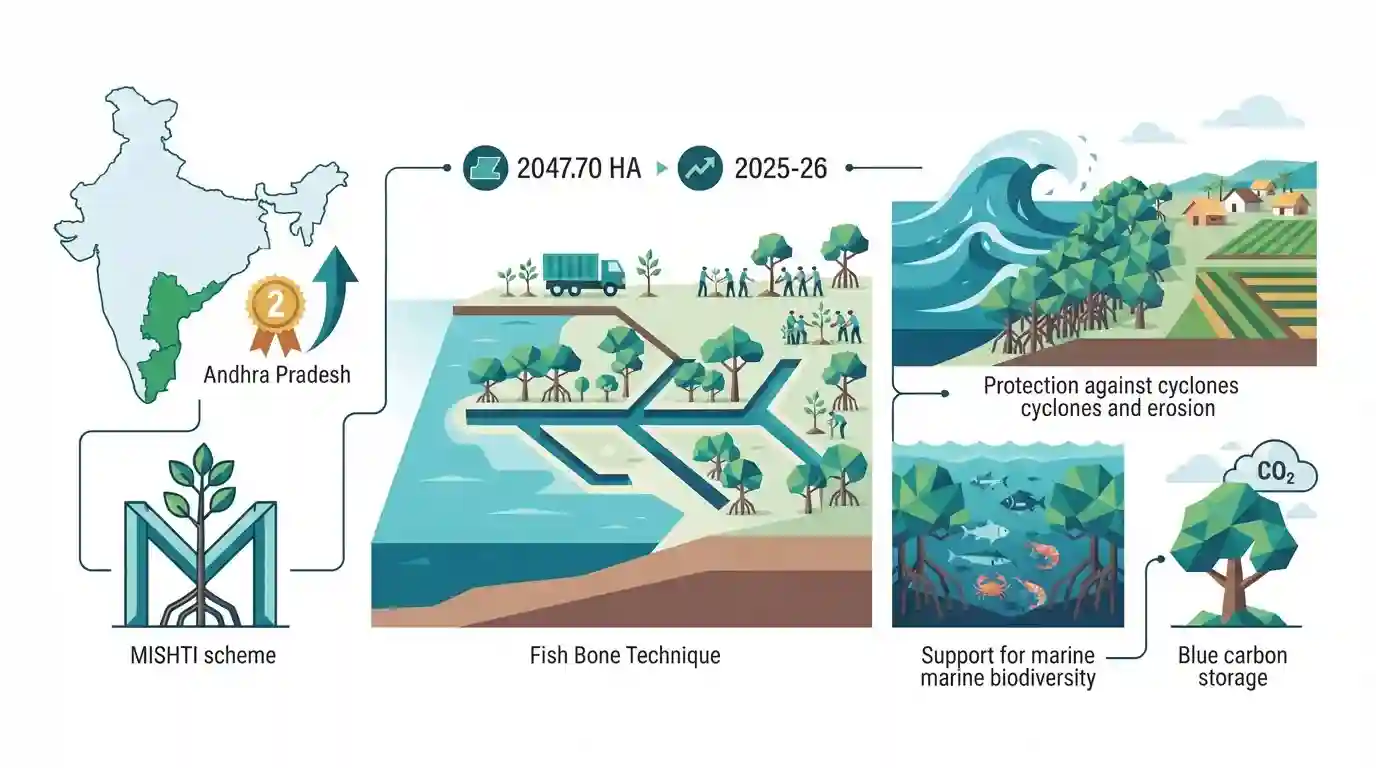
Andhra Pradesh has achieved the second position nationally in mangrove restoration under the MISHTI (Mangrove Initiative for Shoreline Habitats and Tangible Incomes) scheme. Through its 'Great Green Wall of Andhra Pradesh' initiative, the state restored 2,047.70 hectares of mangroves in 2025-26 across multiple coastal districts using the innovative 'Fish Bone Technique' to ensure better survival rates. The initiative aims to leverage mangroves as a natural barrier to protect the state's 1,053-km coastline against climate threats like cyclones and erosion, while supporting marine biodiversity and blue carbon storage.
Key Points
- Andhra Pradesh secured second place under the central MISHTI scheme for mangrove restoration.
- The state successfully developed mangrove plantations over 2,047.70 hectares in 2025-26 with an investment of Rs 18.04 crore.
- An innovative 'Fish Bone Technique' was employed to improve tidal water circulation and increase the survival rate of mangroves.
- The initiative, dubbed the 'Great Green Wall of Andhra Pradesh', aims to protect the state's 1,053-km coastline from cyclones, coastal erosion, and storm surges.
- The state government has set a target to restore an additional 1,618 hectares (4,000 acres) of mangroves for the 2026-27 period.
Important Terms
MISHTI Scheme

The Mangrove Initiative for Shoreline Habitats & Tangible Incomes is a central scheme launched in 2023. It aims to restore mangrove forests along India's coastlines and salt pans, promoting climate resilience and boosting local livelihoods through scientific afforestation.
UPSC context
GS Paper 3 (Environment). Tests knowledge of national conservation policies, climate adaptation schemes, and coastal biodiversity.
Great Green Wall of Andhra Pradesh
A coastal afforestation initiative establishing a multi-layered bio-shield of mangroves and native trees along Andhra Pradesh's coastline. It serves as a nature-based barrier against cyclones, storm surges, and coastal erosion while supporting local biodiversity.
UPSC context
GS Paper 3 (Disaster Management). Highly relevant as a case study for nature-based disaster mitigation strategies and state-led climate resilience.
Fish Bone Technique
An ecological restoration method used in elevated inter-tidal zones. Artificial channels are dug in a fish-bone pattern to facilitate periodic tidal salt-water flushing, creating optimal hydrological conditions for mangrove propagules to survive and thrive.
UPSC context
GS Paper 3 (Environment). Important for questions on scientific methods of ecological restoration and sustainable forestry practices.
Blue Carbon
Carbon captured and naturally stored by the world's coastal and marine ecosystems, predominantly by mangroves, seagrasses, and salt marshes. These environments act as highly efficient carbon sinks to mitigate global climate change.
UPSC context
GS Paper 3 (Environment). Crucial for topics covering carbon sequestration, climate change mitigation, and the ecological value of wetlands.
Prelims Trap
MISHTI is a 100% centrally funded scheme backed entirely by a dedicated standalone Union budget allocation.
MISHTI does not have its own exclusive, standalone central fund. It is designed around budget convergence, utilizing 80% CAMPA funds and 20% MGNREGS (now Vikshit Bharat Guarantee) funds alongside state resources.
Static Concepts Connected
What are the key physiological adaptations of mangrove ecosystems?
- Halophytic systems: Adapted to highly saline environments using specialized salt-excreting glands on leaves and root filtration.
- Pneumatophores: Blind root extensions growing upwards to absorb atmospheric oxygen in anaerobic, waterlogged soils.
- Vivipary reproduction: Seed germination occurs while still attached to the parent plant, facilitating survival in unstable tidal mudflats.
What is the ecological importance of the Coringa Wildlife Sanctuary?
- Estuarine habitat: Second-largest contiguous mangrove forest in India, situated in the dynamic Godavari river estuary.
- Threatened species: Key habitat for the vulnerable Fishing Cat, nesting Olive Ridley turtles, and critically endangered vultures.
- Cyclonic shield: Acts as a critical nature-based barrier mitigating storm surges and protecting the Kakinada coastline.
Cross-Topic Patterns
Nature-based DRR + Coastal Management
Connects GS3 disaster mitigation (cyclones, erosion) with coastal resilience, highlighting how initiatives like MISHTI reduce the socio-economic vulnerability of coastal communities.
Blue Carbon + India's NDCs
Links local mangrove restoration directly to global climate commitments, aiding India's NDC target of creating an additional 2.5 to 3 billion tonnes of CO2 equivalent carbon sink.

Expect a 2026 question blending MISHTI's budget convergence (CAMPA/MGNREGS) with the ecological mechanics of the Fish Bone Technique.
Linked PYQs · 2
Linked PYQs · 2
- 2023APPSC_PRELIMSGS1
Naupada Coastal and Marine Biodiversity Area (ICMBA) is located in the district of
- 2019APPSC_PRELIMSGS1
To enhance food security and to make Indian Agriculture more resilient to climate change, which programme was started in 2011-12?
