Primary health centre outcome based KPI grading system in AP
Source:The Hindu ↗
Why It Matters
Understanding this topic is essential as it highlights a progressive shift in public administration from mere output measurement to outcome-based performance evaluation. It demonstrates how state governments are leveraging key performance indicators to improve accountability, service delivery, and primary healthcare outcomes.
Summary
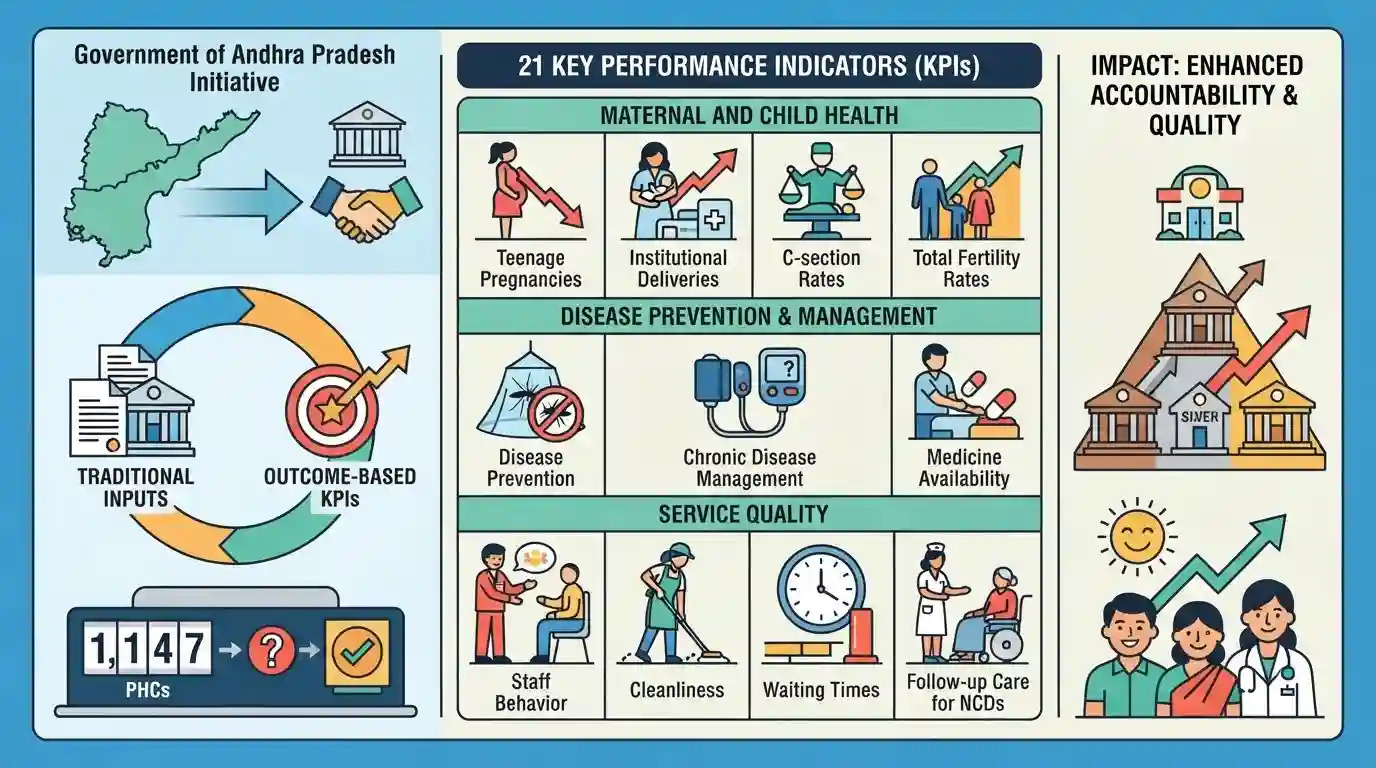
The Government of Andhra Pradesh has launched a new grading system to evaluate the performance of its 1,147 Primary Health Centres (PHCs). Moving away from traditional input-output metrics such as patient volume, the new framework relies on 21 outcome-based Key Performance Indicators (KPIs). These parameters focus on critical healthcare areas, including maternal and child health, disease prevention, and chronic disease management. Specific metrics include tracking teenage pregnancies, institutional deliveries, Caesarean section rates, and total fertility rates. Additionally, the system assesses service quality by evaluating staff behavior, cleanliness, waiting times, medicine availability, and follow-up care for non-communicable diseases. The initiative aims to enhance the accountability, efficiency, and overall quality of public health delivery across the state.
Key Points
- Andhra Pradesh has introduced a new grading system for its 1,147 Primary Health Centres (PHCs).
- The evaluation shifts from basic output metrics (like patient footfall) to 21 outcome-based Key Performance Indicators (KPIs).
- KPIs cover disease prevention, maternal and child health, including teenage pregnancies, high-risk pregnancy registrations, institutional deliveries, and maternal mortality control.
- Service quality aspects such as staff behavior, cleanliness, patient waiting times, medicine availability, and chronic disease follow-ups are also evaluated.
- District Collectors and health officials are mandated to conduct regular reviews using the new performance dashboard to ensure accountability.
Important Terms
Primary Health Centres (PHCs)

State-owned rural clinics in India that act as the primary referral unit and first point of contact with a medical doctor, offering essential curative, preventive, and promotive healthcare services.
UPSC context
GS Paper II (Social Justice/Health). Tests understanding of India's three-tier healthcare system, public service delivery, and primary healthcare reforms.
Medical and Health Department
The state government division in India tasked with formulating healthcare policies, managing public medical facilities, recruiting medical staff, and executing state and national health programs.
UPSC context
GS Paper II (State Governance & Public Health). Tests understanding of state-level public administration, policy execution, and administrative reforms in public service delivery.
World Health Organisation (WHO)
A specialized agency of the United Nations established in 1948, headquartered in Geneva, responsible for directing, coordinating, and setting standards for global public health.
UPSC context
GS Paper II (International Relations/Health). Tests knowledge of global governance, international institutions, multilateral cooperation, and worldwide healthcare standards.
Prelims Trap
"Under IPHS, Primary Health Centres are classified into Type A and Type B based on the population size they serve."
IPHS classifies PHCs into Type A and Type B based on delivery caseload, not population size. Population size strictly dictates where a PHC is established.
Static Concepts Connected
How are Primary Health Centres (PHCs) structured under Indian Public Health Standards (IPHS)?
- Population Norms: Set up for a population of 30,000 in plain areas and 20,000 in hilly, tribal, or difficult terrains.
- Caseload Classification: Classified into Type A (less than 20 deliveries per month) and Type B (20 or more deliveries per month) to optimize clinical resources.
- Referral Mechanism: Acts as the first contact point with a Medical Officer, responsible for referring complex cases upward to Community Health Centres (CHCs).
How do outcome metrics differ from output metrics in public administration?
- Output Metrics: Measure the immediate, quantifiable results of a government activity, such as total patient footfall, number of lab tests conducted, or scheme funds disbursed.
- Outcome Metrics: Measure the actual socio-economic impact or qualitative improvement achieved on the target population, such as reduced maternal mortality rates or improved disease control.
Cross-Topic Patterns
Outcome metrics & NITI Health Index
AP's shift to 21 KPIs mirrors the methodology of the NITI Aayog State Health Index, which heavily weights outcome domains (like TFR and mortality) over mere infrastructure inputs.
GS-2 Mains: Rural healthcare accountability
Using staff behavior, cleanliness, and waiting times as performance parameters serves as an excellent GS-2 case study for bridging the trust deficit in rural public health administration.

The IPHS classification of PHCs based on delivery caseloads, rather than just population norms, is a prime candidate for a 2026 Prelims trap.
Linked PYQs · 1
Linked PYQs · 1
- 2024APPSC_PRELIMSGS1
Which of the following statements are valid regarding the interventions of the Government of Andhra Pradesh in the context of Healthcare ? I. Telemedicine facility is available in all Ayushman Bharat Health and Wellness Centres (AB-HWCs) to avail specialist services through district hub. II. The Family Doctor Programme has been planned to be implemented as a standalone project without the need to be integrated with Primary Health Centres (PHCs). III. Dr. YSR Aarogyasri Scheme has been revamped, by increasing the income limit from ₹ 2.5 lakh to ₹ 5 lakh per annum per family. IV. 'Aarogya Aasara' Scheme is intended to provide post-operative sustenance allowance with certain eligible conditions complied with. Select the correct answer using the codes given below :
