Andhra Pradesh Signs Bilateral MoUs with Australia on Clean Energy
Source:new-indian-express ↗
ఇది ఎందుకు ముఖ్యం
State-level international partnerships are crucial for advancing India's decentralised capacity in clean energy, education, and technology. These MoUs align with national priorities such as renewable energy transition and comprehensive educational reforms.
సారాంశం
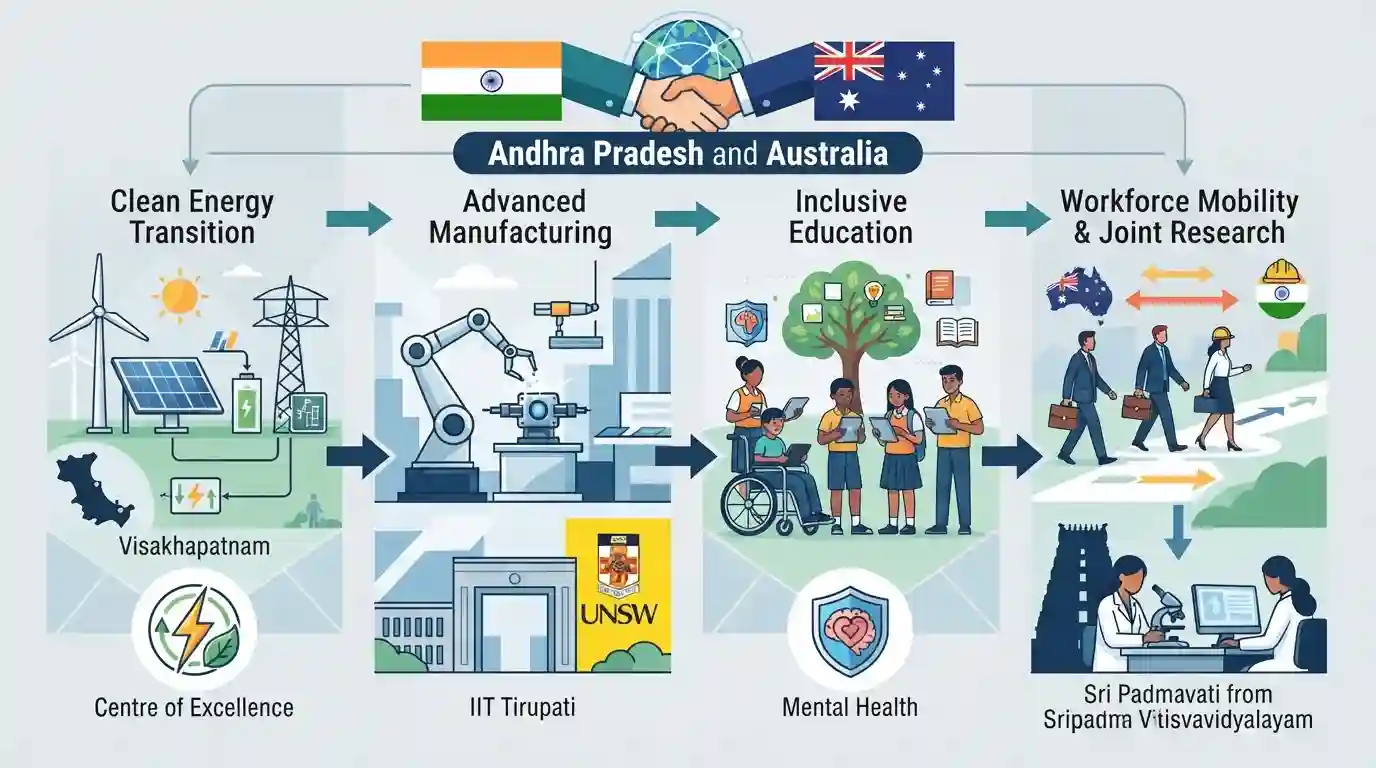
The Andhra Pradesh government signed four Memorandums of Understanding (MoUs) with Australia to foster collaboration in clean energy, advanced manufacturing, inclusive education, and workforce mobility. Key initiatives include establishing a Centre of Excellence for Energy Transition (CoEET) in Visakhapatnam and an advanced manufacturing centre at IIT Tirupati in collaboration with the University of New South Wales (UNSW). Additional MoUs involve Sri Padmavati Mahila Visvavidyalayam for joint research and workforce mobility, and Samagra Shiksha AP for inclusive school education and student mental health programs.
ముఖ్య అంశాలు
- Andhra Pradesh signed four MoUs with Australia to collaborate on clean energy transition, advanced manufacturing, inclusive education, and workforce mobility.
- A Centre of Excellence for Energy Transition (CoEET) is set to be established in Visakhapatnam in partnership with the University of New South Wales (UNSW).
- IIT Tirupati will partner with UNSW to set up an advanced manufacturing centre focused on training, capacity building, and technology.
- Sri Padmavati Mahila Visvavidyalayam (SPMVV) signed an MoU for joint research, curriculum development, and workforce mobility.
- Samagra Shiksha Andhra Pradesh partnered with Australia to enhance inclusive school education and develop mental health modules for students.
ముఖ్యమైన పదాలు
Centre of Excellence for Energy Transition (CoEET)

An initiative by Andhra Pradesh's power utilities (APDISCOMs, APGENCO, APTRANSCO) based in Visakhapatnam, driving clean energy innovations, solar manufacturing R&D, and grid modernization.
UPSC context
GS Paper III (Energy, Infrastructure); tests understanding of state-level institutions driving India's renewable energy goals.
Samagra Shiksha Andhra Pradesh
The state-level implementing body of India’s flagship Centrally Sponsored Scheme, Samagra Shiksha, aimed at ensuring inclusive, equitable, and quality school education from pre-school to Class XII.
UPSC context
GS Paper II (Education, Social Justice); tests state-level implementation of national education policy targets and inclusive learning.
IIT Tirupati
A premier third-generation public engineering and technology institute in Andhra Pradesh, established in 2015, which partners in advanced academic, industrial, and clean-energy research initiatives.
UPSC context
GS Paper II (Education) and GS Paper III (Science & Technology); tests awareness of premier Indian institutions spearheading global R&D.
Sri Padmavati Mahila Visvavidyalayam (SPMVV)
A state-funded all-women's university in Tirupati, Andhra Pradesh, established in 1983 to foster higher professional education and research, currently collaborating on inclusive school teacher-training programmes.
UPSC context
GS Paper II (Social Sector: Education, Gender Empowerment); tests policies and institutions promoting women's education.
University of New South Wales (UNSW Sydney)
A top-tier public research university in Sydney, Australia, renowned for global leadership in photovoltaic technology and solar cell research, actively partnering with Indian state institutions.
UPSC context
GS Paper II (Bilateral Relations, India-Australia ties); tests understanding of global institutional partnerships driving clean technology.
ప్రిలిమ్స్ ఉచ్చు
States have constitutional authority to independently sign binding international treaties.
Treaties are exclusively in the Union List (Entry 14). States engage in "paradiplomacy" (MoUs) which are non-binding and strictly require MEA political clearance.
అనుసంధానమైన స్థిర భావనలు
How does the Constitution regulate foreign agreements and state-level MoUs (Paradiplomacy)?
- Union List: Entry 14 grants exclusive power to the Union government over foreign affairs, diplomacy, and entering into treaties.
- Article 253: Empowers Parliament to legislate for implementing international agreements across the country, even overriding the State List.
- MEA Clearance: States must secure mandatory political clearance from the Ministry of External Affairs before signing international MoUs.
What are the core components of the Samagra Shiksha Scheme?
- Integrated Scheme: It seamlessly subsumes three erstwhile schemes: Sarva Shiksha Abhiyan (SSA), Rashtriya Madhyamik Shiksha Abhiyan (RMSA), and Teacher Education (TE).
- Centrally Sponsored: It is a Centrally Sponsored Scheme funded 60:40 by Centre and States (90:10 for North Eastern and Himalayan States).
- Key Focus Areas: Focuses on inclusive education, foundational literacy, upgrading school infrastructure, student mental health, and gender equity.
అంతర-అంశ నమూనాలు
Clean energy & bilateral workforce mobility
This complements the overarching India-Australia MATES (Mobility Arrangement) and ECTA pacts, linking state-level education and skilling goals directly with national migration agreements.
The rise of Indian paradiplomacy
Reflects a growing trend where states act as direct economic actors in foreign policy, mirroring recent moves by Kerala and Tamil Nadu to establish external outreach units for FDI.

Paradiplomacy (state-level MoUs) combined with MEA's political clearance rules is highly likely to feature in a 2026 Polity question.
అనుసంధాన PYQలు · 3
అనుసంధాన PYQలు · 3
- 2024APPSC_PRELIMSGS1
Which of the following statements are valid in connection with Andhra Pradesh Green Hydrogen and Green Ammonia Policy (2023)? I. The objective is to target Green Energy production up to the capacity of 1 MPTA (Million Tonnes Per Annum) or Green Ammonia production up to the capacity of 2-0 MTPA in the next five years. II. New and Renewable Energy Development Corporation of A.P. Ltd (NREDCAP) shall act as a Nodal Agency under this policy. III. All the Ports in the State have infrastructure for storing liquid nitrogen which can then be utilized for storing Green Hydrogen for exporting to other countries. IV. The Policy prohibits the production of Green Hydrogen/Green Ammonia by using Renewable Energy and/or Biomass from 'Third-Party/Power exchange'. Select the correct answer using the codes given below :
- 2024APPSC_PRELIMSGS1
The Interim Union Budget (FY25) has proposed initiatives to boost India's Green Energy Sector. Which of the following proposals are connected with developing India's Green Energy ? I. Viability Gap Funding (VGF) for utilizing solar energy projects II. To set up coal gasification and liquefaction capacity of 100MT by 2030 III. Optional blending of Compressed Bio Gas (CBG) in Compressed Natural Gas (CNG) for transport and Piped Natural Gas (PNG) for domestic purposes IV. Provision of financial assistance for procurement of biomass aggregation machinery V. Setting up of a payment security system for expanding the bio-manufacturing system in the country Select the correct answer using the codes given below :
- 2024APPSC_PRELIMSGS1
Consider the following statements with regard to India's Foreign Policy : I. India's Act East Policy was originally conceived as an economic initiative but had later extended into political, strategic and cultural dimensions. II. The 'Connect Central Asia Policy' has been taken forward with the institutionalization of the 'India-Central Asia Summit' mechanism. III. Under the 'Security and Growth for All in the Region' (SAGAR) Policy, the DRDO initiated the Marine and Allied Interdisciplinary Training and Research Initiative (MAITRI) for the purpose of establishing long-term collaboration with countries in the East Asian region. IV. India's Think West Policy is an outreach to the Western Industrialized nations for strengthening of relations in areas of education and defence. Which of the above statements are valid ?
