Power Transmission Network Expansion Underway in State
Source:The Hindu ↗
ఇది ఎందుకు ముఖ్యం
Understanding state-level infrastructure initiatives is crucial for APPSC Group 1 Prelims, as questions frequently target regional economic development policies, energy infrastructure capacity, and renewable energy integration efforts in Andhra Pradesh.
సారాంశం
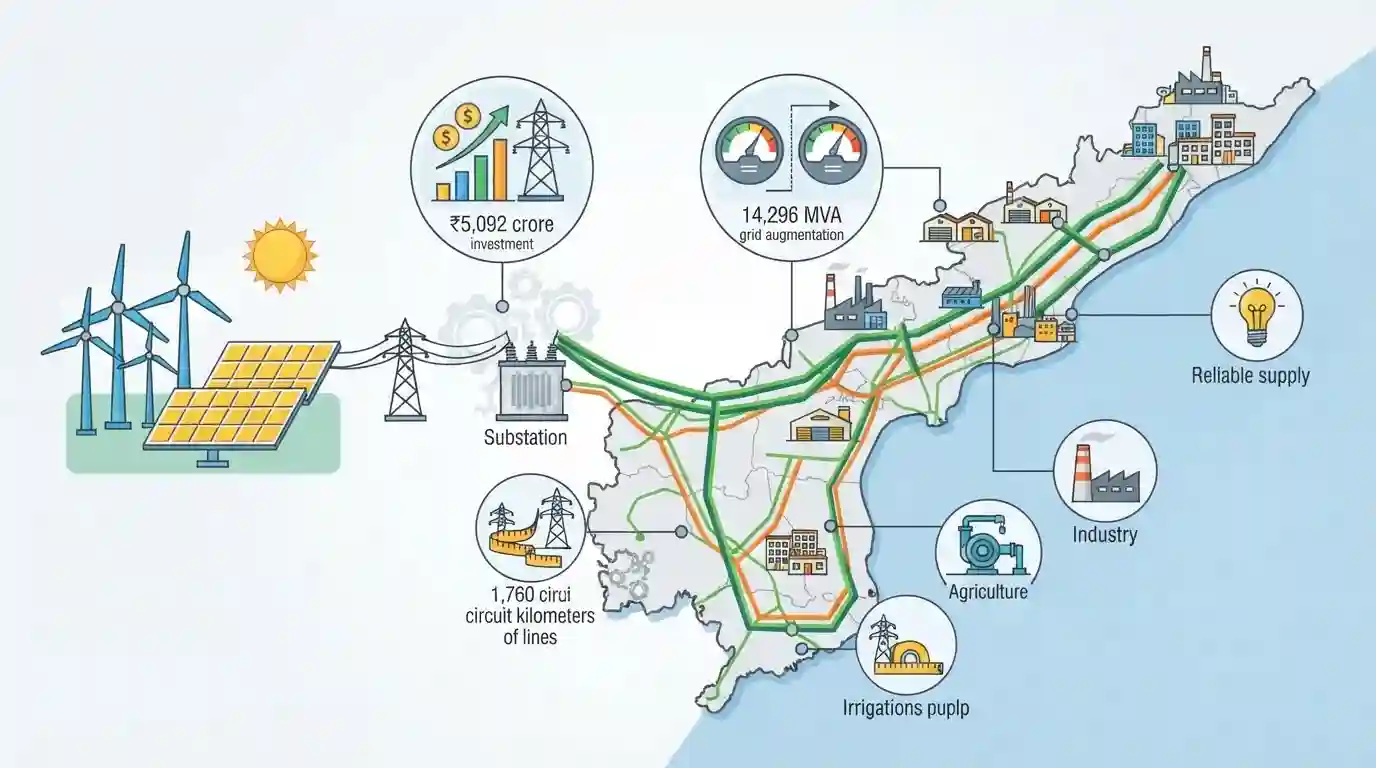
Andhra Pradesh is undertaking a massive expansion of its power transmission infrastructure, implementing 60 major projects with an investment of ₹5,092 crore. The initiative, spearheaded by AP-Transco, will augment the grid's capacity by 14,296 MVA and add 1,760 circuit kilometers of transmission lines to handle peak demands effectively. Besides ensuring a 24x7 reliable power supply for domestic, agricultural, and industrial consumers, the upgraded infrastructure is crucial for seamlessly integrating renewable energy into the state's grid. The project aligns with the state's broader economic goals of supporting rapid industrialization and sustained economic growth.
ముఖ్య అంశాలు
- The Andhra Pradesh government is investing ₹5,092 crore to execute 60 major power transmission projects to cater to growing electricity demand.
- The expansion will add 14,296 MVA in transmission capacity and 1,760 circuit kilometers of lines across 400kV, 220kV, and 132kV networks.
- A significant objective of these grid upgrades is the seamless integration of renewable energy sources into the state power grid.
- The infrastructure overhaul aims to ensure 24x7 uninterrupted power supply, bolstering industrial and economic development in the state.
ముఖ్యమైన పదాలు
Transmission Corporation of Andhra Pradesh Limited (AP-Transco)

The state-owned utility responsible for planning, constructing, operating, and maintaining the extra high-tension power transmission network and grid system within the state of Andhra Pradesh.
UPSC context
GS Paper III (Infrastructure: Energy); tests state-level electricity grid operations and public utility reforms.
State Transmission Utility (STU)
A state-designated government entity responsible for intra-state power transmission, maintaining grid stability, and wheeling electricity from generating stations to regional distribution companies.
UPSC context
GS Paper III (Infrastructure: Energy); tests knowledge of the power sector value chain and federal utility roles.
Grid Integration of Renewable Energy
The technical process of connecting intermittent green energy sources like solar and wind into the main electricity grid while ensuring system frequency and voltage stability.
UPSC context
GS Paper III (Infrastructure: Energy, Environment); tests solutions to clean energy intermittency and grid modernization.
DISCOM (Power Distribution Company)
A utility responsible for last-mile delivery of electricity to households, businesses, and farms, acting as the primary revenue-collecting arm of the power sector.
UPSC context
GS Paper III (Infrastructure: Energy, Economic Development); tests knowledge of distribution efficiency and financial reforms.
Circuit Kilometre (ckm)
A metric measuring the cumulative length of all conductors used in a transmission line network, accounting for multiple circuits suspended on the same towers.
UPSC context
GS Paper III (Infrastructure: Energy); tests technical metrics related to electricity grid scale and transmission capacity.
Mega Volt Ampere (MVA)
A unit of apparent electrical power capacity used to measure the transformer and substation capacity required to step voltages up or down during transmission.
UPSC context
GS Paper III (Infrastructure: Energy); tests familiarity with power system transformation metrics and infrastructure capacity.
ప్రిలిమ్స్ ఉచ్చు
"Green Energy Corridors are entirely state-funded and state-managed initiatives for intra-state renewable power evacuation."
The Green Energy Corridor (GEC) is a Centrally Sponsored Scheme receiving Central Financial Assistance and external loans (e.g., KfW Germany), not purely state-funded.
అనుసంధానమైన స్థిర భావనలు
What are the primary challenges of integrating renewable energy into grids?
- Intermittency: Solar and wind generation fluctuate based on weather, causing frequency and voltage instability in conventional grid systems.
- Evacuation Infrastructure: Major RE potential zones (like solar parks) are often in remote locations, requiring massive upfront investments in new transmission lines.
- Grid Balancing: Managing peak demand requires ancillary services like Pumped Storage Hydro (PSP) or Battery Energy Storage Systems (BESS) to absorb excess generation.
What is the Green Energy Corridor (GEC) project?
- Core Objective: A project to synchronize electricity produced from renewable sources with conventional power stations in the national grid.
- Intra-State Component: Facilitates the evacuation of large-scale renewable power within states, implemented by State Transmission Utilities (STUs).
- Funding Mechanism: Supported by the Ministry of New and Renewable Energy (MNRE) with Central Financial Assistance (CFA) to offset state infrastructure costs.
అంతర-అంశ నమూనాలు
Smart Grids & Digital Twins
State-led "Digital Twin grids" mirror physical transmission networks, showcasing how emerging technologies (GS3 IT) are directly solving renewable energy intermittency (GS3 Energy) and load forecasting.
Cooperative Federalism in Net Zero
National climate targets (Panchamrit) increasingly rely on state-specific 'Integrated Clean Energy' policies, making cooperative federalism a prerequisite for India's 2070 Net Zero ambitions.

Grid stability tech (Digital Twins) and RE evacuation corridors are highly probable as a GS3 Mains 15-marker on India's 500GW target.
అనుసంధాన PYQలు · 3
అనుసంధాన PYQలు · 3
- 2024APPSC_PRELIMSGS1
Which of the following statements are valid in connection with Andhra Pradesh Green Hydrogen and Green Ammonia Policy (2023)? I. The objective is to target Green Energy production up to the capacity of 1 MPTA (Million Tonnes Per Annum) or Green Ammonia production up to the capacity of 2-0 MTPA in the next five years. II. New and Renewable Energy Development Corporation of A.P. Ltd (NREDCAP) shall act as a Nodal Agency under this policy. III. All the Ports in the State have infrastructure for storing liquid nitrogen which can then be utilized for storing Green Hydrogen for exporting to other countries. IV. The Policy prohibits the production of Green Hydrogen/Green Ammonia by using Renewable Energy and/or Biomass from 'Third-Party/Power exchange'. Select the correct answer using the codes given below :
- 2024APPSC_PRELIMSGS1
In connection with transport and infrastructure in Andhra Pradesh, which of the following statement/statements is/are valid? I. Andhra Pradesh's first riverine project has been proposed between Muktayala and Madipadu on Krishna river. II. The Bhogapuram Greenfield International Airport had been started with a corpus fund that is sourced from National Investment and Infrastructure Fund (NIIF). III. Infrastructure investments in Andhra Pradesh are strictly implemented only with reference to strategic investments like ports and industrial corridors, but not with reference to community assets. IV. Rail Over Bridges (ROBs) are being developed in Andhra Pradesh under the Setu Bandhan Scheme. Select the correct answer using the codes given below :
- 2024APPSC_PRELIMSGS1
Which of the following statement/statements is/are incorrect regarding the Andhra Pradesh Industrial Policy 2023 - 27? I. To achieve a minimum contribution of 25% by industry in the State GDP II. To provide end-to-end facilitation in 2 weeks III. To envisage ten (10) priorities of accomplishment IV. To focus on becoming a 'Plug and Play State' for investments V. Ensuring land allotment by APIIC within a period of 2 weeks upon receipt of application Select the answer using the codes given below :
