Andhra Pradesh and UAE Firm Sign MoU for Chittoor Food Processing Unit
Source:etvbharat ↗
Why It Matters
This article is crucial for APPSC Group 1 aspirants as it touches upon state-specific economic geography (Rayalaseema as a horticulture hub), the food processing industry (a key GS3 topic), and international relations (India's economic diplomacy with the UAE/Middle East). Understanding how state-level MoUs facilitate FDI and export-led growth is essential for answers on economic development and external trade.
Summary
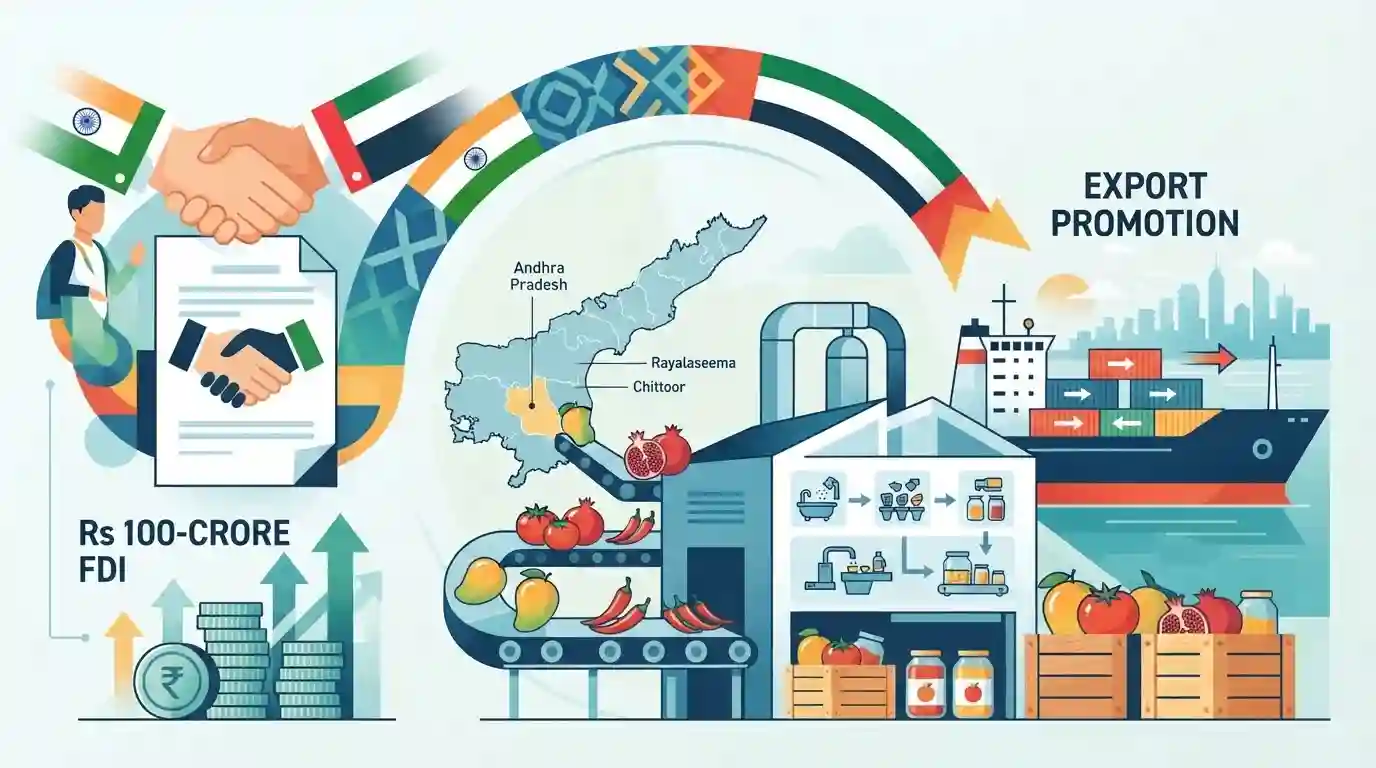
The Andhra Pradesh Economic Development Board (AP EDB) has signed a Rs 100-crore MoU with UAE-based Flour Masters International to set up a food processing unit in Chittoor district. The project aims to boost agricultural exports by adding value to the horticulture produce of the Rayalaseema region. This investment highlights the deepening economic and strategic relations between India and the UAE, emphasizing foreign direct investment in the food and agricultural sector.
Key Points
- The Andhra Pradesh Economic Development Board (AP EDB) has signed a Memorandum of Understanding (MoU) with UAE-based Flour Masters International to establish a food processing unit in the state.
- The project entails an investment of Rs 100 crore and will be located in Gangadhara Nellore mandal in the Chittoor district.
- The initiative is specifically designed to add value to horticultural produce from the Rayalaseema region, transforming it into a hub for agricultural exports.
- This state-level MoU reinforces broader India-UAE economic ties and aligns with India's strategic push to attract Foreign Direct Investment (FDI) into the food processing and export sectors.
Important Terms
Andhra Pradesh Economic Development Board (AP EDB)

The state nodal agency responsible for accelerating inclusive economic growth, promoting strategic investments, and acting as a catalyst for improving the business climate and industrial coordination in Andhra Pradesh.
UPSC context
GS Paper 3 (Investment Models). Highlights the role of state-level institutional frameworks in facilitating ease of doing business.
Foreign Direct Investment (FDI) in Food Processing
Cross-border capital investment into domestic food manufacturing and cold-chain logistics. It helps build resilient supply chains, add value to raw horticulture, and connect local production with global distribution networks.
UPSC context
GS Paper 3 (Food Processing). Tests understanding of how foreign capital boosts agricultural exports, supply-chain resilience, and farmer incomes.
Flour Masters International
A Dubai-headquartered food manufacturing company investing ₹100 crore to establish an export-oriented food processing facility in Chittoor, Andhra Pradesh, under the India-UAE bilateral framework.
UPSC context
GS Paper 3 (Food Processing). Acts as a concrete case study of UAE-backed FDI strengthening India's value-added agro-exports.
UAE Food Cluster Initiative
A strategic bilateral partnership aiming to develop integrated food processing, cold-chain logistics, and storage facilities in India. It aligns with the UAE's National Food Security Strategy 2051 to diversify import sources.
UPSC context
GS Paper 2 (Bilateral Relations). Illustrates the expanding India-UAE strategic partnership, focusing on mutual food security and trade.
Indian School of Agriculture
An upcoming agricultural institution established by the Andhra Pradesh government in partnership with Reliance. It aims to build specialized capacity and support the transformation of the region into a horticulture hub.
UPSC context
GS Paper 3 (Agriculture). Relevant for highlighting Public-Private Partnerships (PPP) in agricultural education, research, and capacity building.
Prelims Trap
100% FDI is permitted under the automatic route for multi-brand retail of locally produced food products.
100% FDI is allowed under the automatic route for food processing. However, FDI in retail trading (including e-commerce) of food products manufactured/produced in India requires prior government approval.
Static Concepts Connected
What are the current FDI limits for India's Food Processing and Retail sectors?
- Food Processing: 100% FDI is permitted under the automatic route for the manufacturing and processing of food products.
- Food Retail: 100% FDI is allowed, but it requires prior government approval for retail trading (including e-commerce) of food products manufactured in India.
How does the India-UAE CEPA specifically boost India's agricultural exports?
- Zero Duty Access: The agreement eliminates tariffs on a massive percentage of Indian agricultural and processed food products, making them highly competitive in the UAE.
- Gateway to MENA: UAE acts as a transit hub for the broader Middle East and North Africa (MENA) region, amplifying the reach of Indian food exports.
Cross-Topic Patterns
I2U2 Food Corridors & CEPA
Gulf nations rely heavily on food imports, while India seeks FDI for its sunrise food processing sector. This structural complementarity drives both India-UAE CEPA and the I2U2 food park investments.
Dryland Horticulture & Regional Equity
Agro-based industrialization in drought-prone, rain shadow regions like Rayalaseema acts as a tool for balanced regional development, turning climatic constraints into dryland horticulture export advantages.

Expect a multi-statement Prelims question blending FDI rules for food processing/retail with UAE investments under the I2U2 framework.
Linked PYQs · 4
Linked PYQs · 4
- 2024APPSC_PRELIMSGS1
Consider the following statements with regard to India's Foreign Policy : I. India's Act East Policy was originally conceived as an economic initiative but had later extended into political, strategic and cultural dimensions. II. The 'Connect Central Asia Policy' has been taken forward with the institutionalization of the 'India-Central Asia Summit' mechanism. III. Under the 'Security and Growth for All in the Region' (SAGAR) Policy, the DRDO initiated the Marine and Allied Interdisciplinary Training and Research Initiative (MAITRI) for the purpose of establishing long-term collaboration with countries in the East Asian region. IV. India's Think West Policy is an outreach to the Western Industrialized nations for strengthening of relations in areas of education and defence. Which of the above statements are valid ?
- 2024APPSC_PRELIMSGS1
Which of the following statement can best be described as having resulted in the recovery of India's external sector ?
- 2008APPSC_PRELIMSGS1
The major route of exports and imports is:
- 2023APPSC_PRELIMSGS1
'World Competitiveness Index' is released by which of the following organizations?
