Andhra Pradesh Expands Green Building and Sustainable Projects
Source:The Hindu ↗
Why It Matters
This highlights a practical, state-level execution of Sustainable Development Goals (SDGs). AP's use of economic incentives (subsidies, tax discounts) to drive environmentally friendly infrastructure development (green buildings) is a prime example for APPSC questions focusing on the intersection of urban planning, environmental ecology, and public finance.
Summary
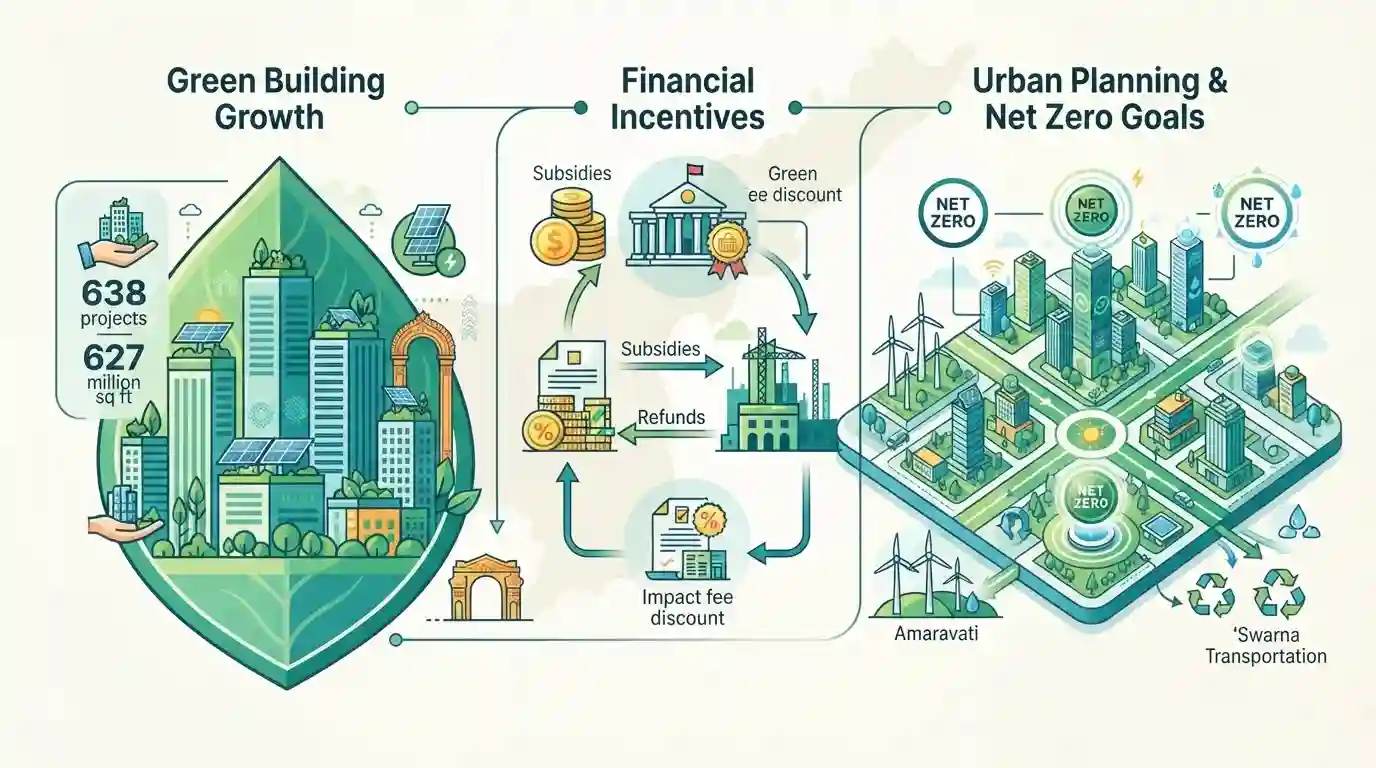
Andhra Pradesh is making significant strides in sustainable urban development, registering 638 green building projects with the Indian Green Building Council (IGBC) that cover over 627 million square feet. To accelerate this transition, the state government has instituted robust financial incentives, including capital subsidies, APRERA registration refunds, and up to a 20% discount on impact fees. This green building push is deeply integrated into the state's broader urban planning framework, particularly in the development of the greenfield capital Amaravati and the Swarna Andhra 2047 vision. Concurrently, the IGBC is advocating for the widespread adoption of its Net Zero ratings to ensure new infrastructure minimizes its environmental footprint in terms of carbon, energy, and water.
Key Points
- Andhra Pradesh hosts 638 IGBC-registered green building projects covering 627.58 million square feet, spanning commercial, residential, industrial, and transit sectors.
- The AP government provides significant fiscal incentives for green buildings, including up to 20% discount on impact fees, APRERA registration refunds, capital subsidies, and transfer charge concessions.
- Sustainable urban planning is a core focus for the development of Amaravati as a greenfield capital city and the transformation of Visakhapatnam, aligning with the state's 'Swarna Andhra 2047' vision.
- The Indian Green Building Council (IGBC) is actively pushing for the adoption of comprehensive Net Zero ratings (energy, water, waste, carbon) to support a low-carbon transition in the real estate sector.
Important Terms
Swarna Andhra 2047

A strategic vision by the Andhra Pradesh government to transform the state into a $2.4 trillion economy by 2047. It focuses on zero poverty, sustainable infrastructure, human capital development, and inclusive growth.
UPSC context
GS Paper 2 & 3. Tests state-level economic planning, decentralized development models, and alignment with national Viksit Bharat goals.
Indian Green Building Council (IGBC)
Established by the Confederation of Indian Industry in 2001, it is India's premier certification body for sustainable buildings. It develops green rating systems and advocates for environmentally responsible infrastructure.
UPSC context
GS Paper 3 (Environment). Crucial for topics on sustainable urban development, green certifications, and India's climate action targets.
IGBC Net Zero ratings
A specialized certification framework evaluating buildings on their ability to eliminate their environmental footprint. It assesses net-zero capabilities across energy use, water consumption, carbon emissions, and waste generation.
UPSC context
GS Paper 3 (Environment). Tests knowledge of decarbonization pathways, sustainable architecture, and mechanisms to achieve global net-zero goals.
Andhra Pradesh Real Estate Regulatory Authority (APRERA)
The state-level regulatory body enforcing the central RERA Act of 2016 in Andhra Pradesh. It ensures transparency, protects homebuyers, and mandates the registration of all real estate projects and agents.
UPSC context
GS Paper 2 (Governance). Relevant for regulatory frameworks, consumer rights protection, and transparency in urban real estate markets.
Confederation of Indian Industry (CII)
A leading non-governmental trade association and advocacy group in India. It works closely with the government to shape industrial policies, promote economic growth, and drive sustainability initiatives like the IGBC.
UPSC context
GS Paper 2 & 3. Highlights the role of industry bodies in policy formulation, economic development, and public-private partnerships.
Prelims Trap
"The Indian Green Building Council (IGBC) is a statutory body under the Ministry of Environment."
IGBC is not a government or statutory body. It was formed by the Confederation of Indian Industry (CII), a non-governmental trade association, in 2001.
Static Concepts Connected
What are the primary Green Building rating frameworks in India?
- GRIHA: Developed by TERI and MNRE to assess environmental performance. A minimum 3-star rating is mandatory for central government buildings under CPWD.
- IGBC: An initiative by the Confederation of Indian Industry (CII) offering voluntary, industry-led sustainability ratings for various building and transit typologies.
- BEE Ratings: Bureau of Energy Efficiency provides Energy Conservation Building Codes (ECBC) and Eco Niwas Samhita specifically targeting residential energy efficiency.
What criteria define a Net-Zero Energy Building (NZEB)?
- Energy Neutrality: The total energy consumed by the building annually is equal to or less than the amount of renewable energy created on-site or procured.
- Demand Reduction: High-performance design and ultra-efficient systems (like HVAC, LED lighting, and passive cooling) drastically reduce baseline energy demand before renewables are applied.
Cross-Topic Patterns
Sub-national Climate Action
State-level fiscal incentives like AP's impact fee discounts for green buildings showcase crucial decentralized execution of India's national COP26 Net-Zero targets.
Greenfield Capitals & Sustainable Urbanization
Amaravati's integration of IGBC norms reflects recurring GS-1 and GS-3 themes on sustainable urbanization and the necessary evolution of 'Smart Cities' into 'Eco-Cities'.

Prelims 2026 will likely test the institutional difference between GRIHA (MNRE) and IGBC (CII) in a multi-statement environment question.
Linked PYQs · 4
Linked PYQs · 4
- 2024APPSC_PRELIMSGS1
The Interim Union Budget (FY25) has proposed initiatives to boost India's Green Energy Sector. Which of the following proposals are connected with developing India's Green Energy ? I. Viability Gap Funding (VGF) for utilizing solar energy projects II. To set up coal gasification and liquefaction capacity of 100MT by 2030 III. Optional blending of Compressed Bio Gas (CBG) in Compressed Natural Gas (CNG) for transport and Piped Natural Gas (PNG) for domestic purposes IV. Provision of financial assistance for procurement of biomass aggregation machinery V. Setting up of a payment security system for expanding the bio-manufacturing system in the country Select the correct answer using the codes given below :
- 2024APPSC_PRELIMSGS1
Which of the following statement/statements is/are valid in connection with Sustainable Development Goals (SDGs) ? I. Achieving Goal 10 will require an entire reform of the financial system that promotes equitable pay and decent work for young people. II. NITI Aayog has developed the National Indicator Framework (NIF) for facilitating monitoring of SDGs in India. III. 'Mission LiFE' aims to influence government and industrial policy to support both sustainable consumption and production. IV. The concept of global citizenship embedded in Sustainable Development Goal 4 (SDG 4) is a reference term that indicates flexible citizenship rights across countries, for the purpose of facilitating better labour markets. Select the correct answer using the codes given below :
- 2019APPSC_PRELIMSGS1
Out of the options given below, what should be the basic goal of "Sustainable Development" ?
- 2024APPSC_PRELIMSGS1
The strategic objective of Asset Monetization Programme may be explained as :
