Guntur Electoral Rolls: Special Voter Registration Campaign
Source:deccanchronicle ↗
Why It Matters
The article highlights the practical execution of the Election Commission of India's mandate (under Article 324) to prepare and revise electoral rolls. Understanding the role of grassroots election machinery (like Booth Level Officers) and digital interventions (like the Voter Helpline App) is crucial for topics related to constitutional bodies, electoral processes, and e-governance in the APPSC syllabus.
Summary
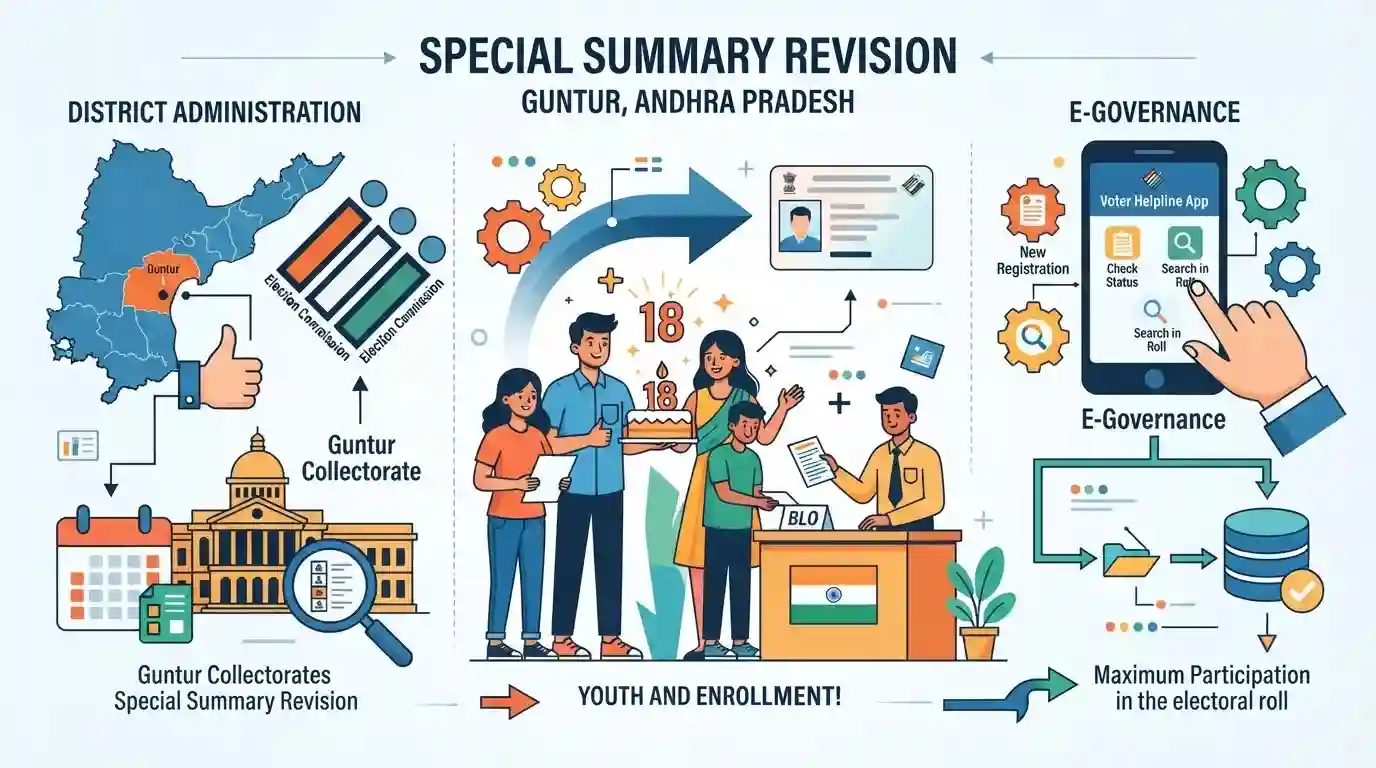
The District Election Officer of Guntur, Andhra Pradesh, has urged eligible citizens, especially youth completing 18 years of age, to enroll as voters during the Election Commission's special campaign days. The initiative is part of the Special Summary Revision of voter lists aimed at ensuring maximum electoral participation. Citizens are encouraged to check their enrollment status through Booth Level Officers or via digital platforms like the Voter Helpline App, reinforcing the Election Commission's mandate to maintain accurate electoral rolls.
Key Points
- The Election Commission of India has designated special campaign days for the Special Summary Revision of voter lists.
- Eligible individuals, particularly those turning 18, are urged to enroll as voters to exercise their franchise in the upcoming elections.
- Voters can verify their names on the electoral list through Booth Level Officers (BLOs) or online via the Election Commission's website and Voter Helpline App.
- The Guntur District Election Officer emphasized the importance of active citizen participation in the electoral process to ensure free and fair elections.
Important Terms
Election Commission of India (ECI)

An autonomous constitutional authority responsible for administering election processes in India at the national and state levels, including the preparation of electoral rolls and the conduct of free and fair elections.
UPSC context
APPSC Group-I Polity (Paper III). Tests knowledge of Article 324, constitutional bodies, and their role in democratic governance.
Special Summary Revision (SSR)
A targeted exercise conducted by the Election Commission to review and update electoral rolls by adding newly eligible voters, updating demographic details, and eliminating duplicate or deceased voters.
UPSC context
APPSC Governance and Polity. Highlights mechanisms for ensuring universal adult suffrage and the maintenance of accurate electoral data.
Booth Level Officer (BLO)
A local government official who acts as the Election Commission's grassroots representative, responsible for maintaining accurate electoral rolls and verifying voter details for a specific polling area.
UPSC context
APPSC Public Administration/Governance. Illustrates the decentralised administrative machinery and grassroots-level execution of electoral processes.
District Election Officer (DEO)
A state government officer, typically the District Magistrate or Collector, designated by the ECI to supervise, direct, and control all election-related work and administration within a district.
UPSC context
APPSC Public Administration. Crucial for understanding the district collector's statutory role in managing elections under the RPA 1950.
Representation of the People Act (RPA)
Key legislation that governs the allocation of seats, delimitation of constituencies, preparation of electoral rolls, qualifications of voters, and the legal framework for conducting elections in India.
UPSC context
Core APPSC Polity topic. Frequently tested on the legal framework of elections, electoral reforms, and statutory provisions guiding the ECI.
Voter Helpline App
A mobile application developed by the Election Commission of India providing digital services for voter registration, electoral roll search, complaint filing, and downloading digital voter slips.
UPSC context
APPSC E-Governance. Demonstrates the integration of technology and digital public infrastructure to enhance voter participation and transparency.
Prelims Trap
The Right to Vote is a Fundamental Right guaranteed to all Indian citizens.
The Right to Vote is a Constitutional Right under Article 326, not a Fundamental Right. It is subject to statutory limitations under the Representation of the People Act.
Static Concepts Connected
Which provisions govern the preparation of electoral rolls in India?
- Article 326: Establishes universal adult suffrage, serving as the constitutional foundation for voting rights at 18 years of age.
- Article 325: Mandates one general electoral roll for every territorial constituency, prohibiting discrimination based on religion, race, caste, or sex.
- RPA 1950: Provides the exact statutory framework for the preparation, continuous updating, and periodic revision of electoral rolls.
What distinguishes the Representation of the People Act 1950 from RPA 1951?
- RPA 1950: Focuses on pre-election processes: delimitation of constituencies, allocation of legislative seats, and preparation of electoral rolls.
- RPA 1951: Focuses on the actual conduct of elections, polling processes, corrupt practices, electoral offenses, and disqualification of members.
Cross-Topic Patterns
E-Governance + SVEEP Initiatives
The Voter Helpline App demonstrates how e-governance tools bridge gaps in electoral participation, forming a core part of ECI's SVEEP (Systematic Voters' Education and Electoral Participation) program.
61st Amendment + Demographic Dividend
Lowering the voting age in 1988 (61st CAA) empowered India's youthful demographic dividend, profoundly shaping modern political campaigning, youth-centric policies, and election manifestos.

Expect multi-statement questions testing the exact differences in scope between RPA 1950 (electoral rolls) and RPA 1951 (election conduct).
Linked PYQs · 2
Linked PYQs · 2
- 2024APPSC_PRELIMSGS1
Consider the following statements with reference to the Election Commission of India : I. The Constitution of India has debarred the retiring Election Commissioners from any further appointment by the government. II. In 'Anoop Baranwal Case' (2023), the Supreme Court has directed the Government to treat the Regional Commissioners on par with the Election Commissioners (other than the Chief Election Commissioner), as far as removal from office is concerned. III. Since its inception, the Election Commission had functioned as a multi-member body. IV. The power of superintendence, direction and control of elections to the office of Vice-President of India is vested in the Election Commission. Which of the above statement/statements is/are valid ?
- 2023APPSC_PRELIMSGS1
The powers of the Election Commission include which of the following? I. The Election Commission takes decisions on every aspect of conduct and control of elections from the announcement of elections to the declaration of results. II. During the election period, the Election Commission can order the Government to dismiss some government officials. III. When on election duty, Government officers work under the control of the Election Commission. Choose the correct answer using the codes given below:
