Andhra Pradesh Telecom Viability Gap Funding for Rural Connectivity
Source:The Hindu ↗
ఇది ఎందుకు ముఖ్యం
It demonstrates an active state-level intervention using mechanisms like Viability Gap Funding to encourage private and public telecom players to build infrastructure in non-profitable remote areas, which is crucial for fulfilling the broader goals of Digital India and inclusive e-governance.
సారాంశం
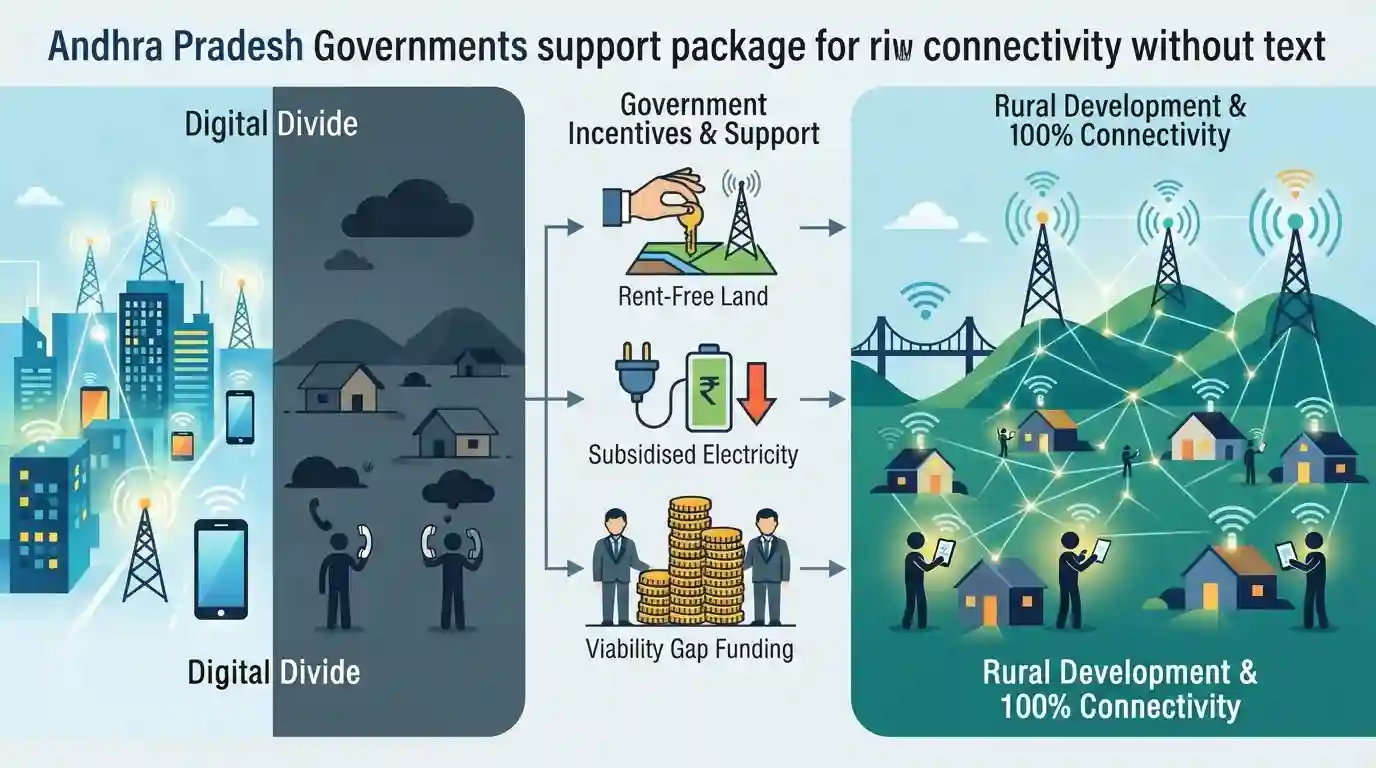
The Andhra Pradesh government has announced a comprehensive support package for Telecom Service Providers (TSPs) aimed at achieving 100% mobile connectivity in the state. By offering rent-free land, subsidised electricity, and viability gap funding, the state intends to incentivize operators like BSNL, Reliance Jio, Airtel, and Vodafone Idea to set up mobile towers in previously unconnected and remote villages, thereby addressing the digital divide.
ముఖ్య అంశాలు
- The Andhra Pradesh government is offering extensive support to Telecom Service Providers (TSPs) to achieve 100% mobile connectivity across the state.
- Incentives include the provision of suitable land without rental charges, subsidised power supply, and viability gap support for establishing mobile towers.
- The initiative targets unconnected villages and remote habitations to bridge the digital divide and ensure equitable access to digital services.
- Major participating operators include BSNL, Bharti Airtel, Reliance Jio, and Vodafone Idea.
ముఖ్యమైన పదాలు
Viability Gap Funding (VGF)

A financial grant provided by the government to support infrastructure projects that are economically essential but commercially unviable, making them attractive for private sector participation.
UPSC context
Relevant for GS-3 (Infrastructure/Economy). Tests understanding of Public-Private Partnerships (PPP) and innovative methods for infrastructure financing.
Universal Service Obligation Fund (USOF)
A fund generated by a 5% levy on telecom operators' adjusted gross revenue, utilized by the government to finance telecom and broadband infrastructure in unserved rural and remote areas.
UPSC context
Important for GS-3 (Infrastructure). Highlights government interventions to bridge the digital divide and ensure inclusive technological development.
Department of Telecommunications (DoT)
A government department under the Ministry of Communications responsible for formulating telecom policies, granting licenses, and managing spectrum and funds like USOF to accelerate telecommunication growth.
UPSC context
Relevant for GS-2 (Governance) and GS-3 (Infrastructure). Tests knowledge of India's regulatory and administrative framework for digital services.
BSNL
Bharat Sanchar Nigam Limited is a central public sector enterprise that provides telecom services, frequently executing state mandates to expand connectivity into commercially unviable rural and remote regions.
UPSC context
Relevant for GS-3 (Economy/Infrastructure). Tests understanding of the role of Public Sector Undertakings (PSUs) in fulfilling social obligations.
ప్రిలిమ్స్ ఉచ్చు
"The Universal Service Obligation Fund (USOF) is an executive, lapsable fund managed under the Consolidated Fund of India."
USOF (now Digital Bharat Nidhi) is a statutory, non-lapsable fund under the Indian Telegraph Act. Unspent funds do not revert to the general budget at the end of the financial year.
అనుసంధానమైన స్థిర భావనలు
What is the Viability Gap Funding (VGF) Scheme for infrastructure?
- Core Purpose: Provides capital grants to Public-Private Partnership (PPP) projects that are economically justified but fall short of financial viability.
- Funding Limits: The Union Government can fund up to 20% of the Total Project Cost (TPC); the sponsoring State/Ministry can provide an additional 20%.
- Eligible Sectors: Originally for roads and ports, it now extensively covers social infra, wastewater, and rural telecommunications/mobile towers.
How is the Universal Service Obligation Fund (USOF) structured?
- Statutory Backing: Given statutory status by the Indian Telegraph (Amendment) Act, 2003. Recently rebranded as 'Digital Bharat Nidhi' under the Telecommunications Act, 2023.
- Revenue Source: Generated by a Universal Service Levy (USL), which is a percentage charged on the Adjusted Gross Revenue (AGR) of all telecom service providers.
- Nature of Fund: It is a non-lapsable fund. Moneys are first credited to the Consolidated Fund of India, then appropriated by Parliament.
అంతర-అంశ నమూనాలు
Telecom VGF + Financial Inclusion (JAM)
Last-mile mobile connectivity dictates the success of the JAM (Jan Dhan-Aadhaar-Mobile) trinity. Without physical telecom infrastructure in remote Schedule V areas, DBT, UPI, and e-governance penetration remains artificially constrained.
Cooperative Federalism in Digital Infrastructure
While telecommunications is firmly a Union List subject, execution relies on state-level cooperative federalism. Local Right of Way (RoW) clearances, rent-free land, and power subsidies are prerequisites for national schemes like BharatNet.

Expect a multi-statement Prelims 2026 question linking Digital Bharat Nidhi (USOF) funding sources, VGF mechanisms, and the digital divide.
అనుసంధాన PYQలు · 2
అనుసంధాన PYQలు · 2
- 2024APPSC_PRELIMSGS1
The Interim Union Budget (FY25) has proposed initiatives to boost India's Green Energy Sector. Which of the following proposals are connected with developing India's Green Energy ? I. Viability Gap Funding (VGF) for utilizing solar energy projects II. To set up coal gasification and liquefaction capacity of 100MT by 2030 III. Optional blending of Compressed Bio Gas (CBG) in Compressed Natural Gas (CNG) for transport and Piped Natural Gas (PNG) for domestic purposes IV. Provision of financial assistance for procurement of biomass aggregation machinery V. Setting up of a payment security system for expanding the bio-manufacturing system in the country Select the correct answer using the codes given below :
- 2024APPSC_PRELIMSGS1
With regard to the progress of Digital Payments in India, which of the following statement/statements is/are valid? I. Promotion of Digital Payments has been transferred from the Ministry of Electronics and Information Technology (MeitY) to the Department of Financial Services. II. e-RUPI is an institution-based voucher management system instead of being person and purpose specific. III. 'Hello! UPI' is an AI voice-enabled payment feature built by a consortium of private sponsored startups recognised by the NPCI. IV. 'UPI LITE X' addresses challenges of remote areas by enabling offline UPI payments. Select the correct answer using the codes given below:
