Tenders Issued for Statewide Implementation of Sanjeevani
Source:thehindu ↗
Why It Matters
The digitization of health records at the state level directly reflects on governance and public service delivery topics in the APPSC Group 1 syllabus. Understanding state-specific schemes like Sanjeevani is crucial for the Prelims as questions frequently target regional health and welfare initiatives.
Summary
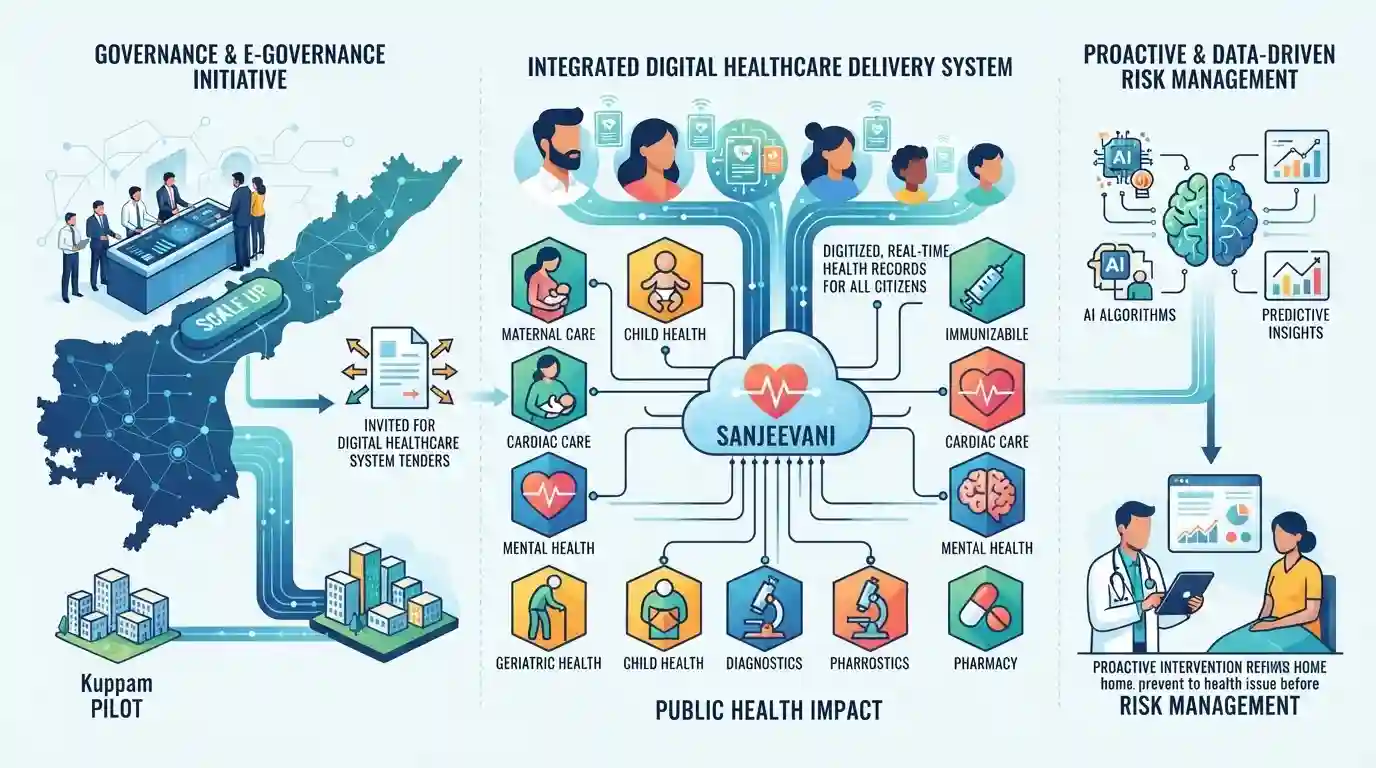
The Andhra Pradesh government is scaling up its 'Sanjeevani' scheme by inviting tenders to establish an integrated digital healthcare delivery system. Following a successful pilot in Kuppam, the scheme aims to maintain digitized, real-time health records for all citizens, covering 12 major domains from maternal care to geriatric health, thereby shifting the state's public healthcare approach toward proactive and data-driven risk management.
Key Points
- The Government of Andhra Pradesh has issued a Request for Proposal (RFP) to implement the ‘Sanjeevani’ scheme statewide.
- Initially rolled out as a pilot project in Kuppam, the initiative focuses on creating a comprehensive digital care coordination and healthcare delivery system.
- The scheme creates continuously updated digital health records for citizens to proactively analyze medical histories, identify risks, and send health alerts.
- It targets 12 critical healthcare domains, including maternal and child health, non-communicable diseases, mental health, trauma care, and free medicine distribution.
Important Terms
Sanjeevani scheme

An Andhra Pradesh digital healthcare initiative utilizing mobile medical units for comprehensive preventive screenings. It creates centralized electronic health records to facilitate personalized telemedicine, health alerts, and data-driven disease management.
UPSC context
Highly relevant for GS Paper 2 (Health, E-governance). Illustrates a proactive, technology-driven shift from reactive treatment to preventive public healthcare.
Department of Health, Medical and Family Welfare
The nodal state government department in Andhra Pradesh tasked with public health administration, managing medical infrastructure, and implementing welfare programs, including integrated digital healthcare delivery systems.
UPSC context
GS Paper 2 (Governance, Health). Represents the institutional framework responsible for state-level health policy execution and improving healthcare access.
Government of Andhra Pradesh
The state executive authority of Andhra Pradesh, currently undertaking policy shifts toward e-governance and proactive public welfare management through digitized, real-time civic and health service delivery systems.
UPSC context
GS Paper 2 (State Governments, E-governance). Useful as a practical case study for state-led digital welfare initiatives and decentralised healthcare administration.
Prelims Trap
Sanjeevani is a pan-India telemedicine initiative under the Union Ministry of Health.
The Union government's telemedicine platform is 'eSanjeevani'. The 'Sanjeevani' scheme highlighted here is an Andhra Pradesh state-level initiative focusing on electronic health records.
Static Concepts Connected
What are the core building blocks of the Ayushman Bharat Digital Mission (ABDM)?
- ABHA Number: A 14-digit unique health identification number allowing citizens to access and share their health records digitally.
- Professionals Registry (HPR): A comprehensive, verified repository of all registered medical practitioners across both modern and traditional systems of medicine.
- Facility Registry (HFR): A centralized database of health facilities, including hospitals, clinics, and diagnostic labs across the country.
How does the DPDP Act, 2023 regulate public healthcare data?
- Consent Requirement: Processing of personal data requires clear, affirmative, and unconditional consent from the citizen, barring specific medical emergencies.
- Data Fiduciary Duties: State health departments managing platforms like Sanjeevani act as fiduciaries and are legally bound to implement security safeguards.
Cross-Topic Patterns
Digital Health Records & Data Privacy
Statewide digitization of health records directly intersects with the DPDP Act 2023, testing the state's capacity as a 'data fiduciary' safeguarding sensitive personal data.
Proactive Care & NCD Mitigation
The shift from reactive treatment to proactive risk management aligns with India's broader public health goals to curb non-communicable diseases (NCDs) and reduce out-of-pocket expenditure.

Expect a 2026 GS-2 Mains question evaluating state-level digital health registries (like AP's Sanjeevani) against the national ABDM framework.
Linked PYQs · 1
Linked PYQs · 1
- 2024APPSC_PRELIMSGS1
Which of the following statements are valid regarding the interventions of the Government of Andhra Pradesh in the context of Healthcare ? I. Telemedicine facility is available in all Ayushman Bharat Health and Wellness Centres (AB-HWCs) to avail specialist services through district hub. II. The Family Doctor Programme has been planned to be implemented as a standalone project without the need to be integrated with Primary Health Centres (PHCs). III. Dr. YSR Aarogyasri Scheme has been revamped, by increasing the income limit from ₹ 2.5 lakh to ₹ 5 lakh per annum per family. IV. 'Aarogya Aasara' Scheme is intended to provide post-operative sustenance allowance with certain eligible conditions complied with. Select the correct answer using the codes given below :
