AP Urban Infrastructure: ₹7,469 Crore Push Approved Under HAM Model
Why It Matters
This development highlights major capital investments in urban infrastructure through innovative financing frameworks like the Hybrid Annuity Model (HAM) in Andhra Pradesh, making it crucial for state economic development and public finance questions in APPSC exams.
Summary
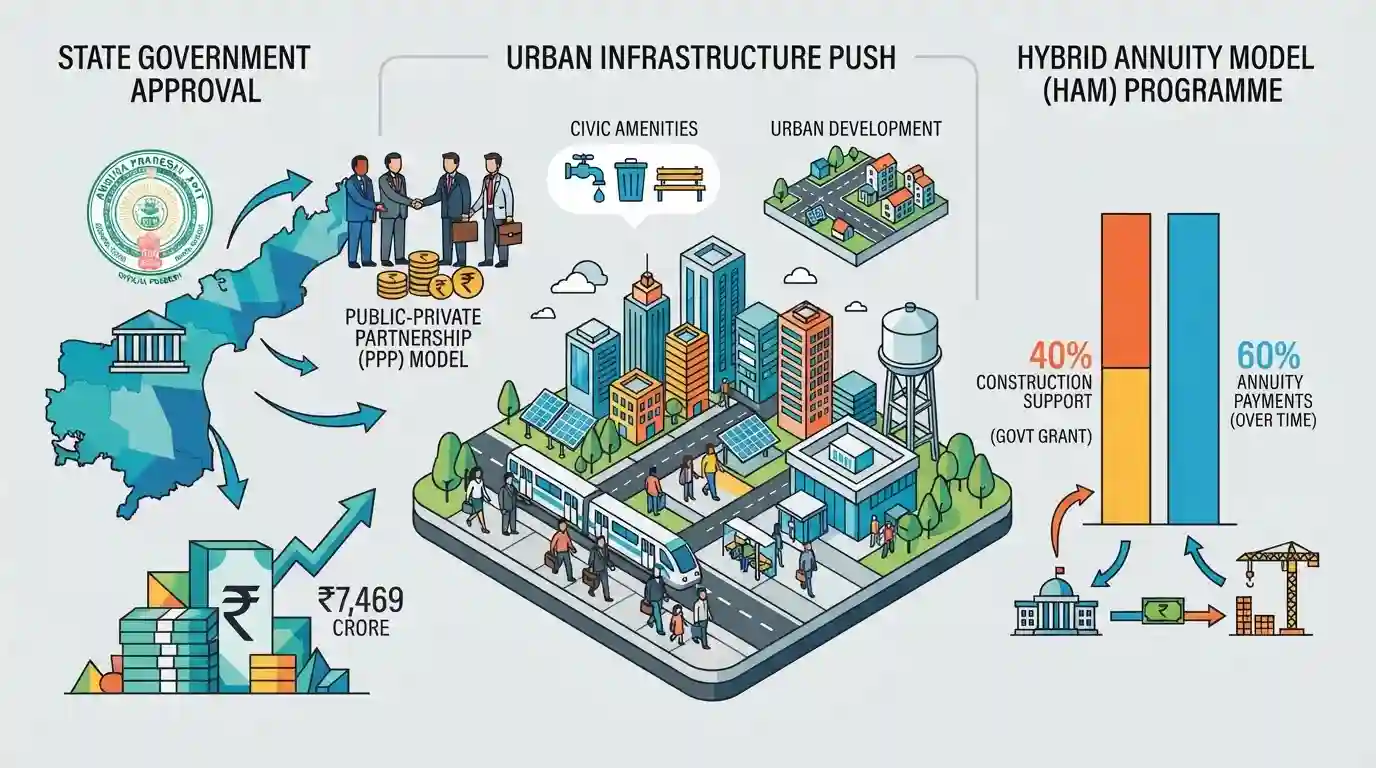
The Andhra Pradesh government has approved a ₹7,469 crore urban infrastructure push under the Hybrid Annuity Model (HAM) programme to boost civic amenities and urban development across the state.
Key Points
- The Andhra Pradesh government cleared a massive urban infrastructure push worth ₹7,469 crore.
- The projects will be implemented under the Hybrid Annuity Model (HAM) programme to fast-track development and attract private participation.
- The initiative focuses on upgrading urban infrastructure, enhancing civic amenities, and improving public service delivery across urban local bodies in the state.
Important Terms
Hybrid Annuity Model (HAM) Programme

A Public-Private Partnership model combining elements of EPC (Engineering, Procurement, Construction) and BOT (Build-Operate-Transfer). The government pays a portion of the project cost upfront, while the rest is paid as annuities over a fixed period.
UPSC context
Crucial for APPSC Group 1/2 Economy and Infrastructure topics, testing knowledge of innovative public-private financing mechanisms for state development.
Prelims Trap
Private concessionaires under HAM recover their entire investment and profit directly through user tolls and municipal taxes collected from citizens.
Aspirants often confuse HAM with BOT (Toll), assuming the private developer collects user fees from citizens, whereas under HAM the government makes annuity payments.
Static Concepts Connected
What are the key financial and operational features of the Hybrid Annuity Model (HAM) in infrastructure projects?
- Model Blend: Combines the features of EPC (Engineering, Procurement, Construction) and BOT (Build, Operate, Transfer) models to reduce private sector risk.
- Financial Split: Government typically pays 40% of the project cost during construction, while the remaining 60% is financed by the developer and paid back via annuities.
- Annuity Payout: Annuity payments include operational and maintenance (O&M) costs along with interest on the remaining capital over a fixed repayment term.
Cross-Topic Patterns
State Urban Infrastructure & Swarna Andhra 2047
AP's urban infrastructure push directly operationalizes the 'Swarna Andhra 2047' vision, connecting state-level decentralized fiscal planning with national urbanization targets under AMRUT.
HAM Models in State Fiscal Management
HAM's risk-sharing mechanism bridges traditional EPC and BOT models, representing a core fiscal instrument studied in APPSC Group 1 Public Administration paper under financial administration.

APPSC may frame multi-statement questions on HAM financial structure (upfront vs annuity split) and ULB coverage under the AP infrastructure push.
Linked PYQs · 2
Linked PYQs · 2
- 2024APPSC_PRELIMSGS1
In connection with transport and infrastructure in Andhra Pradesh, which of the following statement/statements is/are valid? I. Andhra Pradesh's first riverine project has been proposed between Muktayala and Madipadu on Krishna river. II. The Bhogapuram Greenfield International Airport had been started with a corpus fund that is sourced from National Investment and Infrastructure Fund (NIIF). III. Infrastructure investments in Andhra Pradesh are strictly implemented only with reference to strategic investments like ports and industrial corridors, but not with reference to community assets. IV. Rail Over Bridges (ROBs) are being developed in Andhra Pradesh under the Setu Bandhan Scheme. Select the correct answer using the codes given below :
- 2024APPSC_PRELIMSGS1
The strategic objective of Asset Monetization Programme may be explained as :
