Local Body Reservations and Judicial Review in Andhra Pradesh
Source:The Hindu ↗
हे का महत्त्वाचे आहे
It touches upon critical constitutional governance issues: the boundaries of judicial review over legislative/executive reservations, the implementation of triple-test criteria for local body reservations, and federal dynamics concerning state-level electoral policies.
सारांश
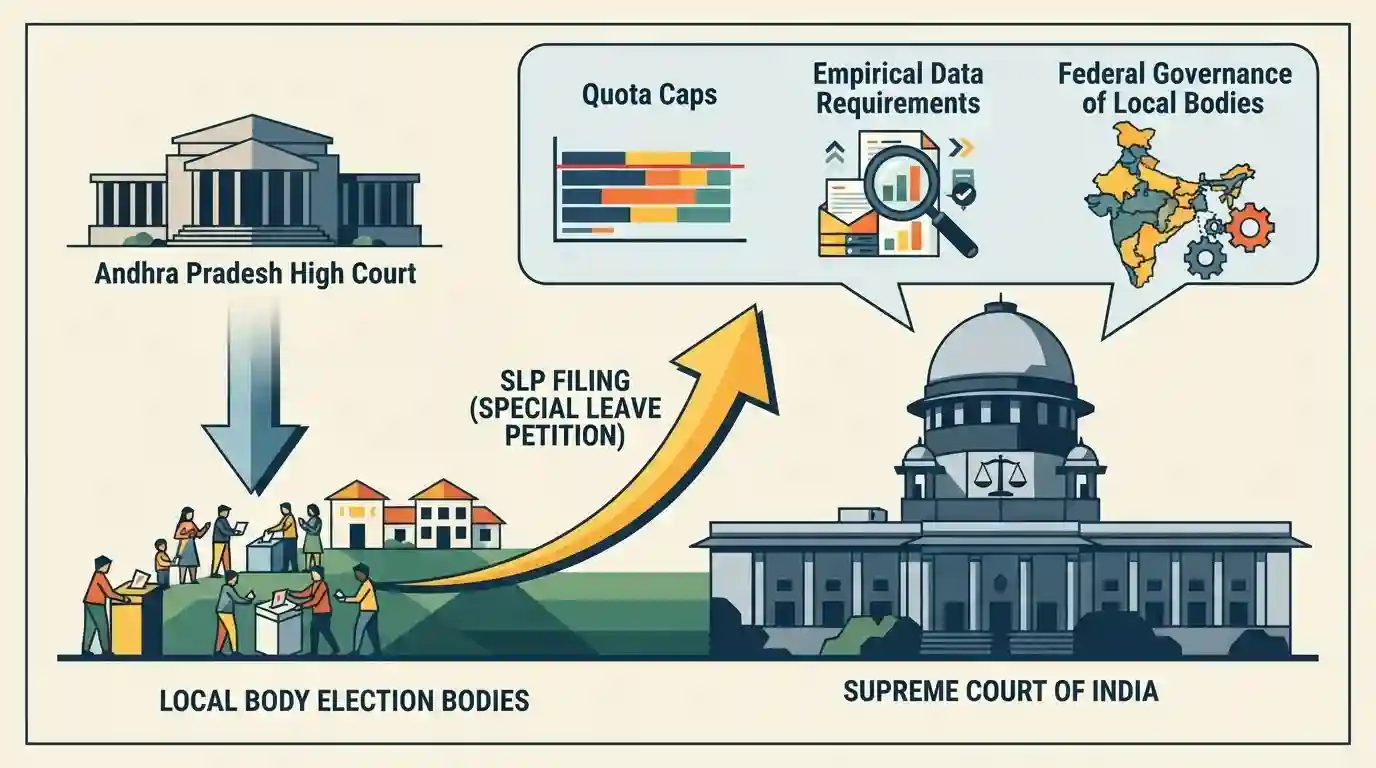
The Andhra Pradesh government filed a Special Leave Petition (SLP) in the Supreme Court challenging a High Court verdict on Backward Classes (BC) reservations in local body elections. The case highlights ongoing legal debates surrounding quota caps, empirical data requirements for political reservation, and federal governance of local bodies.
मुख्य मुद्दे
- The Andhra Pradesh government has filed a Special Leave Petition (SLP) in the Supreme Court challenging the High Court judgment regarding Backward Classes (BC) quotas in local body elections.
- The dispute centers around reservations for backward classes in panchayats and urban local bodies, navigating legal ceilings and empirical data requirements mandated by judicial precedents.
- Local body elections and reservation caps (such as the 50% overall limit and empirical backing of political backwardness via dedicated commissions) remain a contentious arena of Centre-State and Judiciary-Executive friction.
महत्त्वाच्या संज्ञा
Special Leave Petition (SLP)

A discretionary constitutional remedy under Article 136 empowering the Supreme Court of India to grant special permission to appeal against any judgment, decree, or order from any Indian court or tribunal.
UPSC context
UPSC Polity (GS Paper 2): Tests understanding of the Supreme Court's appellate jurisdiction, judicial review, and discretionary powers under Article 136.
Supreme Court of India
The apex judicial institution of India under the Constitution, serving as the final court of appeal, protector of fundamental rights, and arbitrator of constitutional disputes.
UPSC context
UPSC Polity (GS Paper 2): Core structure and functioning of the Indian judiciary, judicial activism, and checks and balances.
Andhra Pradesh High Court
The constitutional court exercising jurisdiction over the state of Andhra Pradesh, empowered to review executive actions and state legislation under Article 226.
UPSC context
UPSC Polity (GS Paper 2): Tests the organization, jurisdiction, and role of High Courts in federal governance and judicial review.
संबंधित स्थिर संकल्पना
What are the constitutional provisions and judicial mandates governing reservations in local body elections in India?
- Constitutional Basis: Mandated under Articles 243D (panchayats) and 243T (municipalities), reserving seats for SCs, STs, and optionally Backward Classes based on state legislation.
- Triple Test Framework: The Supreme Court established a three-pronged requirement: empirical inquiry into backwardness, proportional fixation, and ensuring the 50% aggregate cap is not breached.
- SLP Jurisdiction: Article 136 grants the Supreme Court extraordinary discretionary power to grant special leave to appeal against any judgment or order from any court in India.
आंतर-विषय नमुने
Local Body Quotas vs. Creamy Layer Doctrine
The Triple Test for local bodies mirrors the creamy layer principle in public employment, testing how courts apply data-driven thresholds across different parts of the Constitution.

Expect statement-based questions combining Article 136 discretionary powers with the Supreme Court's 'Triple Test' mandate for local body quotas.
संबंधित PYQ · 2
संबंधित PYQ · 2
- 2022MainsGS2
Discuss the role of the National Commission for Backward Classes in the wake of its transformation from a statutory body to a constitutional body.
- 2023PrelimsGS1
Consider the following statements: Statement-I: The Supreme Court of India has held in some judgements that the reservation policies made under Article 16(4) of the Constitution of India would be limited by Article 335 for maintenance of efficiency of administration. Statement-II: Article 335 of the Constitution of India defines the term 'efficiency of administration'. Which one of the following is correct in respect of the above statements?
