Foreign Direct Investment Inflows Surge in Andhra Pradesh
Source:deccan-chronicle ↗
ఇది ఎందుకు ముఖ్యం
Tracking state-level FDI inflows is critical for evaluating the effectiveness of industrial policies and the broader economic climate, such as the Ease of Doing Business (EoDB). For APPSC Group 1 candidates, understanding the state's economic progress, top-performing sectors, and investment trends is essential for questions on the socio-economic status of Andhra Pradesh.
సారాంశం
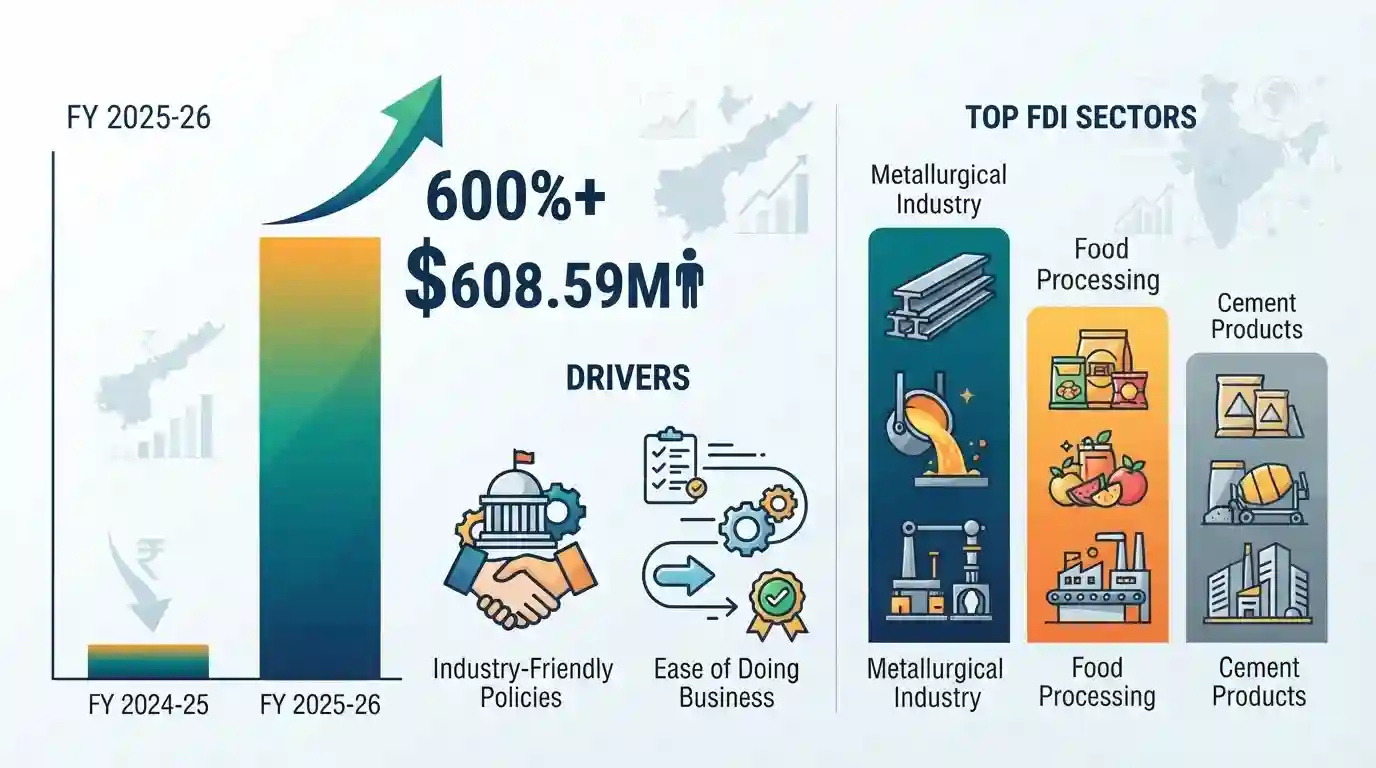
Foreign Direct Investment (FDI) inflows into Andhra Pradesh surged by over 600% in the financial year 2025-26 compared to the previous year, reaching $608.59 million. According to data tabled in the Lok Sabha, this substantial increase is credited to the state's industry-friendly policies and enhanced Ease of Doing Business (EoDB). The metallurgical industry emerged as the leading sector for FDI, followed by food processing and cement products, highlighting targeted sectoral growth within the state's economy.
ముఖ్య అంశాలు
- Foreign Direct Investment (FDI) into Andhra Pradesh increased by over six-fold to $608.59 million in 2025-26, up from $233.14 million in 2024-25.
- The FDI figures were presented in the Lok Sabha by the Union Minister of State for Commerce and Industry in response to a question by YSRC MP Dr Maddila Gurumoorthy.
- The significant growth is attributed to the state's proactive industry-friendly policies and a favorable Ease of Doing Business (EoDB) environment.
- Metallurgical industries received the highest FDI at $250.67 million.
- Other prominent sectors attracting FDI included food processing ($107.30 million), cement and cement products ($99.90 million), and services/R&D ($59.96 million).
ముఖ్యమైన పదాలు
Foreign Direct Investment (FDI)

An investment made by an individual or firm in one country into business interests in another country, establishing a lasting interest and significant decision-making control.
UPSC context
Relevant for GS Paper III (Economic Development, Investment Models), assessing understanding of capital inflows and balance of payments.
Ease of Doing Business (EoDB)
A regulatory metric assessing the simplicity, speed, and cost of starting, operating, complying, and exiting business activities in a country or state.
UPSC context
Important for GS Paper III (Industrial Policy, Economic Growth), testing understanding of regulatory streamlining and ease of operations.
Department for Promotion of Industry and Internal Trade (DPIIT)
A nodal central department under the Ministry of Commerce and Industry responsible for designing industrial growth policies, facilitating internal trade, and monitoring foreign direct investment.
UPSC context
Core institutional body for GS Paper III (Industrial Policy, Investment) and GS Paper II (Government Ministries), testing administrative machinery.
Andhra Pradesh Industrial Development Policy
A state-specific framework designed to stimulate industrial growth, attract foreign capital, offer investment incentives, and develop robust infrastructure through initiatives like single-window portals.
UPSC context
Relevant for GS Paper III (State-led Investment Models, Regional Development), testing competitive federalism and sub-national economic policies.
Business Reforms Action Plan (BRAP)
A sub-national assessment exercise initiated by DPIIT that ranks Indian States and Union Territories on their execution of regulatory reforms to improve the business environment.
UPSC context
Vital for GS Paper III (Planning, Growth) and GS Paper II (Federalism), demonstrating competitive federalism and state-level business reforms.
ప్రిలిమ్స్ ఉచ్చు
100% FDI is permitted under the Automatic Route for both food product manufacturing and retail trading of food products in India.
While 100% FDI is permitted under the Automatic Route for manufacturing food products, the retail trading (including e-commerce) of food products manufactured/produced in India requires prior Government Approval.
అనుసంధానమైన స్థిర భావనలు
What are the differences between the Automatic Route and Government Route for FDI in India?
- Automatic Route: No prior approval is required from the RBI or Government of India; investors merely notify the RBI post-facto.
- Government Route: Mandatory prior clearance is required; applications are submitted via the Foreign Investment Facilitation Portal (FIFP) and cleared by relevant ministries.
- Prohibited Sectors: Certain sectors like Lottery Business, Gambling, Chit Funds, and Nidhi Companies are completely closed to foreign direct investment.
What is the 'Plug and Play' state investment framework in industrial policy?
- Definition: Provides pre-cleared industrial land with pre-integrated utilities (power, water, waste management) so businesses can commence operations immediately.
- Objective: Significantly reduces the gestation period, regulatory compliance delays, and capital-intensive initial setup costs for foreign and domestic investors.
అంతర-అంశ నమూనాలు
Sub-national Federalism + Resource FDI
Concentration of metallurgical FDI in specific states demonstrates how regional resource endowments (like minerals) combined with targeted state-level EoDB reforms shape sub-national investment destinations.
Agri-processing FDI + Supply Chain Security
While 100% food manufacturing FDI is automatic, linking it to agricultural supply chain schemes (like PMKSY) remains critical to resolve India's post-harvest storage losses.

FDI regulatory nuances (such as food manufacturing vs retail trading routes) will likely be tested to assess conceptual precision in 2026.
అనుసంధాన PYQలు · 3
అనుసంధాన PYQలు · 3
- 2024APPSC_PRELIMSGS1
Which of the following statement/statements is/are incorrect regarding the Andhra Pradesh Industrial Policy 2023 - 27? I. To achieve a minimum contribution of 25% by industry in the State GDP II. To provide end-to-end facilitation in 2 weeks III. To envisage ten (10) priorities of accomplishment IV. To focus on becoming a 'Plug and Play State' for investments V. Ensuring land allotment by APIIC within a period of 2 weeks upon receipt of application Select the answer using the codes given below :
- 2024APPSC_PRELIMSGS1
Which of the following statement/statements is/are valid regarding the socio-economic status of Andhra Pradesh ? I. Andhra Pradesh won the Best State Award of ICAR - National Research Center for Banana (NRCB) for export promotion. II. Andhra Pradesh GSDP growth rate has been registering a decline in recent times owing to repeated lower returns in certain sub-sectors of the Service Sector. III. For the FY 2024 - 25, the Revenue Deficit is budgeted higher than the Fiscal Deficit in terms of percentage of Andhra Pradesh GSDP. IV. The technology used by the Government of Andhra Pradesh while conducting resurvey of landholdings is referred to as 'Continuously Operating Reference Stations (CORS)' technology. Select the correct answer using the codes given below :
- 2024APPSC_PRELIMSGS1
In recent times, many leading agencies have reaffirmed high growth for the Indian Economy. Which of the following statement/statements can be the best reason/reasons for India's projected high growth? I. Strong Private Final Consumption Expenditure (PFCE) II. Government's shift of focus from large capital expenditure towards private investment III. Increase in domestic air passenger traffic along with a reduction in the volume of Fast-Moving Consumer Goods (FMCG) IV. Fading of the El Nino oscillation and better Rabi crop prospects Select the correct answer using the codes given below:
