Eluru Cropping Pattern: Sugarcane to Coconut Shift Analysis
Source:chinimandi ↗
Why It Matters
This illustrates a real-world case of agricultural diversification and shifting cropping patterns driven by industrial decline (sugar mills shutting down). It is highly relevant for APPSC Prelims geography and economy sections focusing on crop concentration, agro-based industries, and the economics of commercial farming in Andhra Pradesh.
Summary
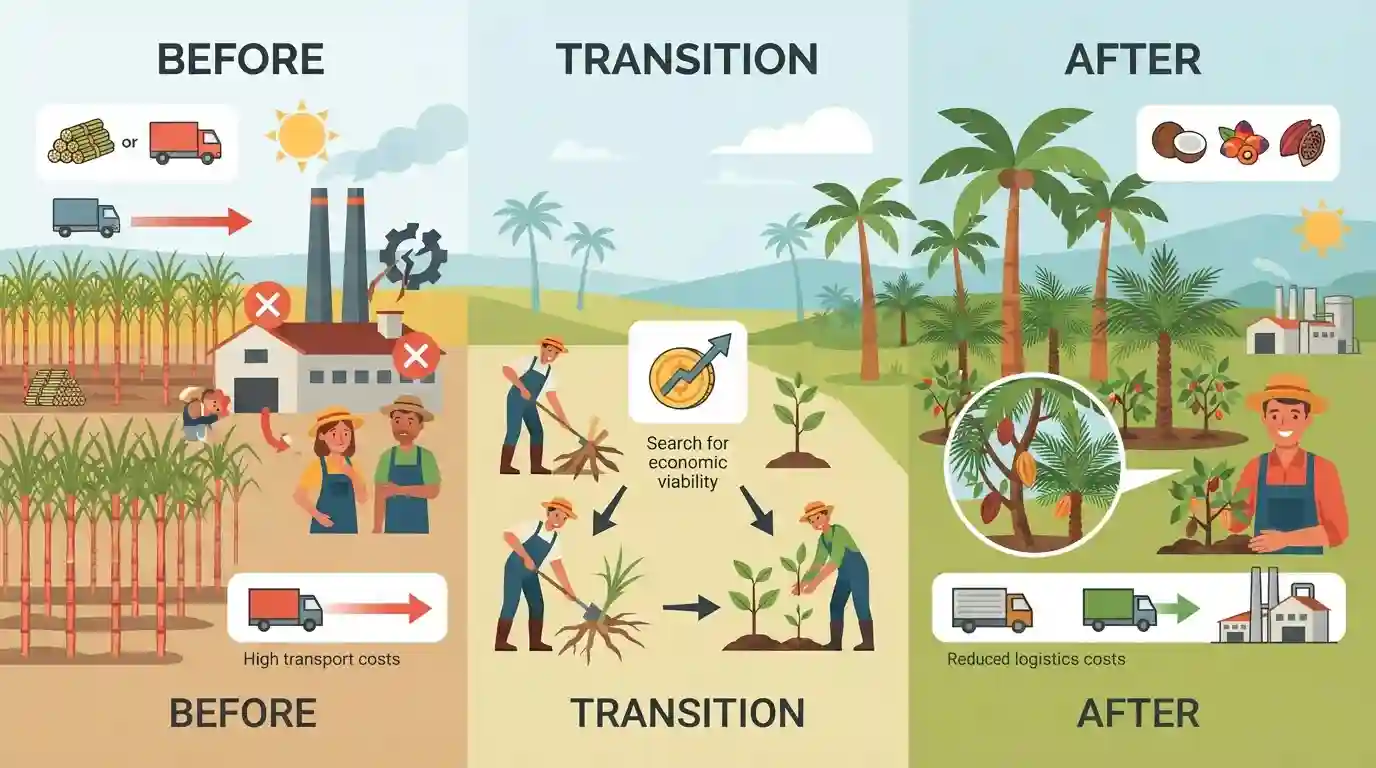
Farmers in the Eluru district of Andhra Pradesh are transitioning from sugarcane cultivation to horticulture crops like coconut, oil palm, and cocoa. This agricultural shift is largely a consequence of the shutdown of local sugar mills, which forced farmers to transport cane to distant facilities, thereby increasing logistics costs and reducing profit margins. Seeking better economic viability, farmers are leveraging the region's favorable conditions for commercial horticulture, utilizing intercropping methods such as growing cocoa alongside coconut to ensure steady income and mitigate risks associated with agro-industrial decline.
Key Points
- Farmers in the upland areas of Andhra Pradesh's Eluru district are steadily shifting from traditional sugarcane cultivation to horticulture and commercial crops.
- The shift is primarily driven by the closure of regional sugar mills, such as Navabharat Sugars, leaving farmers with limited processing options.
- Transportation costs to distant surviving mills like KCP Sugars in Vuyyuru have eroded the profitability of sugarcane for these farmers.
- Farmers are increasingly adopting multi-product commercial crops like coconut, oil palm, and cocoa, which offer better returns, steady income, and lower labor dependency.
- Coconut cultivation allows for intercropping with cocoa, maximizing land use and economic yield per acre.
Important Terms
Navabharat Sugars

A leading edible-oil refining company, originally founded as an agribusiness for palm plantations, headquartered in Eluru, Andhra Pradesh.
UPSC context
Tests agro-based industries in AP. While often associated with palm oil and other agro-products in Eluru, candidates should know its industrial footprint.
KCP Sugars
An integrated sugar manufacturing company operating a major complex in Vuyyuru, Andhra Pradesh. It diversifies into ethanol, co-generation of power, and processing Urad Dal.
UPSC context
Relevant for AP Economy (agro-industries). Demonstrates the viability of circular models (bagasse for power, molasses for ethanol) amidst sugarcane declines.
Prelims Trap
Kerala and Karnataka are the largest producers of Cocoa in India due to their tropical plantation climate.
Aspirants often associate plantation crops exclusively with the Western Ghats, but Andhra Pradesh (specifically Eluru) is actually the leading cocoa producer in India.
Static Concepts Connected
Why must sugar industries be located in close proximity to sugarcane cultivation areas?
- Weight-losing raw material: Sugarcane is a weight-losing crop; the sugar recovered is only about 9-12% of the total weight of the cane, making long-distance transport uneconomical.
- High perishability: Once cut, sucrose content begins to decline rapidly. Cane must be crushed within 24 hours to maximize sugar recovery.
- Transport logistics: Due to its bulky nature, moving sugarcane to distant mills sharply increases logistics costs, eroding farmer and miller profit margins.
What makes cocoa an ideal intercrop for coconut and oil palm plantations?
- Shade tolerance: Cocoa thrives well under the dappled sunlight provided by the canopy of tall palm trees, making it a perfect understory crop.
- Resource optimization: It maximizes the use of vertical space and varying root zones, extracting nutrients and water from different soil depths without competing directly.
- Risk mitigation: Cultivating two or more commercial crops on the same land diversifies income and shields farmers against price volatility in a single commodity.
Cross-Topic Patterns
Agro-industry decay altering cropping patterns
The decline of local sugar mills dictates agricultural geography, proving that cropping shifts are often driven by industrial logistics and transport costs rather than just climate factors.
NMEO-OP and AP's Oil Palm dominance
The transition to Oil Palm in Eluru aligns with the National Mission on Edible Oils, reinforcing Andhra Pradesh's massive 85-90% share in India's crude palm oil production.

Expect a multi-statement question combining AP's rank as India's top cocoa producer with the weight-losing geography of sugarcane.
Linked PYQs · 2
Linked PYQs · 2
- 2023APPSC_PRELIMSGS1
Match the following : | Methods of Agricultural Regionalisation | Agricultural Geographer | |---|---| | a. Crop combination | I. Weaver, Doi | | b. Crop diversification | II. Bhatia, Jasbir Singh | | c. Crop concentration | III. Chisholm, Bhatia | | d. Agricultural productivity | IV. Kendall, Majid Husain, Jasbir Singh | Choose the correct answer using the codes given below : Code: a b c d
- 2023APPSC_PRELIMSGS1
Which of the following factors are responsible for the higher Sugarcane production in tropical regions as compared to sub-tropical regions of India ? I. Cool nights with clear skies II. Latitudinal position III. Long hours of sunshine IV. High temperature disparity Choose the correct answer using the codes given below :
