Panchadarla Hill Mining Operations Face Government Probe
Source:news-on-air ↗
Why It Matters
Demonstrates the conflict between mining operations and the preservation of natural hydrology and historic heritage in Andhra Pradesh, relevant for state-specific geography and environmental conservation questions.
Summary
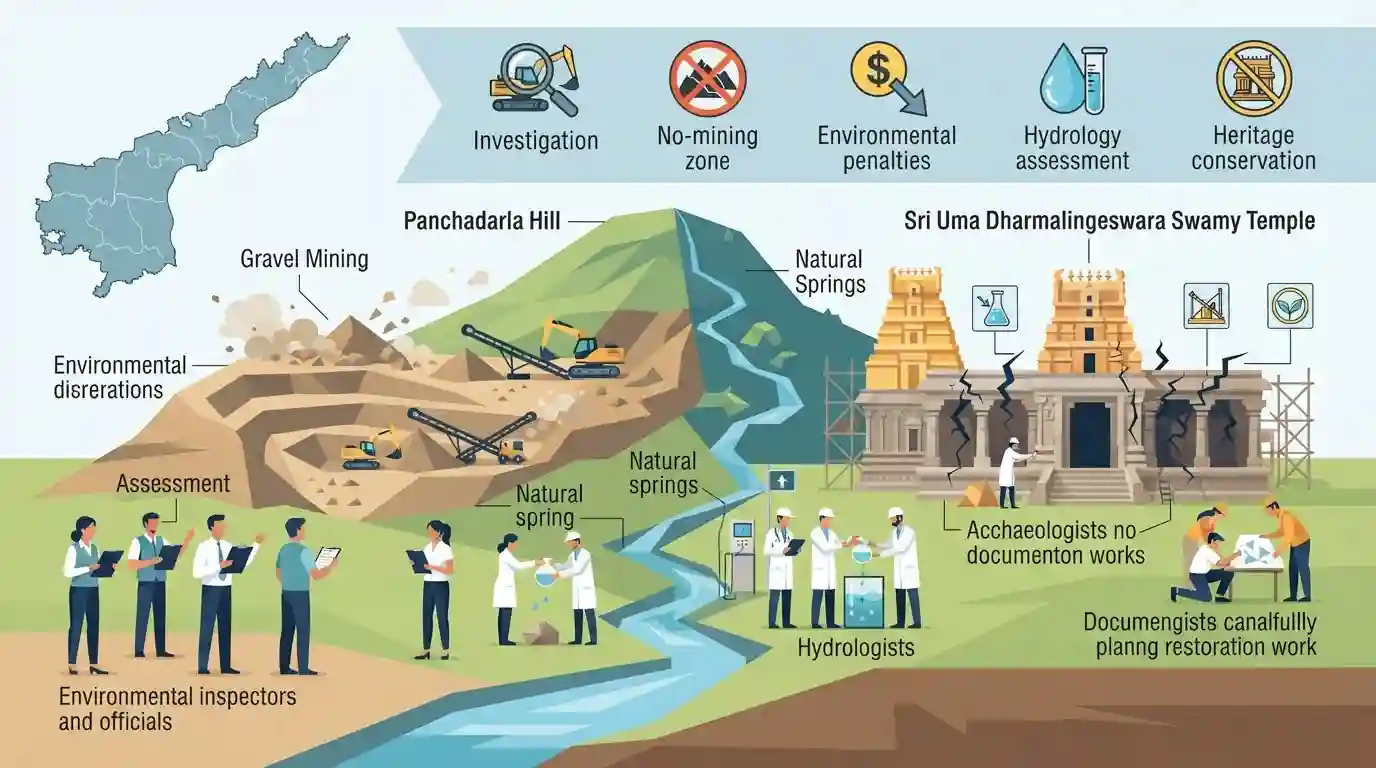
Andhra Pradesh Deputy Chief Minister and Minister for Forests and Environment, Pawan Kalyan, has mandated an investigation into gravel mining operations at Panchadarla Hill in Anakapalli district due to significant environmental and heritage concerns. Authorities have been instructed to assess the potential for levying environmental penalties and to declare the region a no-mining zone. The initiative also involves the National Institute of Hydrology assessing local natural springs, while the Archaeology Department will implement conservation strategies for the historic Sri Uma Dharmalingeswara Swamy Temple affected by nearby mining activities.
Key Points
- Andhra Pradesh Deputy Chief Minister Pawan Kalyan ordered a comprehensive probe into environmental and heritage violations due to gravel mining at Panchadarla Hill in Anakapalli district.
- The State Government intends to declare the Panchadarla Hill area as a no-mining zone and cancel existing mining clearances.
- The National Institute of Hydrology (NIH) has been directed to study the natural water springs in the area and assess the impact of mining.
- Archaeology and Endowments Departments are tasked with adopting conservation measures for the historic Sri Uma Dharmalingeswara Swamy Temple, which has been affected by the blasting activities.
Important Terms
Sri Uma Dharmalingeswara Swamy Temple

An ancient Shiva temple at the foothills of Panchadarla Hill in Anakapalli district, Andhra Pradesh. The heritage site features ecologically fragile natural springs, currently facing severe contamination threats from nearby illegal gravel mining operations.
UPSC context
Relevant for GS-1 (Art & Culture) and GS-3 (Environment). Tests awareness of regional heritage sites threatened by ecological degradation.
National Institute of Hydrology
An autonomous R&D society established in 1978 under the Ministry of Jal Shakti. Headquartered in Roorkee, it coordinates systematic scientific research on all aspects of hydrology, glacial mapping, and sustainable water resource management.
UPSC context
Important for GS-3 (Environment/Science & Tech). Tests knowledge of key national research institutes and their role in water management.
Andhra Pradesh Pollution Control Board
A state-level statutory body constituted under the Water (Prevention and Control of Pollution) Act, 1974. It is responsible for enforcing environmental laws, monitoring air and water quality, and regulating industrial pollution across the state.
UPSC context
Fits GS-2 (Statutory Bodies) and GS-3 (Environment). Highlights the mandate, origin, and enforcement powers of state pollution control boards.
Prelims Trap
Eastern Chalukyan temples follow a strictly pure Dravidian architectural style.
The Eastern Chalukyas operated in a geographic transition zone, often synthesizing both Nagara and Dravidian architectural elements rather than sticking to a single strict style.
Static Concepts Connected
What are the defining historical and cultural markers of the Eastern Chalukyas?
- Origin: They originated as a branch of the Badami Chalukyas in AD 624 when Pulakeshin II appointed Kubja Vishnuvardhana as the viceroy of the Vengi region.
- Architecture: Their temples, like those at Panchadarla and Bikkavolu, uniquely blend Northern (Nagara) and Southern (Dravidian) architectural styles.
- Language Patronage: They played a critical role in the evolution of regional literature, marking a definitive shift toward early Telugu patronage.
How is the mining of minor minerals like gravel and sand regulated in India?
- State Jurisdiction: Under the MMDR Act, 1957, State governments possess complete legislative and administrative control over minor minerals, including framing rules and collecting royalties.
- Environmental Clearances: Despite state jurisdiction, Supreme Court rulings (e.g., Deepak Kumar case) mandate strict environmental clearances (EC) for all minor mineral mining, regardless of the lease area size.
Cross-Topic Patterns
Heritage preservation vs Extractive mining
The Panchadarla temple issue highlights the broader GS-3/GS-1 conflict where unregulated minor mineral mining physically threatens un-ticketed regional archaeological and heritage sites.
Aquifers and Spring-shed management
Deploying the National Institute of Hydrology to map groundwater springs disrupted by blasting aligns with the growing UPSC focus on spring-shed depletion and hydro-geological mapping.

Expect a Prelims pairing of Eastern Chalukya sites (Panchadarla, Bikkavolu) with their unique Nagara-Dravidian architectural synthesis.
Linked PYQs · 2
Linked PYQs · 2
- 2024APPSC_PRELIMSGS1
In Andhra Pradesh, Dharwar types of rocks are found in:
- 2008APPSC_PRELIMSGS1
Vast reserves of metals and precious stones have been discovered for future mining in:
