Great Green Wall Project Accelerated to Prevent Coastal Erosion
Source:etvbharat ↗
Why It Matters
This state-specific environmental initiative provides excellent case-study material for coastal disaster mitigation, afforestation, and mangrove conservation, making it highly relevant for the APPSC Group 1 Prelims geography and environment sections.
Summary
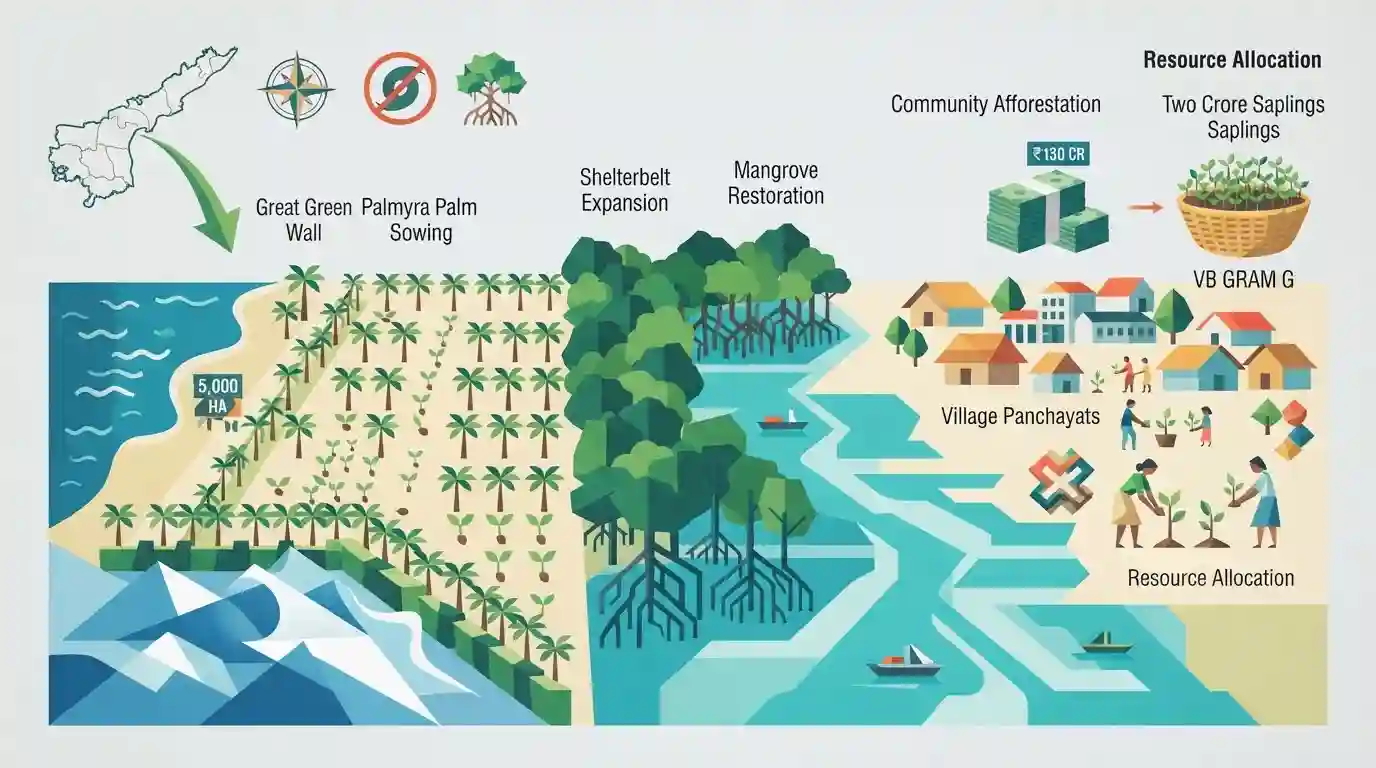
Andhra Pradesh is expediting its 'Great Green Wall' project to combat coastal erosion and enhance environmental protection. Directed by Deputy Chief Minister Pawan Kalyan, the initiative involves sowing palmyra palm seeds across 5,000 hectares, expanding shelterbelt plantations, and restoring mangrove forests—where the state currently holds the second position nationally. Furthermore, the government is utilizing MNREGA for planting native saplings and has allocated ₹130 crore under the VB GRAM G scheme to distribute two crore saplings to village panchayats for extensive afforestation.
Key Points
- Andhra Pradesh Deputy Chief Minister Pawan Kalyan instructed officials to expedite the 'Great Green Wall of Andhra Pradesh' project to combat coastal erosion.
- The state plans to sow palmyra palm seeds across 5,000 hectares to prevent soil erosion along its coastline.
- The project emphasizes the restoration and expansion of mangrove forests, a category in which Andhra Pradesh currently ranks second nationally.
- Additional measures include establishing shelterbelt plantations and planting casuarina and native saplings under the MNREGA scheme.
- ₹130 crore has been allocated to village panchayats via the VB GRAM G scheme to distribute two crore saplings.
Important Terms
Great Green Wall of Andhra Pradesh project

An ambitious 974 km-long, 5 km-wide ecological corridor along Andhra Pradesh's coastline designed to mitigate cyclones and tsunamis, reduce coastal erosion, and protect local livelihoods through extensive mangrove and shelterbelt plantations.
UPSC context
GS Paper III (Disaster Management & Environment); tests coastal vulnerability mitigation, climate resilience, and eco-friendly disaster prevention models.
VB-G RAM G Scheme
The 'Viksit Bharat - Guarantee for Rozgar and Ajeevika Mission (Gramin)' is a statutory social welfare scheme enacted in 2025 that replaced MGNREGA, guaranteeing 125 days of wage employment annually to rural households.
UPSC context
GS Paper II (Government Schemes) & GS Paper III (Employment); tests reforms in rural social security networks and durable asset creation.
MGNREGA
Enacted in 2005, the Mahatma Gandhi National Rural Employment Guarantee Act legally guaranteed 100 days of unskilled work to rural households. It served as India's primary social safety net before being succeeded by VB-G RAM G.
UPSC context
GS Paper II (Social Justice) & GS III (Employment); tests evolution of rights-based welfare programs, rural distress mitigation, and public asset creation.
Prelims Trap
"The 'Great Green Wall' project in India exclusively refers to the ecological corridor combating desertification in the Aravallis."
India now has multiple 'Green Walls'. The Aravalli Green Wall combats desertification, while Andhra's 'Great Green Wall' is a coastal bio-shield against cyclones and erosion.
Static Concepts Connected
How do coastal bio-shields and the 'Fish Bone Technique' protect vulnerable shorelines?
- Bio-shield zonation: A multi-layered barrier uses mangroves (seaward) to absorb tidal energy and tall trees like Palmyra palms (landward) to force cyclonic winds upwards.
- Fish Bone Technique: A restoration method where channels are dug in a fishbone shape to ensure proper tidal water circulation, preventing hypersalinity and promoting mangrove survival.
What are shelterbelts and how do they mitigate coastal geographic hazards?
- Wind velocity reduction: Rows of trees planted across the prevailing wind direction to dramatically reduce wind velocity and prevent aeolian (wind-driven) soil erosion.
- Dune stabilization: Deep-rooted coastal species like Casuarina and Palmyra stabilize loose sand dunes and act as a barrier against saltwater intrusion into groundwater aquifers.
Cross-Topic Patterns
MNREGA convergence with climate resilience
Using MNREGA funds for coastal bio-shields highlights a growing policy shift—evolving the scheme from purely rural employment generation toward climate-resilient asset creation and disaster risk reduction.
Eco-DRR and Sendai Framework
The shift from concrete sea walls to mangrove and palmyra bio-shields aligns with the Sendai Framework's emphasis on Ecosystem-based Disaster Risk Reduction (Eco-DRR).

Expect a multi-statement Prelims question contrasting India's 'Green Walls' (Aravalli desertification vs. Andhra coastal bio-shields).
Linked PYQs · 2
Linked PYQs · 2
- 2024APPSC_PRELIMSGS1
Match the following : | List-I (Wildlife Sanctuary in Andhra Pradesh) | List-II (Region) | |---|---| | A. Coringa | I. Kurnool | | B. Gundla Brahmeswaram | II. Kadapa | | C. Rollapadu | III. East Godavari | | D. Sri Lankamalleswara | IV. Kurnool and Prakasam | Choose the correct answer using the codes given below : Code: A B C D
- 2023APPSC_PRELIMSGS1
The greatest variety (diversity) of animal and plant species can be found in
