Andhra Pradesh Drought Mitigation and Agricultural Resilience
Source:vajiramandravi ↗
Why It Matters
Crucial for APPSC aspirants to understand regional climate vulnerabilities, agricultural risks, and administrative disaster response mechanisms within Andhra Pradesh.
Summary
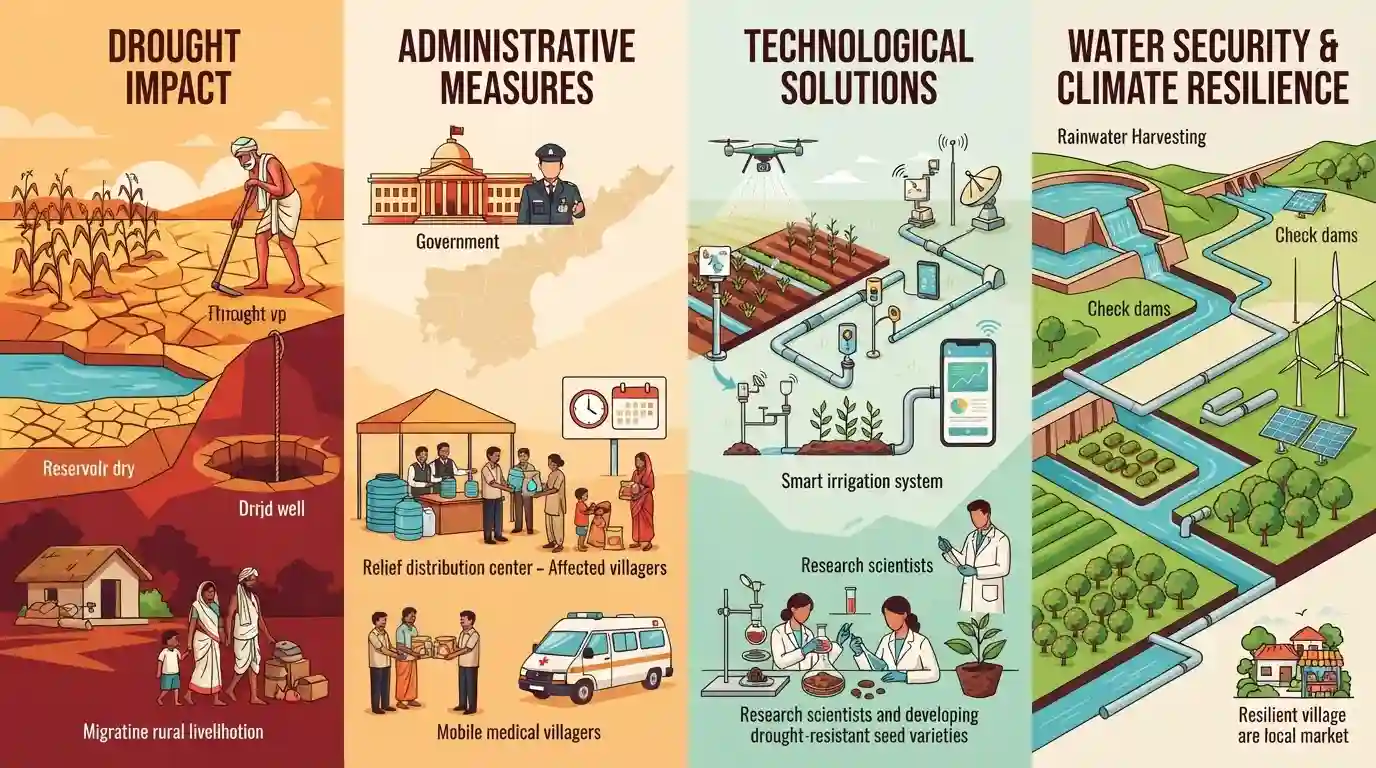
The article addresses the recurring drought conditions in Andhra Pradesh, highlighting their severe impact on agriculture and rural livelihoods, especially in arid and semi-arid zones. It discusses the critical administrative, technological, and policy measures needed for effective drought mitigation, climate resilience, and water security in the state.
Key Points
- Andhra Pradesh faces severe drought conditions affecting agricultural productivity, particularly in drought-prone regions like Rayalaseema.
- Drought management requires integrated water resource management, watershed development, and micro-irrigation systems.
- Policy interventions focus on drought relief, crop insurance schemes, and alternative livelihood opportunities for affected farmers.
Important Terms
Government of Andhra Pradesh

The executive authority of the state of Andhra Pradesh, responsible for formulating policies, administering disaster management responses, implementing drought mitigation projects (like APDMP), and providing relief to farmers in arid regions.
UPSC context
Relevant for APPSC Group 1 & 2 (Economy of AP, Polity, and Disaster Management), testing governance, welfare schemes, and administrative responses to agrarian crises.
Prelims Trap
Micro-irrigation is promoted exclusively through state-funded grants and subsidies without central convergence.
Aspirants often assume micro-irrigation subsidies are funded 100% by the State, whereas they are backed by combined central-state schemes like PMKSY-PMKS (Per Drop More Crop) alongside state top-ups.
Static Concepts Connected
What are the key institutional mechanisms and structural programs for drought management in Andhra Pradesh?
- Rayalaseema Vulnerability: Rayalaseema Region is historically arid, experiencing recurring moisture stress and meteorological drought requiring targeted watershed and lift irrigation interventions.
- APCNF Initiative: APCNF (Community Managed Natural Farming) promotes zero-budget natural farming, enhancing soil organic carbon and moisture retention during dry spells.
- Micro-Irrigation (APMIP): Micro-Irrigation AP (APMIP) implements drip and sprinkler networks with heavy subsidies to optimize scarce water utilization in upland tracts.
- Watershed Management: IWMP (Integrated Watershed Management Programme) focuses on ridge-to-valley treatment, soil conservation, and groundwater recharge in rain-fed districts.
Cross-Topic Patterns
AP Agriculture + State Disaster Management Financing
Drought mitigation in Rayalaseema connects the AP economy's agrarian structure with institutional irrigation infrastructure and disaster financing under the State Disaster Response Fund (SDRF).
APCNF + Climate Resilient Dryland Farming
Regenerative farming models like APCNF link climate adaptation strategies with rural livelihood security and sustainable groundwater extraction policies in peninsular India.

AP dryland farming, Rayalaseema irrigation projects, and APCNF are high-yield areas for APPSC Group 1/2 agriculture & economy questions.
Linked PYQs · 2
Linked PYQs · 2
- 2023APPSC_PRELIMSGS1
The CCRC introduced by Government of Andhra Pradesh stands for
- 2024APPSC_PRELIMSGS1
Which of the following statement/statements is/are valid regarding the socio-economic status of Andhra Pradesh ? I. Andhra Pradesh won the Best State Award of ICAR - National Research Center for Banana (NRCB) for export promotion. II. Andhra Pradesh GSDP growth rate has been registering a decline in recent times owing to repeated lower returns in certain sub-sectors of the Service Sector. III. For the FY 2024 - 25, the Revenue Deficit is budgeted higher than the Fiscal Deficit in terms of percentage of Andhra Pradesh GSDP. IV. The technology used by the Government of Andhra Pradesh while conducting resurvey of landholdings is referred to as 'Continuously Operating Reference Stations (CORS)' technology. Select the correct answer using the codes given below :
