APCRDA Sanctions Funds for Amaravati Basic Infrastructure
Source:the-new-indian-express ↗
Why It Matters
The revival and execution of infrastructure plans in the Amaravati capital region, governed by the APCRDA, is a high-priority topic for APPSC Group 1 Prelims, covering regional economic planning, state infrastructure, and local governance.
Summary
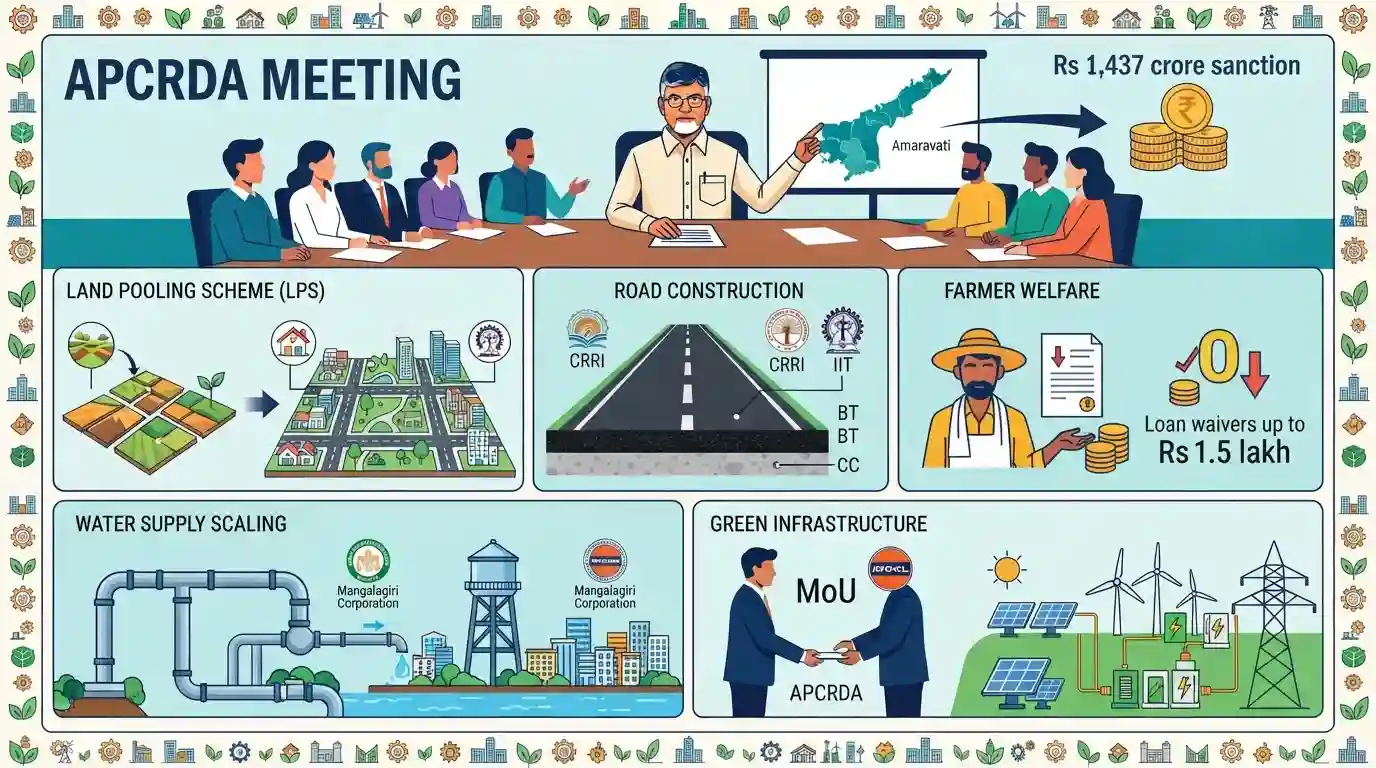
At its 65th authority meeting chaired by Chief Minister N. Chandrababu Naidu, the APCRDA sanctioned Rs 1,437 crore for establishing basic urban infrastructure across 29 villages in Amaravati. The authority approved crucial policy decisions including constructing Blacktop (BT) roads over Cement Concrete (CC) roads based on CRRI and IIT Kharagpur recommendations, farmer loan waivers up to Rs 1.5 lakh, scaling up bulk drinking water supply to Mangalagiri Corporation, and signing a green energy infrastructure MoU with IOCL.
Key Points
- The APCRDA sanctioned Rs 1,437 crore (comprising Rs 904 crore previously allocated and an additional Rs 533 crore) to build 100% basic infrastructure across 29 villages in the Amaravati capital region.
- Based on technical studies by CRRI, New Delhi, and IIT Kharagpur on soil dynamics, the APCRDA decided to construct Blacktop (BT) roads instead of Cement Concrete (CC) roads in Land Pooling Scheme (LPS) layouts.
- The authority approved a loan waiver of up to Rs 1.5 lakh per family for farmers participating in the ongoing land pooling scheme, applicable to loans taken before January 1, 2026.
- Bulk water supply from Amaravati reservoirs to Mangalagiri Corporation was scaled from 30 MLD to 80 MLD at a rate of Rs 10 per kilolitre.
- The CRDA approved the drafting of a Master Plan for a District Cooling System in Amaravati and cleared an MoU with IOCL to co-develop green energy infrastructure.
- Additional sanctions include Rs 596 crore for a Central Public Library, Auditorium, and HR infrastructure complex at Sakhamuru, alongside 8.5 acres of land allotted for a NIELIT Deemed University.
Important Terms
Andhra Pradesh Capital Region Development Authority (APCRDA)

An urban planning agency established in 2014 by the Government of Andhra Pradesh to plan, coordinate, and develop the capital region, specifically the greenfield capital city of Amaravati.
UPSC context
APPSC Paper-III (AP Economy) and Paper-I (Essay) — crucial for understanding capital city planning, governance, and regional infrastructure development.
Mangalagiri Tadepalli Municipal Corporation
A major civic body in Guntur district, Andhra Pradesh, formed in 2021 by merging Mangalagiri and Tadepalli municipalities to govern a key urban portion of the capital region.
UPSC context
APPSC Paper-II (Polity & Governance) — tests knowledge of local self-government, municipal mergers, and decentralised urban governance in Andhra Pradesh.
Central Road Research Institute (CRRI)
A premier national laboratory under the Council of Scientific and Industrial Research (CSIR) that conducts research and development on road engineering, pavement design, traffic, and transportation.
UPSC context
APPSC Paper-IV (Science & Technology) — tests knowledge of premier national scientific bodies, infrastructure technology, and sustainable connectivity solutions.
National Institute of Electronics & Information Technology (NIELIT)
An autonomous scientific society under the Ministry of Electronics and Information Technology (MeitY), Government of India, promoting digital literacy, IT training, and tech education.
UPSC context
APPSC Paper-IV (Science & Technology) — covers national institutes, human resource development in IT, and digital skill-building initiatives.
Indian Oil Corporation Limited (IOCL)
A premier Indian public sector enterprise operating under the Ministry of Petroleum and Natural Gas, active in refining, petrochemicals, pipelines, and green energy development.
UPSC context
APPSC Paper-IV (S&T) and Paper-III — relevant to public sector investments, energy transitions, and green infrastructure partnerships.
IIT Kharagpur
A premier public technical university founded in 1951, recognized as an Institute of National Importance that provides advanced engineering education, scientific research, and academic studies.
UPSC context
APPSC Paper-IV (Science & Technology) — covers premier educational and research institutions playing a key role in national infrastructure and policy.
Prelims Trap
APCRDA decided to construct rigid Cement Concrete (CC) roads to counter the unstable soil dynamics of the capital region.
Based on CRRI and IIT Kharagpur studies of Amaravati's expansive clayey soil, APCRDA opted for flexible Blacktop (BT) roads over rigid Cement Concrete (CC) roads to better absorb soil settlement.
Static Concepts Connected
What is the Land Pooling Scheme (LPS) under APCRDA?
- Mechanism: A voluntary land assembly mechanism where landowners surrender land to APCRDA for infrastructure, receiving developed, reconstituted plots back.
- LARR alternative: Bypasses the expensive, litigation-prone processes of the Right to Fair Compensation and Transparency in Land Acquisition (RFCTLARR) Act, 2013.
- Benefit-sharing: Landowners receive annual crop compensation payments and commercial/residential developed plots, making them partners in urban development.
Why does expansive Black Cotton soil challenge highway engineering?
- Soil dynamics: Contains montmorillonite clay, which swells when wet and shrinks dramatically when dry, leading to severe differential settlement.
- Pavement selection: Flexible pavements (Bitumen/Blacktop) can deflect under load and accommodate minor soil shifts, unlike rigid pavements (CC) which crack easily without heavy subgrade stabilizing.
Cross-Topic Patterns
Sustainable urban planning and climate resilience
Amaravati's District Cooling System (DCS) links urban design with climate action, targeting mitigation of the Urban Heat Island (UHI) effect and optimizing energy efficiency in tropical climates.
Land monetization and infrastructure financing
APCRDA's 250% pricing model for additional adjacent plots highlights Value Capture Financing (VCF) as a fiscal tool to fund greenfield infrastructure without state-debt escalation.

APCRDA's infrastructure choices (BT vs CC roads) and LPS fiscal policies are highly likely as multi-statement questions in Group I/II.
Linked PYQs · 2
Linked PYQs · 2
- 2024APPSC_PRELIMSGS1
Which of the following statements are valid in connection with Andhra Pradesh Green Hydrogen and Green Ammonia Policy (2023)? I. The objective is to target Green Energy production up to the capacity of 1 MPTA (Million Tonnes Per Annum) or Green Ammonia production up to the capacity of 2-0 MTPA in the next five years. II. New and Renewable Energy Development Corporation of A.P. Ltd (NREDCAP) shall act as a Nodal Agency under this policy. III. All the Ports in the State have infrastructure for storing liquid nitrogen which can then be utilized for storing Green Hydrogen for exporting to other countries. IV. The Policy prohibits the production of Green Hydrogen/Green Ammonia by using Renewable Energy and/or Biomass from 'Third-Party/Power exchange'. Select the correct answer using the codes given below :
- 2023APPSC_PRELIMSGS1
Part V of the Andhra Pradesh Reorganisation Act deals with
