CPI Demands Caste Census for Backward Classes in Andhra Pradesh
Source:The Hindu ↗
Why It Matters
The push for a caste census is a critical ongoing debate relevant to GS-2 (Social Justice and Governance). It deals directly with the issue of intra-group inequalities within backward classes and the need for empirical socio-economic data to rationalize affirmative action and formulate targeted welfare policies.
Summary
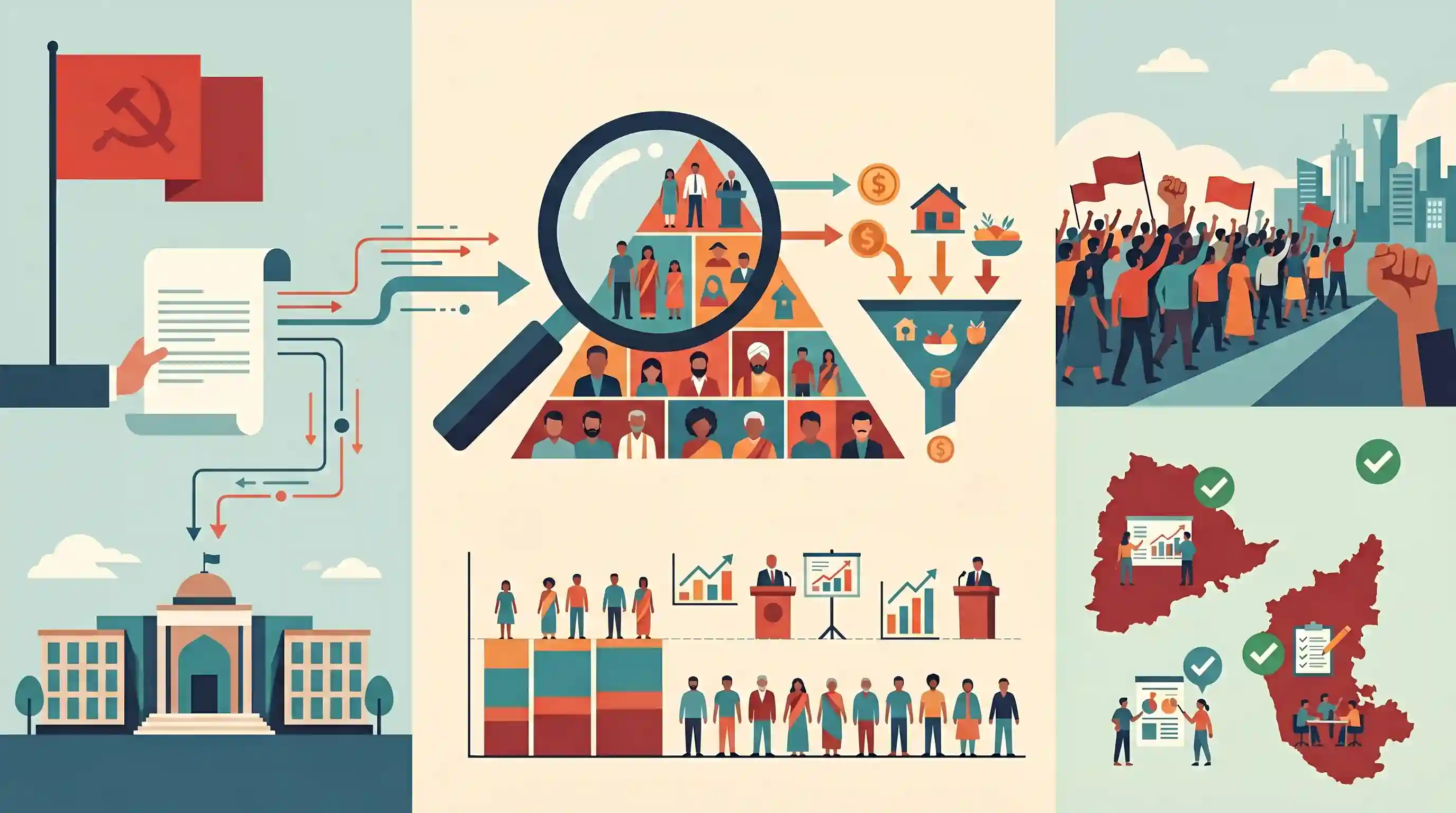
The Communist Party of India (CPI) has urged the Andhra Pradesh government to conduct a caste census, stating that such data is vital for formulating targeted development strategies for backward classes (BCs). Highlighting significant intra-group disparities, CPI State secretary K. Ramakrishna noted that only a handful of the 143 BC communities have achieved adequate political and economic empowerment. He warned of a 'Chalo Amaravati' agitation if the demand is ignored, pointing out that neighboring States like Telangana and Karnataka have already moved forward with caste census initiatives.
Key Points
- CPI State secretary K. Ramakrishna has demanded a caste census in Andhra Pradesh to formulate effective development strategies for backward classes (BCs).
- He highlighted that out of 143 BC communities in the State, only a few have seen significant political and economic advancement, underscoring severe intra-group inequality.
- The CPI threatened to organize a 'Chalo Amaravati' agitation if the government does not act on the demand.
- The demand is supported by citing similar initiatives backed by the Congress in Telangana and Karnataka.
Important Terms
Caste Census

A systematic recording of individuals' caste identities during a national population census to map socio-economic distribution and inform reservation policies.
UPSC context
GS Paper I (Society) and GS Paper II (Social Justice/Governance). Tests understanding of data-driven policy and inclusivity.
Backward Classes (BCs)
Socially and educationally disadvantaged groups recognized under the Indian Constitution (Articles 15, 16, and 340) for affirmative action and targeted welfare.
UPSC context
GS Paper II: Welfare schemes for vulnerable sections. Tests knowledge of constitutional safeguards and institutional mechanisms like the NCBC.
Article 340
A constitutional provision empowering the President to appoint a commission to investigate the conditions of socially and educationally backward classes.
UPSC context
GS Paper II (Constitution). Key for understanding the legal basis for identifying OBCs and implementing the Mandal Commission report.
Communist Party of India (CPI)
A national political party in India that advocates for scientific caste enumeration to address intra-group disparities and ensure social justice.
UPSC context
GS Paper II: Political parties and pressure groups. Tests understanding of ideological stances on social equity.
Telugu Desam Party (TDP)
A major regional political party in Andhra Pradesh that supports a caste census as a tool for poverty alleviation and wealth creation.
UPSC context
GS Paper II: Federalism and regional parties. Relevant for state-specific governance and welfare models.
Indian National Congress (Congress)
India's primary opposition party nationally, currently championing a nationwide caste census to remove the 50% cap on reservations.
UPSC context
GS Paper II: Comparison of political platforms and their impact on constitutional amendments regarding reservations.
Prelims Trap
"The 105th Constitutional Amendment empowers State governments to conduct their own decennial Caste Census to identify SEBCs."
The 105th CAA restored States' power to maintain their own lists of SEBCs. However, conducting a statutory Census remains a Union subject (Entry 69). States legally conduct socio-economic "surveys", not censuses.
Static Concepts Connected
What are the key Constitutional provisions safeguarding Backward Classes?
- Article 340: Empowers the President to appoint a commission (like the Rohini Commission) to investigate the conditions of socially and educationally backward classes.
- Article 338B: Inserted via the 102nd Constitutional Amendment Act, granting constitutional status to the National Commission for Backward Classes (NCBC).
- Article 342A: Relates to identifying SEBCs. The 105th CAA amended it to explicitly restore the power of State governments to notify their own independent SEBC lists.
How does the Socio-Economic Caste Census (SECC) differ from the regular Census?
- Statutory Backing: The regular Census is conducted under the Census Act of 1948, while the SECC is independent of this Act and administrative in nature.
- Confidentiality: Census data is strictly confidential and cannot be used to identify individuals. SECC data is open for government departments to target welfare benefits.
- Data Release: While SECC was conducted in 2011, the raw caste data was never officially published due to massive classification errors and political sensitivities.
Cross-Topic Patterns
Sub-categorization and intra-group equity
The highlight of severe intra-group disparity among BCs mirrors the Justice G. Rohini Commission's mandate for OBC sub-categorization, aligning with the recent Supreme Court verdict allowing sub-classification within SC/ST quotas.
Federal friction over data collection
States initiating caste enumerations (like Bihar and Karnataka) highlight federal friction, as they conduct "surveys" to bypass the Union's exclusive constitutional domain over the statutory "Census" (Entry 69, Union List).

Expect a multi-statement question on the 105th Amendment, Article 338B, and the legal distinction between a State survey and Union Census.
Linked PYQs · 2
Linked PYQs · 2
- 2022MainsGS2
Discuss the role of the National Commission for Backward Classes in the wake of its transformation from a statutory body to a constitutional body.
- 2019MainsGS2
Performance of welfare schemes that are implemented for vulnerable sections is not so effective due to absence of their awareness and active involvement at all stages of policy process. Discuss.
