Andhra Pradesh Seeks Centre Support for Tobacco Farmers
Source:newsonair ↗
Why It Matters
Tobacco is a major commercial crop in Andhra Pradesh, contributing significantly to the state's agricultural economy and export revenue. Government policies concerning crop cultivation, farmer welfare schemes, and market interventions (like price deficiency compensation) are critical topics in the APPSC Group 1 Prelims, particularly within the Economy and Geography sections.
Summary
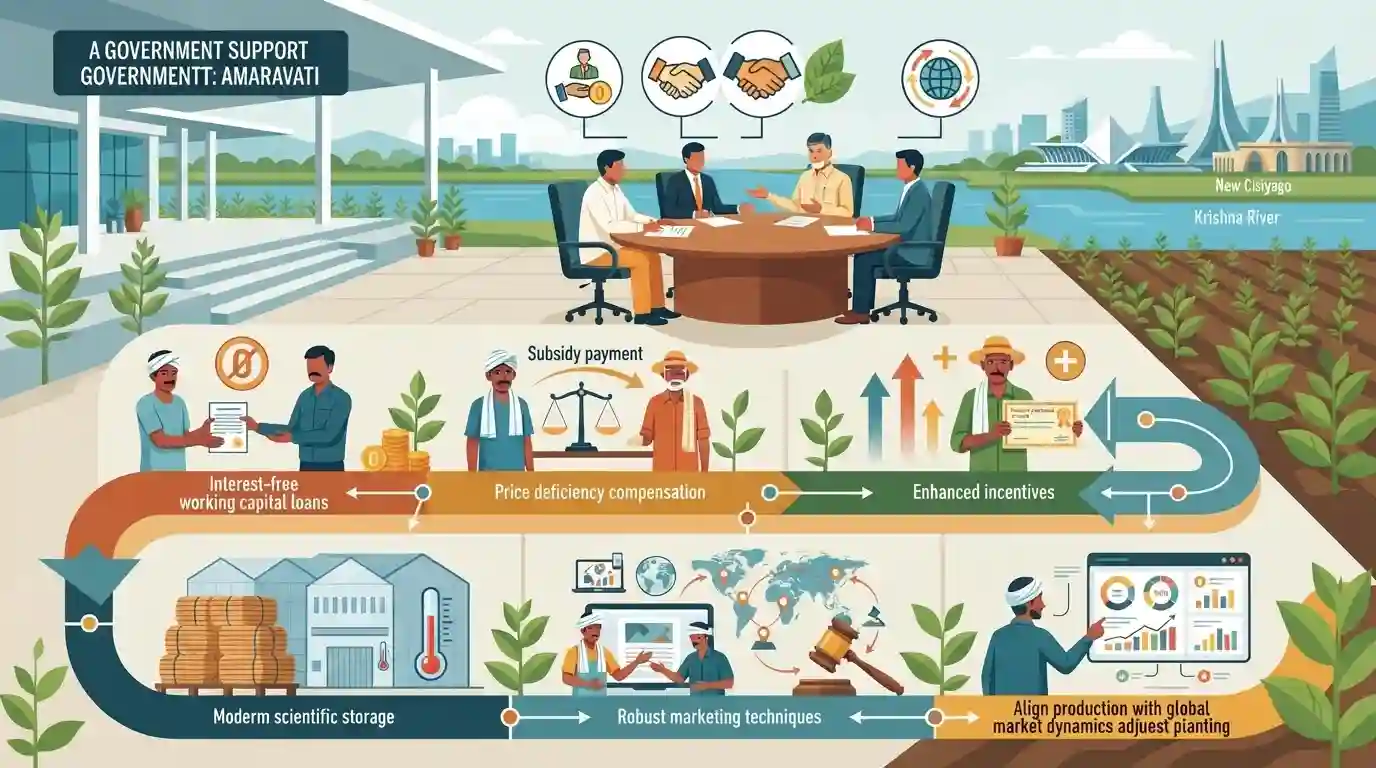
Andhra Pradesh Chief Minister N. Chandrababu Naidu and representatives from the Union Ministry of Commerce held discussions in Amaravati to formulate support measures for tobacco farmers. The proposed interventions include interest-free working capital loans, price deficiency compensation, and enhanced incentives. The state government is focusing on a sustainable, multi-tiered strategy that includes better scientific storage, robust marketing techniques, and alignment of production with global market dynamics to protect farmers from price fluctuations.
Key Points
- Andhra Pradesh Chief Minister N. Chandrababu Naidu held discussions with the Union Ministry of Commerce to resolve challenges faced by tobacco farmers in the state.
- Proposed relief measures include interest-free working capital loans, specific incentives, and a price deficiency compensation mechanism to shield farmers from market volatility.
- The Chief Minister emphasized the need for a comprehensive short, medium, and long-term strategy for sustainable tobacco cultivation.
- Focus was placed on establishing scientific storage facilities, improving marketing strategies, and aligning crop production with international market demand.
Important Terms
Price Deficiency Compensation

A financial support mechanism where the government pays farmers the difference between the Minimum Support Price (MSP) and the lower actual market price, ensuring income security without requiring physical crop procurement.
UPSC context
Relevant for GS-3 Agriculture. Tests knowledge of PM-AASHA, alternative MSP mechanisms, agricultural subsidies, and farmer welfare policies.
Union Ministry of Commerce
The central government ministry responsible for India's foreign trade, export promotion, and commercial regulations. It oversees various commodity boards, including the Tobacco Board, to manage and promote commercial crop exports.
UPSC context
Relevant for GS-2 (Governance) and GS-3 (Economy). Tests knowledge of administrative structures governing international trade and export-oriented agricultural commodities.
Tobacco Board
A statutory body created under the Tobacco Board Act, 1975, headquartered in Guntur, Andhra Pradesh. It regulates the production, marketing, and export of tobacco, particularly the Flue-Cured Virginia varieties.
UPSC context
Important for GS-2 (Statutory Bodies) and GS-3 (Major Crops). Tests awareness of commercial crop regulation, price stabilization, and commodity boards.
Prelims Trap
The Tobacco Board of India is a statutory body functioning under the Ministry of Agriculture and Farmers Welfare.
Because it is an agricultural crop, aspirants assume it falls under Agriculture. However, due to its commercial and export value, it falls under Commerce and Industry.
Static Concepts Connected
What are the ideal geographical conditions for cultivating tobacco?
- Temperature: Requires a mean daily temperature between 20°C and 30°C alongside a frost-free period of 90 to 120 days.
- Rainfall & Moisture: Necessitates a distinct dry period during the ripening and harvesting phases to ensure quality leaf curing.
- Soil Requirements: Thrives in well-drained, light to medium loamy soils, as the plant is highly sensitive to waterlogging.
How does the Price Deficiency Payment Scheme (PDPS) function?
- Core Objective: Compensates registered farmers for the difference between the Minimum Support Price (MSP) and the actual market price.
- No Physical Procurement: Unlike traditional MSP operations, it does not involve any physical procurement of the crop by government agencies.
- Direct Transfer: The deficiency amount is credited directly to the farmers' bank accounts via Direct Benefit Transfer (DBT).
Cross-Topic Patterns
Exports vs WHO FCTC obligations
India balances tobacco export promotion via the Commerce Ministry with commitments to crop diversification and demand reduction under the WHO Framework Convention on Tobacco Control (FCTC).
Cash crops and price deficiency
Using price deficiency compensation for commercial crops reflects a policy shift from physical procurement models to fiscal, market-linked support mechanisms like PDPS under PM-AASHA.

Expect a multi-statement question combining tobacco's geographical prerequisites, India's global export rank, and the Tobacco Board's role.
Linked PYQs · 3
Linked PYQs · 3
- 2023APPSC_PRELIMSGS1
The CCRC introduced by Government of Andhra Pradesh stands for
- 2023APPSC_PRELIMSGS1
Government of Andhra Pradesh is implementing YSR Rythu Bharosa - PM Kisan Scheme for the benefit of farmers of Andhra Pradesh. Which of the following statements are correct about the above scheme ?
- 2024APPSC_PRELIMSGS1
Consider the following erstwhile districts of Andhra Pradesh : I. West Godavari II. East Godavari III. Visakhapatnam IV. Srikakulam In which of the above districts are coffee plantations mainly existing in their agency areas ?
