Amaravati Quantum and AI University Campus AP Cabinet Approval
Source:itvoice ↗
Why It Matters
This initiative represents a major milestone in deep-tech education and regional technology infrastructure in India. It directly supports federal science missions like the National Quantum Mission and the India Semiconductor Mission, while establishing a major scientific hub in Andhra Pradesh's capital region. Understanding the funding, administrative agency (NIELIT/MeitY), and constitutional backing (Union List Entry 64) is highly relevant for APPSC Group 1 Prelims.
Summary
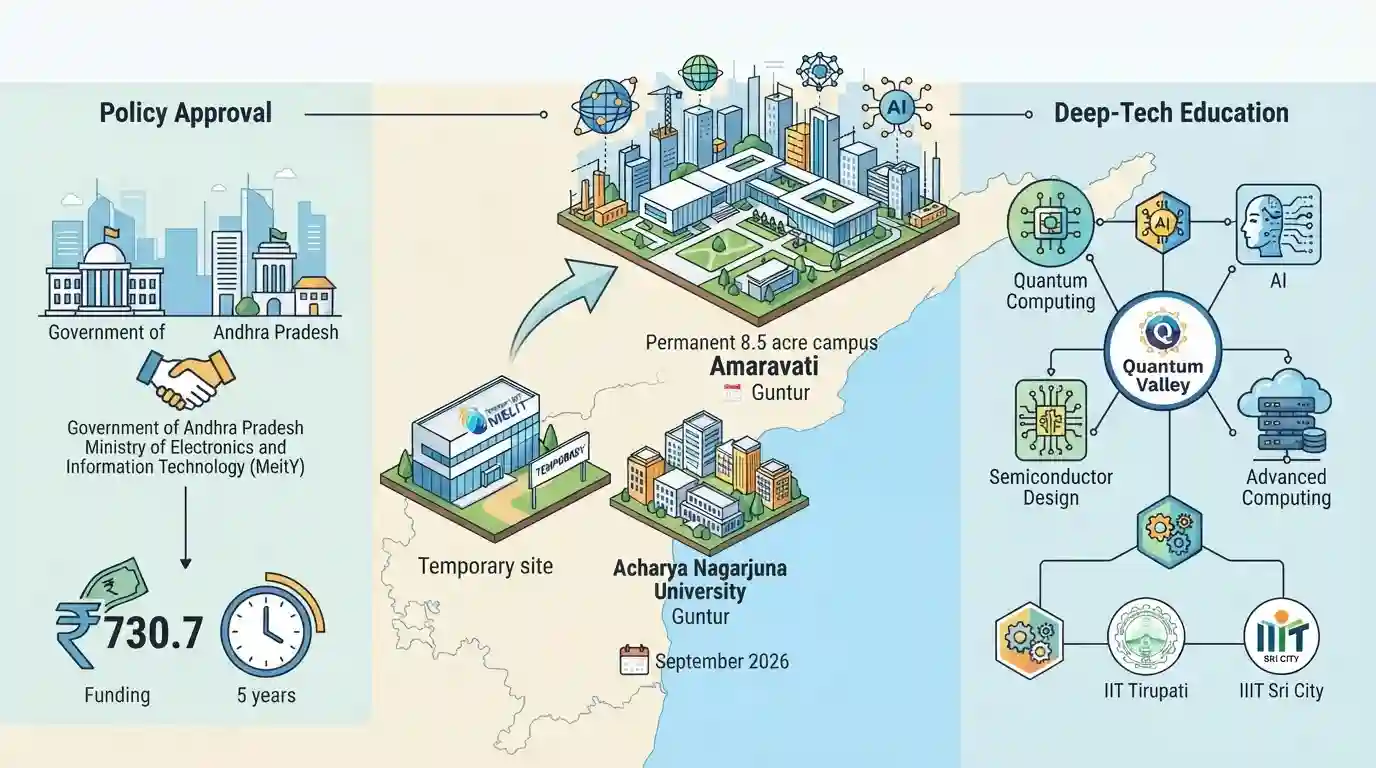
The Government of Andhra Pradesh has approved the setting up of India's first dedicated Quantum and AI University campus in Amaravati. Fully funded by the Ministry of Electronics and Information Technology (MeitY) with a grant of Rs 730.7 crore over five years, the project will be established by NIELIT. It will temporarily operate from Acharya Nagarjuna University in Guntur starting September 2026 before moving to its permanent 8.5-acre facility. Focused on creating an 'Amaravati Quantum Valley,' the institution will offer deep-tech education in quantum computing, AI, semiconductor design, and advanced computing, collaborating with premier regional institutes like IIT Tirupati and IIIT Sri City.
Key Points
- Andhra Pradesh Chief Minister N. Chandrababu Naidu has approved the establishment of India's first dedicated Quantum and Artificial Intelligence University campus in the capital region of Amaravati.
- The campus is developed by the National Institute of Electronics and Information Technology (NIELIT), an autonomous scientific society under the Union Ministry of Electronics and Information Technology (MeitY).
- The initiative is backed by a 100% Grant-in-Aid of Rs 730.7 crore over five years from MeitY, making it a fully centrally funded project.
- A permanent 8.5-acre campus will be built in Amaravati, with academic sessions commencing in September 2026 from a temporary facility at Acharya Nagarjuna University in Guntur.
- The core academic and research curriculum focuses on four key deep-tech areas: Quantum Technology, Artificial Intelligence, Semiconductors & Electronics, and Advanced Computing.
- Features include a specialized Quantum Research, Innovation and Incubation Block (QRIIB) with a target of reaching 8,250 learners (including PhDs, graduates, and diploma candidates) over five years.
- Partnerships will be forged with regional premier institutions, including IIT Tirupati, IIIT Sri City, Andhra University, and JNTU, to establish the 'Amaravati Quantum Valley'.
Important Terms
National Quantum Mission (NQM)

A flagship central initiative with a ₹6,003.65 crore outlay to scale up R&D and build national capabilities in quantum computing, communication, and materials from 2023 to 2031.
UPSC context
Science & Technology (Paper V); tests national deep-tech missions and AP’s integration through the Amaravati Quantum Valley project.
IndiaAI Mission
A comprehensive national program under MeitY (outlay ₹10,371.92 crore) designed to build a competitive domestic AI ecosystem by expanding compute infrastructure, funding startups, and developing foundational models.
UPSC context
Science & Technology (Paper V); evaluates strategic policy frameworks for AI development and human resource skilling initiatives.
India Semiconductor Mission (ISM)
A specialized nodal agency under MeitY tasked with implementing incentive schemes to build a sustainable, self-reliant semiconductor and display manufacturing ecosystem in India.
UPSC context
Economy & S&T (Paper V); tests electronic manufacturing initiatives and AP's growth in VLSI and semiconductor design.
National Institute of Electronics and Information Technology (NIELIT)
An autonomous scientific society and Deemed-to-be University under MeitY that offers specialized education, training, and certification in electronics and information technology.
UPSC context
S&T and Administration; examines central agencies driving technical education, skilling, and deep-tech university campuses in AP.
Acharya Nagarjuna University (ANU)
A major state public university in Guntur, Andhra Pradesh, established in 1976, which will host the interim campus of India's first Quantum & AI University.
UPSC context
AP Economy & Infrastructure; tests state-level educational facilities hosting premier national and central deep-tech initiatives.
IIT Tirupati
A premier autonomous central technical university in AP established in 2015 as an Institute of National Importance under the Ministry of Education.
UPSC context
AP Education & Infrastructure; tests premier national institutions collaborating to advance AP’s research and technical ecosystem.
IIIT Sri City
An autonomous Indian Institute of Information Technology in Sri City, Andhra Pradesh, operating in a public-private partnership focused on CSE, ECE, and emerging deep-tech research.
UPSC context
AP Economy & S&T; examines specialized tech institutes aiding state digital growth and industrial-academic collaborative ecosystems.
Prelims Trap
The Amaravati Quantum and AI University is funded under a 60:40 split between the Union Government and Andhra Pradesh.
Aspirants often assume new state capital institutions are funded via shared CSS ratios. This is actually a 100% centrally funded project under MeitY's Grant-in-Aid.
Static Concepts Connected
What are the key pillars of India's National Quantum Mission (NQM)?
- NQM Framework: Approved in 2023 under the Department of Science and Technology (DST) with a budget of over ₹6,000 crore to run till 2031.
- Four Core Hubs: Establishes Thematic Hubs (T-Hubs) in Quantum Computing, Quantum Communication, Quantum Sensing & Metrology, and Quantum Materials.
- Qubit Milestones: Aims to develop intermediate-scale quantum computers with 50-1,000 physical qubits in various platforms within eight years.
Which constitutional provisions govern scientific and higher education institutions in India?
- Union List Jurisdiction: Entry 66 of List I (Union List) governs coordination and standards in institutions for higher education or research and scientific institutions.
- Deemed University Status: Declared by the Central Government under Section 3 of the UGC Act, 1956, giving institutions academic and administrative autonomy.
Cross-Topic Patterns
Amaravati's service-led GSDP growth
Leveraging deep-tech clusters like the Quantum Valley to revive Amaravati's economic momentum, shifting AP's growth engine toward high-value service exports and specialized tech jobs.
ISM talent pipelines
Aligning NIELIT's academic curriculum directly with India Semiconductor Mission (ISM) goals to supply specialized VLSI, fabrication, and ATMP design talent.

MeitY's 100% funding of the Amaravati campus is likely to be contrasted with standard state-shared CSS patterns in APPSC Group I.
Linked PYQs · 3
Linked PYQs · 3
- 2023APPSC_PRELIMSGS1
Which of the following entries of the Indian Constitution deals with the institutions for scientific or technical education financed by the Government of India, wholly or in part, and declared by Parliament, by law to be institutions of national importance ?
- 2024APPSC_PRELIMSGS1
Which of the following statement/statements is/are incorrect regarding the Andhra Pradesh Industrial Policy 2023 - 27? I. To achieve a minimum contribution of 25% by industry in the State GDP II. To provide end-to-end facilitation in 2 weeks III. To envisage ten (10) priorities of accomplishment IV. To focus on becoming a 'Plug and Play State' for investments V. Ensuring land allotment by APIIC within a period of 2 weeks upon receipt of application Select the answer using the codes given below :
- 2024APPSC_PRELIMSGS1
With regard to the progress of Digital Payments in India, which of the following statement/statements is/are valid? I. Promotion of Digital Payments has been transferred from the Ministry of Electronics and Information Technology (MeitY) to the Department of Financial Services. II. e-RUPI is an institution-based voucher management system instead of being person and purpose specific. III. 'Hello! UPI' is an AI voice-enabled payment feature built by a consortium of private sponsored startups recognised by the NPCI. IV. 'UPI LITE X' addresses challenges of remote areas by enabling offline UPI payments. Select the correct answer using the codes given below:
