Andhra Pradesh PPP Policy and Ease of Doing Business Legislation
Source:gktoday ↗
ఇది ఎందుకు ముఖ్యం
This represents a comprehensive overview of the current socio-economic and legislative trajectory of Andhra Pradesh, highly relevant for APPSC questions on State Government schemes, industrial policies (Ease of Doing Business), capital city development (Amaravati), and modifications to significant State bills (Disha Bill).
సారాంశం
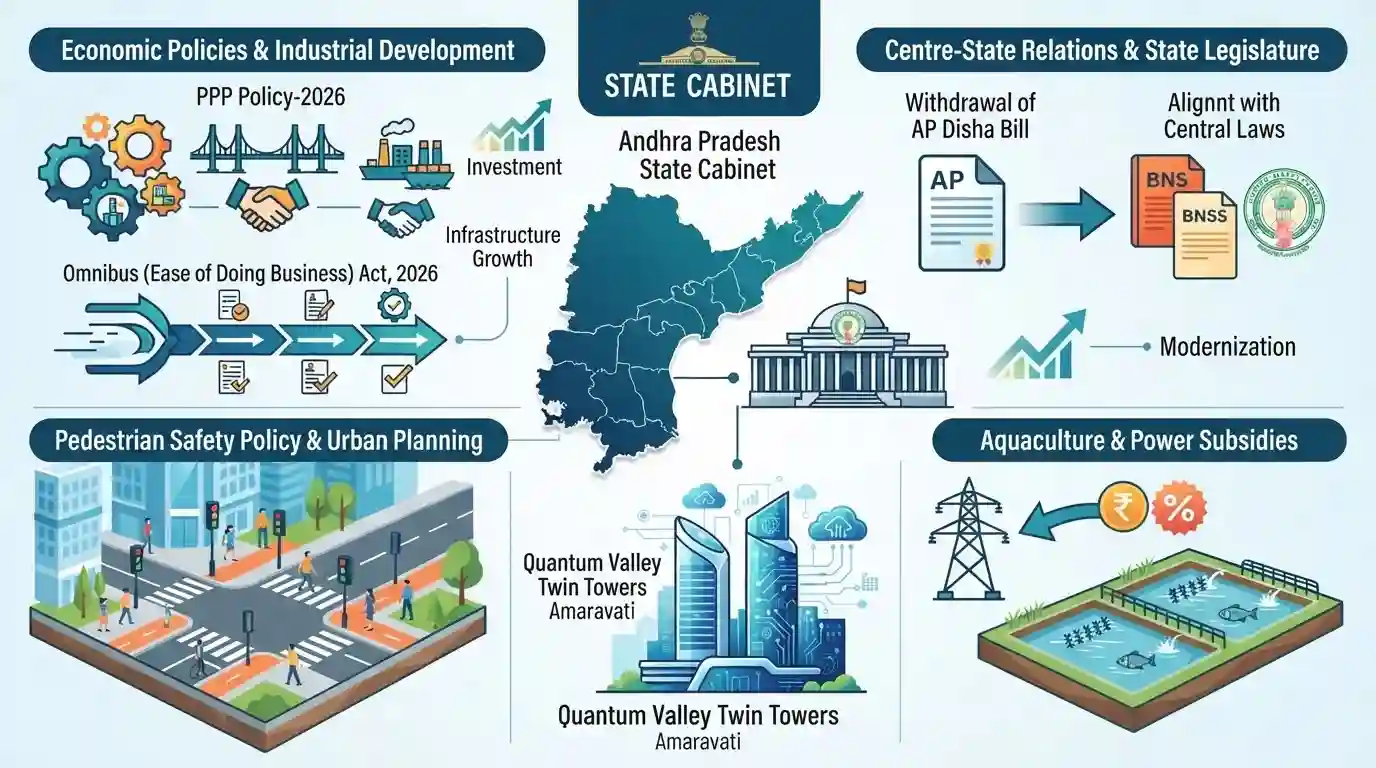
The Andhra Pradesh State Cabinet recently approved a slew of significant policies, most notably the 'PPP Policy-2026' and the 'Omnibus (Ease of Doing Business) Act, 2026', aimed at accelerating infrastructure development and industrial investment through structured public-private partnerships. In a major governance shift, the state formally withdrew the AP Disha Bill, 2020 to bring the state's criminal justice system in line with the recently implemented Central laws—BNS and BNSS. Additionally, the Cabinet greenlit a Pedestrian Safety Policy, approved the creation of the 'Quantum Valley Twin Towers' in the capital city of Amaravati to boost the IT sector, and extended significant power tariff subsidies for the aquaculture industry.
ముఖ్య అంశాలు
- The AP Cabinet approved the PPP Policy-2026 to stimulate private investment in infrastructure, featuring Viability Gap Funding (VGF) provisions and establishing high-level project monitoring committees.
- The Omnibus (Ease of Doing Business) Act, 2026 was cleared to drastically streamline regulations, simplify compliance processes, and improve the state's industrial climate.
- The controversial Andhra Pradesh Disha Bill, 2020 was officially withdrawn because its provisions contradicted the newly implemented Central criminal codes—the Bharatiya Nyaya Sanhita (BNS) and Bharatiya Nagarik Suraksha Sanhita (BNSS).
- A new Pedestrian Safety Policy was sanctioned to develop safer road infrastructure, including dedicated walkways and automated pedestrian crossing signals.
- Sector-specific decisions include the establishment of the 'Quantum Valley Twin Towers' in Amaravati for IT/AI industries and massive power tariff subsidies (₹1.50 per unit) for aqua farmers, costing the exchequer ₹4,233 crore annually.
ముఖ్యమైన పదాలు
Bharatiya Nyaya Sanhita (BNS)

India's primary criminal code enacted in 2023, replacing the Indian Penal Code (IPC) of 1860, to modernise the justice system and address contemporary crimes.
UPSC context
GS Paper II (Polity & Governance). Key for understanding criminal law reforms, judicial administration, and rights of citizens.
Bharatiya Nagarik Suraksha Sanhita (BNSS)
India's criminal procedure code enacted in 2023, replacing the Code of Criminal Procedure (CrPC) of 1973, governing investigation, trial, and arrest processes.
UPSC context
GS Paper II (Polity & Governance). Crucial for questions on criminal justice reforms, police procedural changes, and institutional checks.
Andhra Pradesh Disha Bill, 2019
A state-proposed criminal law amendment seeking capital punishment and fast-tracked 21-day trials for sexual crimes against women and children, withdrawn in 2026.
UPSC context
GS Paper II (Polity/Federalism). Highlights Union-State legislative dynamics, presidential assent under Article 201, and criminal law alignment.
Public-Private Partnership (PPP)
A collaborative funding and operational model between public authorities and private entities to design, build, and operate public infrastructure and services.
UPSC context
GS Paper III (Infrastructure & Investment Models). Extremely important for questions on infrastructure development, resource mobilisation, and policy models.
Omnibus Legislation
A single proposed law that consolidates multiple distinct, often unrelated measures or amends several different acts to streamline administrative and regulatory procedures.
UPSC context
GS Paper II (Polity & Governance). Evaluates federal and state legislative efficiency, administrative reforms, and ease of doing business frameworks.
Viability Gap Funding (VGF)
A government grant provided to support infrastructure projects that are economically essential but lack financial viability for private sector execution.
UPSC context
GS Paper III (Indian Economy & Infrastructure). Tests concepts of fiscal tools for infrastructure, private sector engagement, and PPP success.
ప్రిలిమ్స్ ఉచ్చు
A state law on a Concurrent subject conflicting with a Central law is automatically and irreversibly void under Article 254.
Article 254(2) provides an exception: if the State law receives Presidential assent, it can prevail in that state despite conflicting with a Central law.
అనుసంధానమైన స్థిర భావనలు
What is the Doctrine of Repugnancy under Article 254?
- Constitutional Basis: Governs legislative conflicts between the Parliament and State Legislatures on subjects listed under the Concurrent List (List III).
- General Rule: Article 254(1) mandates that Central law prevails over State law to the extent of repugnancy, rendering the latter void.
- Presidential Exception: Under Article 254(2), a repugnant State law remains valid in that State if it receives the President's assent.
What is Viability Gap Funding (VGF)?
- Definition: A capital grant designed to support infrastructure projects that are economically essential but financially unviable for private developers.
- Funding Limit: The Central government typically provides up to 20% of the project cost, often matched by another 20% from the state/sponsoring agency.
- Sectors Covered: Primarily targets Public-Private Partnerships (PPPs) in physical infrastructure (roads, energy) and social sectors (health, education).
అంతర-అంశ నమూనాలు
Criminal Law Reform + Federal Friction
The transition from IPC/CrPC to BNS/BNSS requires states to reconcile local criminal amendments to prevent operational friction and legal repugnancy under Concurrent List III.
Aquaculture Subsidies vs. WTO Discipline
Heavy state-level power subsidies for aquaculture risk international trade scrutiny under WTO rules targeting agricultural and fisheries support mechanisms.

Transition from IPC to BNS/BNSS will likely trigger multi-statement questions testing Article 254 repugnancy and state law exemptions in 2026.
అనుసంధాన PYQలు · 5
అనుసంధాన PYQలు · 5
- 2024APPSC_PRELIMSGS1
Which of the following statement/statements is/are incorrect regarding the Andhra Pradesh Industrial Policy 2023 - 27? I. To achieve a minimum contribution of 25% by industry in the State GDP II. To provide end-to-end facilitation in 2 weeks III. To envisage ten (10) priorities of accomplishment IV. To focus on becoming a 'Plug and Play State' for investments V. Ensuring land allotment by APIIC within a period of 2 weeks upon receipt of application Select the answer using the codes given below :
- 2023APPSC_PRELIMSGS1
The following App developed by Government of Andhra Pradesh is an SOS service for women in distress or danger.
- 2024APPSC_PRELIMSGS1
The strategic objective of Asset Monetization Programme may be explained as :
- 2024APPSC_PRELIMSGS1
The Interim Union Budget (FY25) has proposed initiatives to boost India's Green Energy Sector. Which of the following proposals are connected with developing India's Green Energy ? I. Viability Gap Funding (VGF) for utilizing solar energy projects II. To set up coal gasification and liquefaction capacity of 100MT by 2030 III. Optional blending of Compressed Bio Gas (CBG) in Compressed Natural Gas (CNG) for transport and Piped Natural Gas (PNG) for domestic purposes IV. Provision of financial assistance for procurement of biomass aggregation machinery V. Setting up of a payment security system for expanding the bio-manufacturing system in the country Select the correct answer using the codes given below :
- 2024APPSC_PRELIMSGS1
In connection with transport and infrastructure in Andhra Pradesh, which of the following statement/statements is/are valid? I. Andhra Pradesh's first riverine project has been proposed between Muktayala and Madipadu on Krishna river. II. The Bhogapuram Greenfield International Airport had been started with a corpus fund that is sourced from National Investment and Infrastructure Fund (NIIF). III. Infrastructure investments in Andhra Pradesh are strictly implemented only with reference to strategic investments like ports and industrial corridors, but not with reference to community assets. IV. Rail Over Bridges (ROBs) are being developed in Andhra Pradesh under the Setu Bandhan Scheme. Select the correct answer using the codes given below :
