AP Cabinet Approves PPP Policy 2026 and Withdraws Disha Bill
Source:telanganatoday ↗
Why It Matters
Important for APPSC Group 1 aspirants tracking state-level economic policies, infrastructure frameworks, and key legislative changes like the withdrawal of the Disha Bill.
Summary
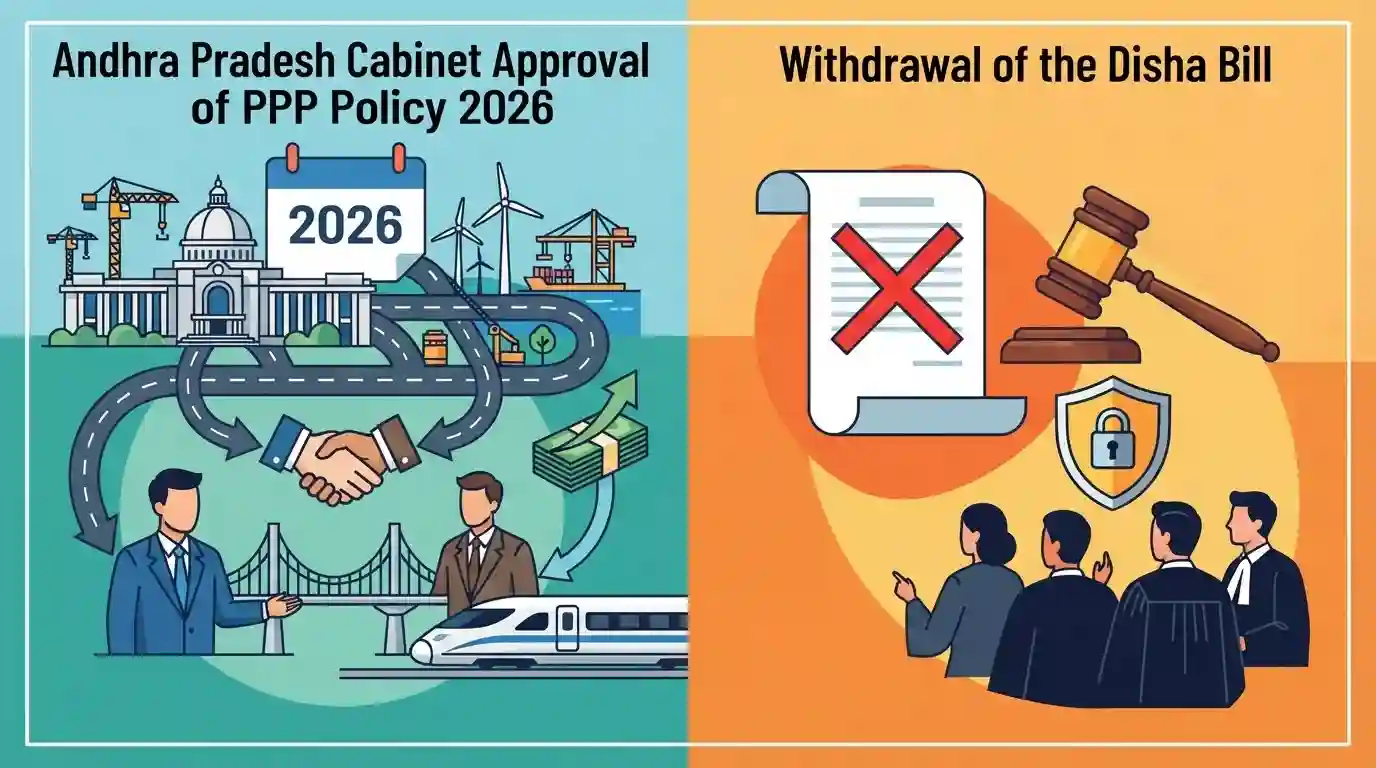
The Andhra Pradesh Cabinet has approved the PPP Policy 2026 to foster private sector participation in state infrastructure development while simultaneously withdrawing the Disha Bill previously introduced for legislative reforms in criminal law.
Key Points
- The Andhra Pradesh Cabinet approved the Public-Private Partnership (PPP) Policy 2026 to accelerate infrastructure development and attract private investments in the state.
- The Cabinet decided to formally withdraw the Disha Bill (Andhra Pradesh Criminal Law (Amendment) Bill), which was earlier introduced for speedy trial and harsher punishment for crimes against women.
- The policy shifts focus toward structured concession agreements and private participation models for public asset creation and management in Andhra Pradesh.
Important Terms
PPP Policy 2026

A policy framework introduced by the Andhra Pradesh government to attract private sector investments in infrastructure sectors like transport, ports, and healthcare through viability gap funding.
UPSC context
Relevant for APPSC Group 1 & 2 (Economy and Infrastructure Development); tests knowledge of state-level private investment models.
Disha Bill
A proposed legislative reform originally passed in 2019 to expedite trials for crimes against women, withdrawn by the AP Cabinet following advice from the Union Home Ministry in light of new central criminal laws.
UPSC context
Important for APPSC Polity and Governance; tests understanding of state legislation vis-à-vis central criminal laws like BNS.
Andhra Pradesh Cabinet
The executive decision-making body of the state government headed by the Chief Minister, responsible for policy formulation, administrative approvals, and legislative agendas in Andhra Pradesh.
UPSC context
Crucial for APPSC Polity and Administration; tests knowledge of state executive functioning and decision-making structures.
Prelims Trap
The Disha Bill was withdrawn solely due to administrative delays rather than the enactment of the new central criminal codes (BNS/BNSS) and central guidance.
Aspirants often assume state criminal law amendments like the Disha Bill automatically become law once passed by the state legislature, ignoring that they require Presidential assent when they touch concurrent list subjects covered by central codes.
Static Concepts Connected
What are the key models of Public-Private Partnership (PPP) used in Indian infrastructure development?
- BOT Model: BOT Model: Private partner builds, operates for a concession period, and transfers the facility back to the government.
- DBFOT Model: DBFOT Model: Design, build, finance, operate, and transfer arrangement where private entity secures financing alongside construction.
- HAM Model: Hybrid Annuity Model: Government pays a portion upfront and remaining as annuities during the operational period, sharing financial risk.
- VGF Scheme: Viability Gap Funding: Government financial support up to a specified percentage for infrastructure projects economically justified but financially unviable.
Cross-Topic Patterns
PPP Policy & Infrastructure Financing Models
State-level PPP policies frequently interact with Central VGF schemes and the NITI Aayog's guidelines on public asset monetization and infrastructure risk-sharing.
Disha Bill Withdrawal & Central Criminal Laws
State criminal law amendments require Presidential assent under Article 254 if they conflict with central legislation like the new BNS and BNSS.

APPSC Group 1 mains questions often test state-level infrastructure financing mechanisms alongside recent legislative withdrawals under Article 254.
Linked PYQs · 4
Linked PYQs · 4
- 2024APPSC_PRELIMSGS1
The Interim Union Budget (FY25) has proposed initiatives to boost India's Green Energy Sector. Which of the following proposals are connected with developing India's Green Energy ? I. Viability Gap Funding (VGF) for utilizing solar energy projects II. To set up coal gasification and liquefaction capacity of 100MT by 2030 III. Optional blending of Compressed Bio Gas (CBG) in Compressed Natural Gas (CNG) for transport and Piped Natural Gas (PNG) for domestic purposes IV. Provision of financial assistance for procurement of biomass aggregation machinery V. Setting up of a payment security system for expanding the bio-manufacturing system in the country Select the correct answer using the codes given below :
- 2024APPSC_PRELIMSGS1
The strategic objective of Asset Monetization Programme may be explained as :
- 2024APPSC_PRELIMSGS1
Which of the following statement/statements is/are incorrect regarding the Andhra Pradesh Industrial Policy 2023 - 27? I. To achieve a minimum contribution of 25% by industry in the State GDP II. To provide end-to-end facilitation in 2 weeks III. To envisage ten (10) priorities of accomplishment IV. To focus on becoming a 'Plug and Play State' for investments V. Ensuring land allotment by APIIC within a period of 2 weeks upon receipt of application Select the answer using the codes given below :
- 2024APPSC_PRELIMSGS1
Which of the following statement/statements is/are valid regarding the socio-economic status of Andhra Pradesh ? I. Andhra Pradesh won the Best State Award of ICAR - National Research Center for Banana (NRCB) for export promotion. II. Andhra Pradesh GSDP growth rate has been registering a decline in recent times owing to repeated lower returns in certain sub-sectors of the Service Sector. III. For the FY 2024 - 25, the Revenue Deficit is budgeted higher than the Fiscal Deficit in terms of percentage of Andhra Pradesh GSDP. IV. The technology used by the Government of Andhra Pradesh while conducting resurvey of landholdings is referred to as 'Continuously Operating Reference Stations (CORS)' technology. Select the correct answer using the codes given below :
